
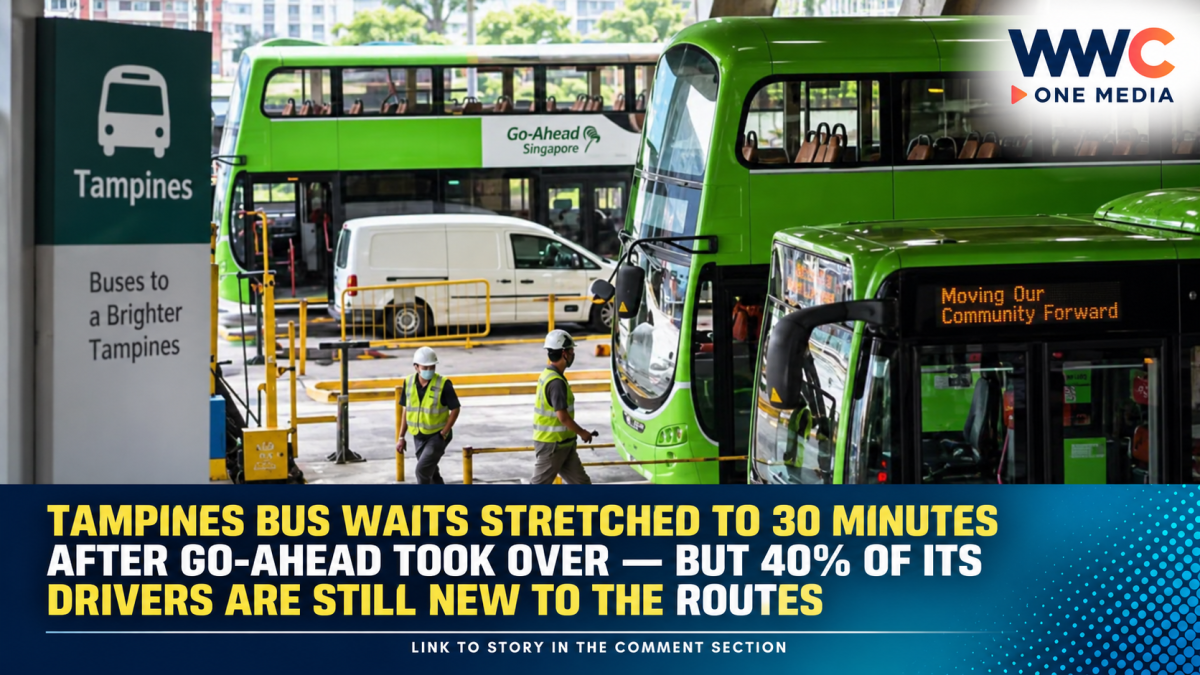
SINGAPORE — A S$646 million bus contract that was supposed to bring a new operator, a new depot and new technology to Tampines is facing its first major commuter test just two months after launch.
Residents have complained of longer and less predictable waiting times, buses arriving in bunches and arrival estimates that sometimes do not match what is actually happening on the road since Go-Ahead Singapore took over Tampines services from SBS Transit in July.
Go-Ahead says it has now deployed more ground staff, strengthened training and paired less experienced bus captains with veteran colleagues as it tries to stabilise operations.
The company says the situation is improving.
But one number helps explain why the transition has been difficult:
about 40% of bus captains operating the new contract are new to the routes and operating environment, according to Tampines GRC MP and Minister of State for Transport Baey Yam Keng.
And at least one observed wait was far longer than the timetable suggested.
Lianhe Zaobao reported that on September 14, Bus Service 29 had a gap of about 30 minutes at Tampines — more than double its published weekday mid-day frequency of roughly 12 to 15 minutes.
That turns what could have been dismissed as an app problem into a bigger question:
How quickly can one of Singapore’s largest recent bus-contract transitions settle down before commuters lose patience?
Go-Ahead took over the whole Tampines network in July
The handover happened in two stages.
Go-Ahead began operating the first 14 Tampines services on July 5, then took over another 15 service numbers on July 19.
That means it now operates 29 listed services from Tampines-area hubs, although LTA describes the contracted package as 27 routes because some variants are counted together.
The services run from:
Tampines Bus Interchange,
Tampines Concourse Bus Interchange,
Tampines North Bus Interchange,
and Changi Business Park Bus Terminal.
Go-Ahead says more than 400 buses are involved in the Tampines operation.
That makes this substantially larger than simply changing the logo on a few buses.
An entire operating system — drivers, dispatching, staff schedules, depot movements and route familiarity — had to switch at the same time.
The contract is worth about S$646 million
Go-Ahead won the Tampines package in September 2025.
The five-year contract is valued at roughly S$646.2 million, before adjustments for factors such as inflation, wages, fuel costs and service changes. LTA can later extend the contract by between two and five years.
Interestingly, Go-Ahead did not submit the lowest bid.
SBS Transit bid about S$596 million, SMRT around S$613.5 million and Tower Transit around S$617 million under their base proposals.
LTA said it uses a two-envelope tender system, evaluating quality before opening price submissions. Go-Ahead achieved the highest overall score and, according to LTA, still offered savings compared with the previous contract.
The winning proposal specifically highlighted Go-Ahead’s expertise in electric buses and technology intended to improve service reliability.
LTA said Go-Ahead would use AI tools to fight bus bunching
One detail from the original tender has become especially relevant.
When LTA awarded the contract, it said Go-Ahead proposed using AI-driven tools to help service controllers regulate bus intervals and deployment, with the stated objective of reducing bus bunching and improving reliability.
Bus bunching occurs when two or more buses on the same route arrive close together instead of maintaining the planned gap.
The result can be frustratingly familiar:
A commuter waits much longer than expected.
Then two or three buses appear almost at once.
The first is often crowded.
The buses behind it may be relatively empty.
Then another long gap can develop because several vehicles have passed together.
That is exactly the pattern some Tampines residents have been reporting since the transition.
The problem does not necessarily mean the technology failed. Driver familiarity, road conditions, dispatch decisions, passenger loading and disruptions along a route can all cause bunching.
But it means one of the central promises of the winning bid is now being tested under real operating conditions.
Forty percent of the drivers are new
Baey said Go-Ahead’s management acknowledged transition issues when he and grassroots leaders met the company following residents’ complaints.
About 40% of the bus captains serving the contract are new, he said.
They therefore need time to become familiar with route details, road conditions and operating procedures.
For a passenger, a bus route can look straightforward.
For the driver, it involves far more than following roads from one terminal to another.
Bus captains must learn where traffic routinely builds up, how long passenger boarding tends to take at particular stops, where turns are difficult, when bus lanes operate, where recovery time is available and how to regulate speed when another bus on the same service is too close ahead or behind.
That operational familiarity matters because maintaining even spacing can require bus captains to adjust their pace rather than simply drive as quickly as possible.
LTA explicitly says drivers may alter travelling speed to help maintain regular intervals between buses.
The new depot also changed drivers’ daily routines
Go-Ahead is operating the Tampines package from the new East Coast Integrated Depot in Changi.
Previously, the services were operated by SBS Transit from Bedok North Bus Depot.
That change affects more than where buses sleep overnight.
Drivers have different off-service journeys between the depot and interchange.
Their commute to work may change.
Their break locations and timing may change.
And the time required to position a bus before it begins carrying passengers may be different.
Baey said those adjustments could affect staff attendance and performance and indirectly influence bus service reliability. He added that Go-Ahead told him most of these transition issues had since been resolved.
This helps explain why a bus-contract transfer can produce disruption even when the routes themselves do not change.
Go-Ahead explicitly told commuters before the handover that routes and fares would remain unchanged.
What changed was the machinery behind them.
Go-Ahead is now putting more staff on the ground
The operator says it has deployed additional operations staff at bus interchanges and important bus stops.
Their job is to monitor actual conditions, manage intervals and provide drivers with support when problems emerge.
Experienced bus captains are also mentoring newer colleagues.
Go-Ahead said its aim is to help drivers gain confidence on unfamiliar routes and improve the consistency of service.
The operator said it was “encouraged” by improving performance and would continue adjusting operations where necessary.
That is the company’s assessment.
Independent public performance figures specifically measuring the post-transition Tampines routes have not yet been published in the reports reviewed.
So the practical test remains what commuters experience at bus stops over the coming weeks.
One reporter saw a 30-minute gap on Service 29
The most striking independent observation comes from Lianhe Zaobao.
Its reporter visited Tampines Bus Interchange at around 2.30pm on September 14 and found several differences between expected and actual timings.
For Service 29, which connects Tampines with the Changi/Loyang area, the gap between buses reached about 30 minutes.
Go-Ahead’s published timetable says weekday buses between about 8.31am and 4.59pm should generally arrive every 12 to 15 minutes.
So that particular observed gap was roughly twice the upper end of the published frequency.
One observation does not establish that Service 29 routinely runs 30 minutes apart.
But it corroborates at least part of the commuter concern that the problem is not purely perception.
The arrival displays were also behaving strangely
Zaobao also observed mismatches involving electronic arrival estimates.
For Service 38, the system reportedly showed an 11-minute wait, yet the bus departed about a minute later.
For feeder Service 291, an expected 10-minute wait turned into an arrival about four minutes earlier than predicted.
Passengers interviewed by the newspaper said displayed timings could jump abruptly — for example, from a shorter wait to a much longer one — before the bus suddenly appeared.
That can make journey planning almost as frustrating as a late bus.
But it is important to distinguish between two different problems:
A bus can actually be delayed.
Or the bus can be operating normally while the arrival prediction is wrong.
The current Tampines complaints appear to include examples of both.
Singapore has already had wider ETA-system trouble this year
That distinction matters because LTA’s bus-arrival prediction system has experienced several technical incidents in 2026.
In January, LTA said a technical problem caused inaccurate or missing timings across the network even though buses themselves continued operating at normal frequencies.
The eventual cause was traced to a memory-cache build-up in onboard systems, disrupting transmissions between buses and central servers. About half of Singapore’s fleet was affected at one point.
Technicians ultimately had to update or service transmitters on about 4,000 buses.
There were also shorter arrival-display disruptions later in the year, including in July.
There is no published evidence in the current reports showing that those earlier system-wide failures are the cause of the Tampines transition problems.
The relevance is narrower: an arrival display and the actual reliability of a bus route are related, but they are not the same metric.
LTA does measure actual waiting-time reliability
Under Singapore’s Bus Contracting Model, operators do not simply receive a contract and then decide their own service standards.
LTA owns the buses and infrastructure, plans services and pays operators to run them according to specified requirements.
Operators must run at least 96% of scheduled mileage for every service each month.
Reliability is also assessed through measures such as Excess Wait Time or On-Time Adherence.
Excess Wait Time is particularly relevant to frequent services.
Instead of asking only whether a bus reached a stop at an exact minute, it looks at whether actual passenger waiting time exceeds what should be expected from the scheduled service.
That better captures the frustration caused by bus bunching.
If two buses arrive together and the next bus is much later, scheduled mileage might still be operated — but the passenger experience is worse because the spacing is uneven.
Local leaders want actual waiting times measured
Baey and grassroots leaders have proposed targeted monitoring at key Tampines bus stops.
The aim is to measure actual waiting times, identify recurring delays and bunching, and determine which corrective measures are needed.
That could prove important because commuter complaints are difficult to diagnose from anecdotes alone.
A route may perform badly only during one peak period.
One junction may consistently delay a service.
A depot dispatch problem may create long gaps at the beginning of routes.
Or a particular service may simply need schedule adjustments because actual journey times are longer than planned.
Detailed stop-level monitoring can distinguish among those possibilities.
This transition is also tied to Singapore’s electric-bus push
The Tampines contract is strategically important for another reason.
LTA gave additional weight to electric-bus experience when evaluating the tender because the package involves large-scale deployment of electric buses.
Go-Ahead Group says it expects to introduce 260 zero-emission buses as part of its Singapore operation and is using experience from its UK network to support the transition.
Its winning proposal also included plans to establish a Singapore Bus Academy satellite centre focused partly on electric-bus expertise.
That makes Tampines something of a test bed not only for a new operator but for Singapore’s larger shift toward cleaner bus technology.
Yet from a passenger’s perspective, none of that matters much if the bus itself does not arrive when expected.
The takeover was designed to be seamless
That is what makes the current complaints significant.
Before the July transfer, Go-Ahead described the two-stage takeover as a way to ensure a seamless transition for commuters.
There were no planned fare changes.
There were no major route changes caused simply by switching operators.
Most affected SBS Transit employees were offered the opportunity to move across under employment protections requiring terms no worse than before.
The objective was therefore continuity.
The complaints show how difficult continuity can be when the people, depot and operational control behind a network are changing simultaneously.
It is still early — but the grace period will not last forever
Go-Ahead only completed the handover on July 19.
By mid-September, less than two months had passed.
A transition period involving hundreds of buses, dozens of services and a large number of new drivers will inevitably involve some adjustment.
That is the operator’s strongest argument for patience.
But commuters generally judge a service much more simply.
If a bus used to arrive every 12 minutes and now sometimes takes 25 or 30 minutes, the explanation behind the delay is less important than the lost time.
And if two buses finally appear together after that wait, frustration intensifies.
Go-Ahead says the network is improving.
Baey says most of the transition issues have been addressed.
LTA’s formal reliability framework will provide another measure over time.
But the daily test happens at the bus stop.
The S$646 million contract now faces its first real performance test
When Go-Ahead won Tampines, LTA highlighted technology, electric-bus expertise, cost savings and service reliability.
The first months have instead been dominated by something far more basic:
waiting.
Some commuters say they are waiting longer.
Some say buses arrive together.
Independent reporting found at least one service running at a much wider interval than its published timetable.
And around 40% of the captains serving the new network are still relatively new to these operations.
None of this establishes that the contract has failed.
Transitions can improve.
Drivers become more familiar with routes.
Controllers gather better data.
Schedules can be adjusted.
But after S$646 million was committed to a five-year package, residents will understandably judge the new operator on something much more immediate than tender scores.
They will judge it by how long they stand at the bus stop.




Leave a Reply