
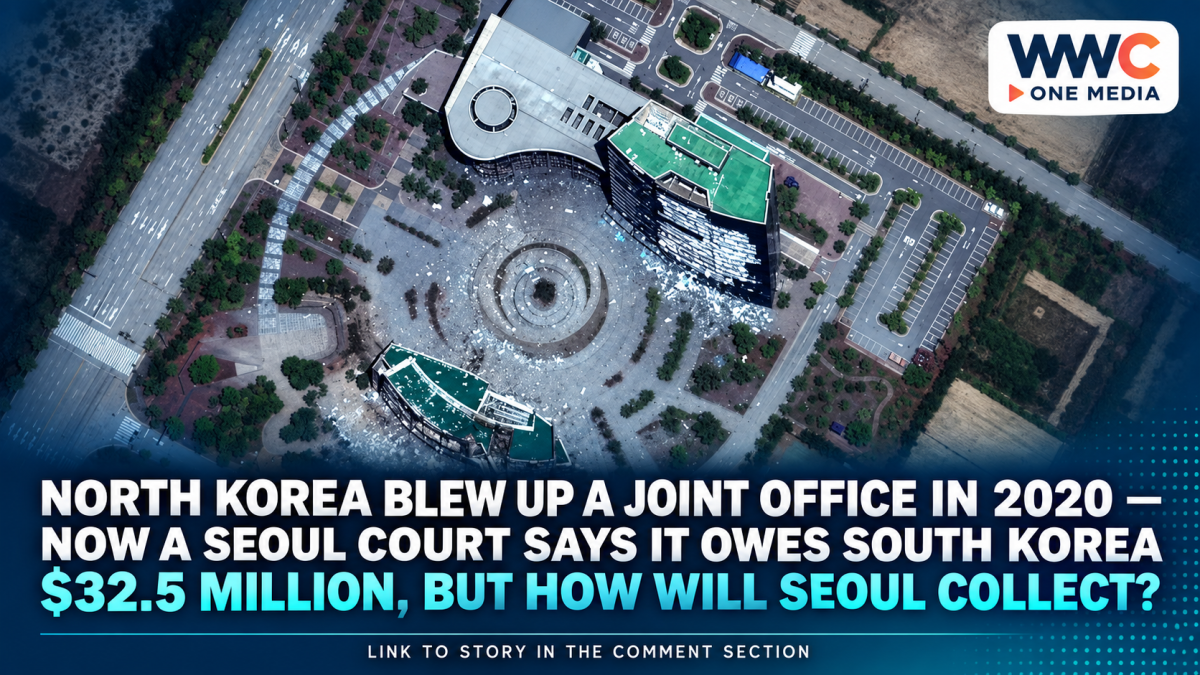
SEOUL — More than six years after a huge explosion ripped through a building created to keep North and South Korea talking, a South Korean court has put a price on the damage.
The Seoul Central District Court ordered North Korea on Wednesday, September 16, to pay 44.626 billion won, roughly US$32.5 million, to the South Korean government for destroying the inter-Korean liaison office in Kaesong and damaging a neighboring South Korean-funded facility in June 2020.
The ruling is historically unusual.
It is the first judgment in a damages lawsuit brought directly by the South Korean government against North Korea, rather than by individual South Korean citizens. Seoul filed the case in June 2023, just before the three-year limitation period on the property claim was due to expire.
But the court ruling creates an obvious problem.
North Korea did not participate in the case.
It has no normal legal relationship with the South through which a judgment can simply be invoiced and collected.
And previous South Korean plaintiffs who won civil judgments against Pyongyang have faced the same obstacle: getting a court order is one thing; enforcing it against North Korea is another.
That means the most consequential question may not be whether Seoul won.
It is whether South Korea will ever see the money.
The court awarded almost everything Seoul demanded
The Civil Division 46 of the Seoul Central District Court ordered the Democratic People’s Republic of Korea to pay 44,626,410,722 won and bear the litigation costs, according to SBS and Korean court reporting.
The court did not publicly provide an extensive explanation of its reasoning when delivering the decision.
The figure closely matches what the South Korean government demanded when it filed the case in June 2023.
At the time, the Ministry of Unification calculated the property damage at approximately 44.7 billion won:
about 10.25 billion won for the joint liaison-office building itself, and
about 34.45 billion won for damage to the neighboring Kaesong Industrial Complex General Support Center.
That second number matters because the 2020 detonation did not damage only the liaison office.
Images from the blast showed debris, shattered windows and serious damage to nearby structures, while later satellite imagery indicated that the explosion produced significant collateral damage around the complex.
This building once represented a dramatically different Korean Peninsula
The destroyed office had been created during one of the most hopeful periods in recent inter-Korean diplomacy.
Then-South Korean President Moon Jae-in and North Korean leader Kim Jong Un agreed in the April 27, 2018 Panmunjom Declaration to establish a permanent liaison office, giving officials from the two sides a regular communication channel. The facility opened in Kaesong in September 2018.
That was significant because North and South Korea do not maintain normal diplomatic relations or conventional embassies in each other’s capitals.
The liaison office was intended to function as something closer to an always-available contact point.
South and North Korean representatives could work in the same complex, coordinate meetings and handle day-to-day issues without relying entirely on occasional summits or military hotlines.
The building itself predated the 2018 détente.
Completed in 2007, it had earlier served as an inter-Korean economic cooperation consultation office within the Kaesong Industrial Complex before being renovated for the new liaison mission.
For a brief period, it became one of the most visible symbols of the diplomatic opening between Moon and Kim.
Two years later, North Korea blew it up.
Relations had already deteriorated before the explosion
The office’s destruction did not come without warning.
The diplomatic momentum generated by the 2018 Korean summits weakened significantly after the February 2019 Hanoi summit between Kim Jong Un and U.S. President Donald Trump ended without a denuclearization agreement.
Regular senior-level liaison meetings slowed, and South Korean personnel later withdrew from the Kaesong office during the COVID-19 outbreak.
By June 2020, tensions had escalated further over anti-North Korean leaflets sent across the border by activist and defector groups in South Korea.
Pyongyang repeatedly condemned the leaflets and criticized Seoul for failing to prevent them.
Then, at about 2:50pm on June 16, 2020, North Korea detonated explosives inside the liaison-office complex.
North Korean state media later confirmed that the facility had been destroyed.
South Korea’s National Security Council responded at the time by expressing strong regret, saying the destruction undermined hopes for improved inter-Korean relations and peace on the peninsula.
Seoul waited three years before taking North Korea to court
The South Korean government did not immediately file a civil case.
Instead, it acted in June 2023, shortly before the applicable three-year property-damage limitation period was due to expire.
The Ministry of Unification explicitly said the lawsuit was intended both to preserve the government’s financial claim and interrupt the statute of limitations.
The lawsuit was filed during the administration of then-President Yoon Suk Yeol.
That timing is relevant because inter-Korean policy can change significantly from one administration to another.
But once the government had filed the suit, it became a legal claim belonging to the South Korean state rather than merely a political statement by one president.
The case then took more than three years to reach judgment.
How do you sue a country that will not accept the paperwork?
That procedural problem shaped the case.
South Korean courts had no practical way to deliver normal legal documents directly to the North Korean government.
The court therefore eventually relied on service by public notice, a procedure under which documents are publicly posted and legally treated as having been served when ordinary delivery is impossible.
The South Korean government sought that procedure in late 2024, allowing the case to move forward.
North Korea did not appear to defend itself in court.
That means the ruling was not the result of lawyers for Seoul and Pyongyang arguing their competing positions before the same bench.
The South Korean court considered Seoul’s damages case without North Korean participation.
The government itself asked for the judgment to be delayed
The ruling had originally been expected in August.
But South Korea’s Unification Ministry asked the court to postpone it until September.
A ministry official said the government needed additional time to review possible “post-ruling measures” because this was the first legal case brought by the South Korean government itself against North Korea.
The court moved the decision to September 16.
That request hinted at the difficulty officials knew would follow a favorable judgment.
Winning establishes a legal claim.
What comes next is much less obvious.
Seoul says it is now reviewing what to do
After Wednesday’s judgment, the Unification Ministry said it respects the court’s decision and will review necessary measures.
The ministry also said it hopes inter-Korean dialogue can eventually resume so that issues between the two sides can be addressed through dialogue and cooperation.
Those two objectives — preserving a legal claim while leaving space for future diplomacy — illustrate the unusual nature of litigation involving North Korea.
For a conventional defendant, the next steps might involve payment demands, liens, seizure of property or other enforcement actions.
North Korea is not a conventional judgment debtor.
Previous cases show just how difficult collection can be
South Korean courts have ordered North Korea to pay damages before.
In 2020, two former South Korean prisoners of war won a landmark case over forced labor after being held in North Korea following the Korean War.
The Seoul Central District Court ordered North Korea and Kim Jong Un to pay 21 million won to each plaintiff.
That case was historically significant because it was the first time a South Korean court had recognized jurisdiction over North Korea and issued a damages order against it.
Yet Yonhap noted that there was no straightforward means to force Pyongyang to comply.
In 2021, a South Korean court similarly ordered North Korea and Kim to compensate a family member of a South Korean abducted during the Korean War.
Again, reporting emphasized the enforcement problem.
Other abductee families later obtained similar judgments.
Wednesday’s decision therefore does not create the problem of collection.
It expands it from individual plaintiffs to the South Korean government itself.
Could Seoul seize North Korean assets?
In theory, civil judgments can sometimes be enforced against identifiable assets belonging to a debtor.
In practice, identifying North Korean state property in South Korea that is legally available for execution is highly complicated.
Some assets connected with inter-Korean projects are subject to their own legal and political disputes, while sanctions regimes and the unresolved status of the two Koreas add further complications.
The September 16 court ruling itself did not announce a specific asset-seizure plan.
The Unification Ministry has said only that it is examining follow-up action.
So any claim that Seoul can now simply confiscate a particular North Korean property or account would be premature.
The judgment creates a recognized claim of roughly 44.6 billion won.
It does not automatically produce 44.6 billion won in cash.
The lawsuit was also about preserving a principle
When filing the case in 2023, Seoul described the blast as an unlawful destruction of South Korean state property and a breach of inter-Korean agreements.
The government said it intended to respond firmly to violations involving the property rights of both the South Korean state and its citizens.
That explains why the government pursued litigation despite the obvious enforcement difficulty.
A court judgment does more than seek immediate payment.
It establishes a formal domestic legal record that South Korea regards North Korea as financially responsible for the damage.
That could matter if circumstances change in the future or if potentially enforceable assets become available.
Exactly how Seoul will use that judgment remains uncertain.
There may be even bigger property disputes still waiting
The liaison-office case is not the only dispute involving South Korean property in Kaesong.
South Korea shut the Kaesong Industrial Complex in 2016 following North Korean nuclear and missile tests.
The complex had once hosted South Korean companies employing North Korean workers and was one of the largest examples of economic cooperation between the two sides.
Seoul later accused North Korea of operating South Korean-owned facilities in the complex without authorization.
In early 2024, the Unification Ministry said it was examining legal options over those activities. Reports at the time suggested potential damages involving hundreds of billions of won, although the government had not confirmed a final claim figure.
That means Wednesday’s 44.6 billion-won judgment could eventually become part of a much larger legal question:
What happens to property built, owned or financed by South Koreans but physically located inside North Korea?
The explosion also destroyed more than money
The dollar figure attracts attention because courts calculate property damage in money.
But the liaison office had political value that cannot be reduced to construction costs.
It existed because the two Koreas had agreed that regular communication was useful even when major diplomatic disputes remained unresolved.
Its opening in September 2018 followed months of unusually intense diplomacy.
The destruction in June 2020 became an equally striking visual representation of how quickly that diplomatic opening had deteriorated.
The court’s 44.6 billion-won figure addresses damaged physical assets.
It cannot restore the institution the building represented.
North Korea has not been compelled to participate
Another important limit on the judgment is that it exists inside the South Korean legal system.
North Korea has not recognized the process by appearing before the Seoul court.
That does not erase the judgment’s status under South Korean law, but it helps explain why enforcement is so uncertain.
The case highlights the unique legal reality of the Korean Peninsula: the two governments operate as separate states in international practice while their relationship remains shaped by division, competing constitutional claims, the unresolved legacy of the Korean War and a dense network of inter-Korean agreements.
That is very different from an ordinary cross-border commercial dispute.
The Korean War itself never formally ended with a peace treaty
The historical background also matters.
The 1950-1953 Korean War ended with an armistice rather than a comprehensive peace treaty.
That left the peninsula divided and created a security structure that remains in place more than seven decades later.
Periods of cooperation have repeatedly alternated with periods of military and diplomatic confrontation.
The Kaesong Industrial Complex was created during one period of engagement.
The liaison office emerged during another.
Both later became casualties of deteriorating relations.
That cycle is one reason the court case is about more than a destroyed building.
Six years later, the image of the blast still carries weight
The footage was dramatic.
A large explosion erupted at the Kaesong complex.
Smoke and debris shot into the air.
Windows in the nearby support building shattered.
A building that had opened less than two years earlier as a permanent communication channel between the Koreas was suddenly unusable.
Commercial satellite analysis conducted days later found major structural damage and debris extending around the site, suggesting significant collateral damage beyond the immediate detonation point.
South Korea has now attached a legal price to that physical destruction.
44,626,410,722 won.
But that number may prove easier to write in a judgment than to collect.
The ruling changes the legal record — not the reality at the border
North Korea now owes South Korea roughly $32.5 million under a Seoul court judgment.
That is a clear legal outcome inside South Korea.
What it does not automatically change is the broader political and security situation.
The liaison office remains destroyed.
Normal permanent inter-Korean representation has not been restored.
North Korea did not defend itself in the lawsuit.
And Seoul has not announced a practical way to force payment.
The South Korean government says it will consider what comes next.
That is why the most intriguing part of Wednesday’s decision begins after the judge’s order.
South Korea has finally received a legal answer to who should pay for the Kaesong explosion.
Now it has to determine whether that judgment can ever become something more than a number on paper.



Leave a Reply