
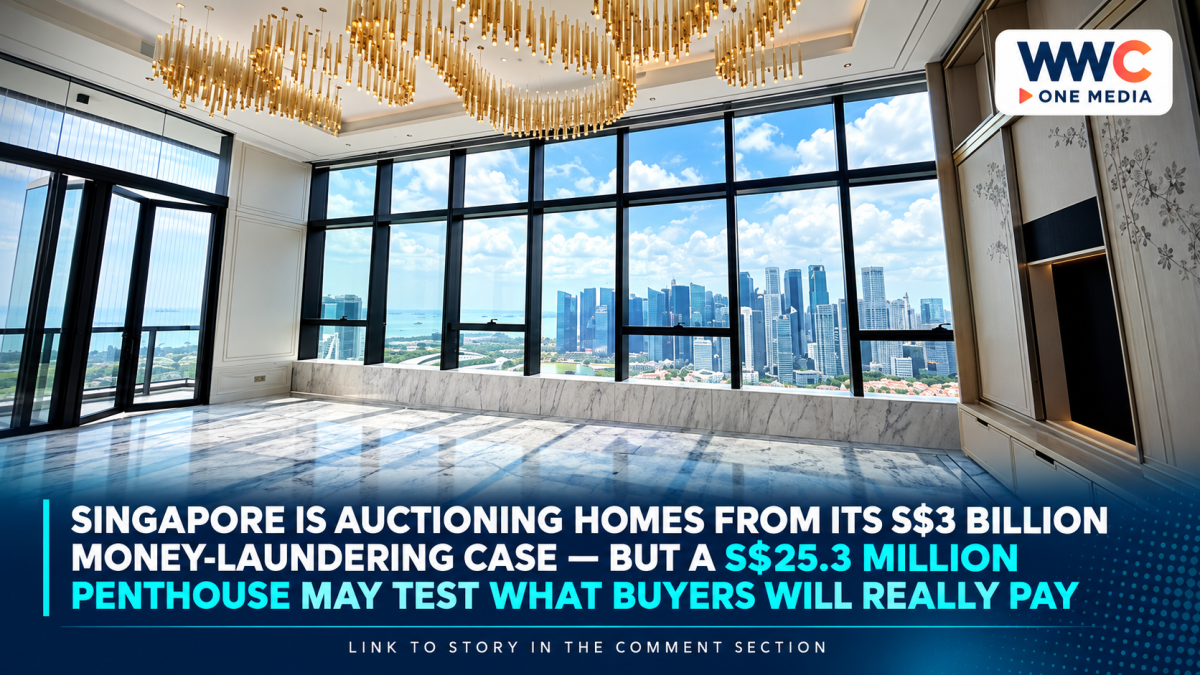
SINGAPORE — Three years after more than 400 police officers swept through luxury homes across Singapore in the country’s biggest-ever money-laundering operation, some of the most valuable property connected to the case is finally heading back onto the market.
The first 25 forfeited properties are being offered through auctions on September 17 and September 23, ranging from luxury condominiums in Orchard, River Valley and the Central Business District to a Grade A office in Suntec Tower One.
At the top of the price range sits a 6,727 sq ft four-bedroom penthouse at South Beach Residences with a S$25.32 million guide price. At the other end of the initial group, a Martin Modern apartment is being marketed from S$2.238 million.
But these auctions are not simply an unusual chance to inspect multimillion-dollar homes connected to one of Singapore’s most notorious financial-crime cases.
They mark the beginning of a much larger liquidation exercise.
Deloitte Singapore says more than 80 forfeited real estate properties and over 1,000 luxury items will be progressively offered for sale between September 2026 and mid-2027, with proceeds ultimately flowing back to the State.
For buyers, that raises an obvious question:
Does a property linked to a S$3 billion money-laundering scandal come with a discount?
Property specialists say not necessarily.
The first auction happens on September 17
Knight Frank will open the property-sale programme on Thursday, September 17, at Ocean Financial Centre.
Among the forfeited assets it is marketing are four units at Gramercy Park on Grange Road, with guide prices ranging from S$3.8 million to S$7.6 million; two three-bedroom units at Sloane Residences on Balmoral Road, guided between S$3.6 million and S$3.7 million; and a 3,498 sq ft office at Suntec Tower One with a S$11.5 million guide price.
Six days later, on September 23, two more auction houses will bring additional properties to market.
Edmund Tie & Company is handling five apartments at South Beach Residences, including the S$25.32 million penthouse, as well as two units at 8 Saint Thomas and one at Paterson Suites.
SRI will offer four apartments at Wallich Residence and six at Martin Modern. Wallich guide prices range from S$4.42 million to S$6.78 million, while the Martin Modern units start at S$2.238 million and go as high as S$4.98 million.
Altogether, those three auction sessions account for the first 25 properties announced under the latest disposal programme.
The S$25.3 million penthouse is the headline property
The most expensive publicly listed property in the opening batch is difficult to miss.
The South Beach Residences penthouse spans approximately 6,727 sq ft, occupies the 42nd floor and carries a guide price of S$25.32 million.
The Straits Times reported that the unit includes elaborate interior features such as a raindrop-style chandelier and a suspended ceiling installation, according to marketing photographs.
Its size and pricing also illustrate why not every seized luxury property is suitable for a straightforward auction.
Deloitte has appointed List International Realty to market certain properties through an expression-of-interest process instead. Property experts told CNA that extremely expensive homes may have a much smaller pool of potential buyers, making private negotiations more suitable than a conventional auction room.
So although “auction” dominates the headlines, Singapore is actually using several methods to convert the forfeited real estate into cash.
A guide price is not the price you necessarily pay
This is where potential buyers need to understand the terminology.
A guide price is essentially an indication of where the seller hopes to attract market interest.
It is not necessarily the same as the property’s reserve price, which is the minimum amount the seller has authorised the auctioneer to accept.
And it is certainly not a guaranteed selling price.
Property agents told CNA that guide prices are established using factors including recent comparable transactions, market conditions, tenure, location, property condition and valuation information.
If several buyers compete aggressively, a property can sell above its guide.
If nobody is prepared to meet the reserve price, it may not sell at all.
In that situation, the property can be offered again at another auction or negotiations can continue privately.
An unsuccessful auction also does not automatically require the State to slash its asking price.
That is why expecting an automatic “crime-case discount” could be a mistake.
Winning the auction is legally serious
A property auction is not like clicking “bid” on an online shopping site and deciding later whether to complete the purchase.
Once the auctioneer accepts the highest qualifying bid and the hammer falls, a binding purchase obligation arises under the sale conditions.
The successful purchaser typically has to sign the relevant documentation and pay a deposit of about 10% of the purchase price immediately.
Failing to complete the deal can mean losing that deposit and could potentially expose the buyer to further legal remedies under the conditions of sale.
That makes financing preparation critical.
Prospective buyers are encouraged to arrange any necessary bank approval beforehand, inspect the property where possible and complete legal and financial due diligence before bidding.
Anyone can participate provided they satisfy the legal and regulatory eligibility requirements for the particular property, according to Edmund Tie.
The fact that a property is being sold by auction does not override Singapore’s normal property-ownership or financing rules.
Auctions themselves are not unusual
What is unusual is why these particular properties are being auctioned.
Singapore’s auction market normally handles mortgagee sales, voluntary disposals, deceased estates, liquidations and court-ordered sales.
In the first six months of 2026 alone, 292 properties were listed for auction, including 216 mortgagee sales, according to Edmund Tie data cited by CNA.
So an auction sign does not automatically mean a desperate seller or distressed property.
What makes this month’s sales extraordinary is their origin in a criminal investigation of unprecedented scale.
Property portal Mogul.sg’s Nicholas Mak described it as very rare for assets connected with such a high-profile money-laundering operation to enter the public auction market.
The case began with more than 400 officers raiding homes across Singapore
On August 15, 2023, Singapore Police mounted a massive islandwide operation involving more than 400 officers from the Commercial Affairs Department, Criminal Investigation Department, Special Operations Command and Police Intelligence Department.
Ten foreign nationals were arrested in raids that included luxury condominiums and Good Class Bungalows.
Police said the investigation had identified a network suspected of laundering the proceeds of overseas organised crime, including scams and online gambling, with forged documents allegedly used in some cases to explain the origins of money flowing into Singapore bank accounts.
By January 2024, the value of assets seized or subjected to prohibition-of-disposal orders had climbed beyond S$3 billion, including real estate, vehicles, cash, bank deposits, jewellery, watches and luxury bags.
It became the largest money-laundering case Singapore had ever uncovered.
All 10 people arrested in the raids were eventually convicted
The criminal cases moved relatively quickly.
By June 2024, all 10 people arrested in the August raids had been convicted of money-laundering and related offences and received prison terms ranging from 13 to 17 months.
Around S$944 million, representing more than 90% of assets linked to the 10 convicted offenders, was ordered forfeited or surrendered to the State.
After completing their sentences, the offenders were deported and barred from returning to Singapore.
But those 10 defendants represented only one part of the wider investigation.
Police were also pursuing assets linked to another 17 foreign nationals who were outside Singapore.
By November 2024, 15 of those individuals had agreed to surrender approximately S$1.85 billion, or 98.6% of the seized and prohibited assets associated with them.
By the end of 2024, Singapore had recovered about S$2.79 billion
A Ministry of Home Affairs parliamentary response provides the clearest picture of just how much wealth eventually went to the State.
As of December 31, 2024, approximately S$2.79 billion of assets had been surrendered.
Around S$1.54 billion consisted of cash or financial assets, while the remainder was non-cash property such as real estate, vehicles and luxury goods.
The liquidation process had already begun before the current auctions.
By the end of 2024, authorities had disposed of 54 properties, 33 vehicles and 11 country-club memberships.
That means the September 2026 auctions are not the first time assets from the case have been sold.
What is new is the scale and public visibility of the remaining disposal programme.
Deloitte is now managing the remaining non-cash assets
Singapore Police appointed Deloitte in July 2025 to manage and realise the remaining forfeited non-cash assets connected to the case.
The physical handover began the following month and included hundreds of luxury products and gold bars.
Deloitte announced in August 2026 that the next stage would involve public sales of more than 80 real estate properties and over 1,000 luxury items.
The programme is expected to run in phases until around the middle of 2027.
SRI, Edmund Tie and Knight Frank are handling real-estate auctions.
List International Realty is managing selected expression-of-interest property sales.
Hotlotz has been appointed for luxury goods such as jewellery, watches and handbags.
In other words, the properties are only one part of a much broader conversion of forfeited wealth back into public funds.
The handbags and jewellery are already being sold
The liquidation has already started online.
More than 600 pieces of fine jewellery, handbags and other luxury items were included in the first Hotlotz auctions launched in September.
The goods are being stored at Le Freeport, the high-security storage facility near Changi Airport, with approved bidders able to book controlled viewing appointments.
The first two luxury-goods auctions alone carried combined pre-sale estimates of approximately S$2.9 million to S$3.9 million.
That shows how unusual the overall liquidation is.
Singapore is simultaneously disposing of multimillion-dollar penthouses, CBD apartments, office space, designer handbags, high jewellery and other assets accumulated by people linked to the same financial-crime investigation.
Where does the money go?
The proceeds do not return to the former owners.
They are paid into Singapore’s Consolidated Fund, the government’s central account into which public revenues are paid and from which government spending is authorised.
Home Affairs Minister K Shanmugam told Parliament that proceeds from the liquidation of forfeited non-cash assets would ultimately be transferred into the fund.
As of the end of 2024, only a relatively small portion had physically reached that account, while hundreds of millions of dollars were still pending transfer as different assets were realised and administrative processes completed.
The current auctions should progressively convert more of the remaining physical property into cash that can likewise flow to the government.
Will buyers care about the properties’ criminal history?
That may be the most fascinating market question.
CNA’s property experts generally do not expect the connection with the money-laundering case itself to have a material negative impact on demand.
Unlike a house associated with physical damage, structural problems or some other defect, the criminal activity concerned the owners and their finances rather than something inherently wrong with the apartments themselves.
The properties also sit in some of Singapore’s most expensive locations.
Wallich Residence is integrated with Guoco Tower above Tanjong Pagar MRT.
Martin Modern sits in prime River Valley.
Gramercy Park is on Grange Road near the Orchard area.
South Beach Residences occupies a prominent downtown location overlooking the city and Marina Bay district.
For serious bidders, location, tenure, floor area, condition and pricing are likely to matter considerably more than the identity of a previous owner.
But public curiosity may be far greater than actual buying interest
The auctions could nevertheless draw unusually large crowds.
Knight Frank told CNA it is preparing for a potentially higher-than-usual turnout because of the publicity surrounding the case.
But an important distinction remains:
watching is not buying.
Property auctions routinely attract interested observers, neighbouring owners curious about achievable prices, investors gathering market intelligence and people who simply want to see how the process works.
With these properties, the criminal case adds another layer of curiosity.
That does not mean the room will suddenly contain dozens of people willing to write multimillion-dollar cheques.
The S$25.32 million South Beach penthouse, for example, requires an entirely different buyer pool from a mass-market condominium.
And auction does not mean bargain
That is probably the biggest misconception surrounding the sale.
Buyers may find value.
There may eventually be prices below what previous owners paid.
Some properties may need to be repriced if bidding is weak.
But there is no rule requiring the State to dispose of them cheaply simply because they came from a criminal forfeiture.
Knight Frank told CNA that buyers should evaluate the total acquisition and ownership cost rather than assume an auction automatically means a discount.
Guide prices have been set with reference to current market conditions and comparable deals.
Competitive bidding can push prices higher.
And if reserve prices are not met, sellers can simply walk away and try another sales route.
The auction is designed to discover market value — not to stage a fire sale.
The bigger story is what happens to S$3 billion after the courtroom closes
Singapore’s money-laundering case dominated headlines when police entered luxury homes in August 2023.
Then came the court cases.
The prison sentences.
The deportations.
The asset forfeitures.
Now comes a much less dramatic but financially essential part of enforcement:
turning seized wealth into actual recoverable value.
That process could take almost another year.
More than 80 properties must be marketed.
Luxury goods must be authenticated and sold.
Buyers have to be found.
Transactions must complete.
And the proceeds eventually have to enter the Consolidated Fund.
For Singapore, this is the final economic phase of a case that exposed vulnerabilities in banks, property transactions and other parts of the country’s high-end financial ecosystem.
For prospective buyers, however, the equation is considerably simpler.
A S$25.3 million penthouse is about to hit the auction block.
The address is prestigious.
The history is extraordinary.
But the hammer will still fall only if somebody believes the property itself is worth the price.




Leave a Reply