
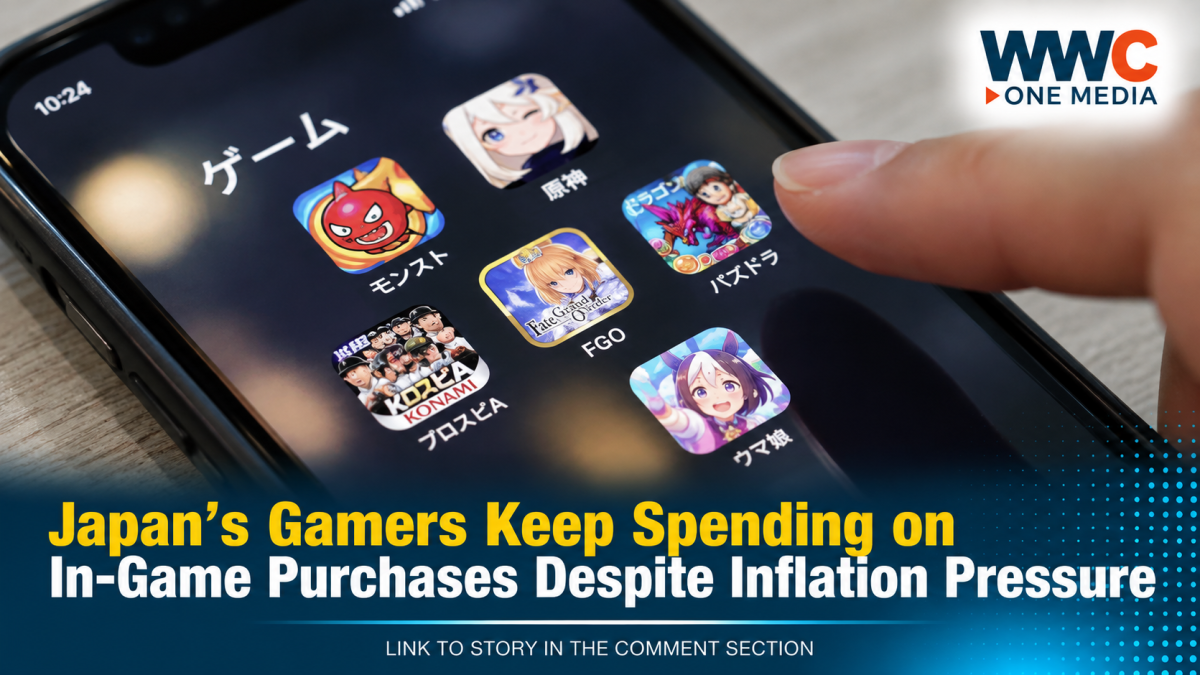
TOKYO, Japan — As higher prices squeeze household budgets, Japanese consumers are showing a surprising resilience in one corner of discretionary spending: in-game purchases.
A new report highlighted by Nikkei Asia points to continued spending on virtual items and other game content in Japan even as inflation puts pressure on everyday expenses. The trend underscores the unusual strength of Japan’s gaming market, particularly for mobile and free-to-play titles that generate revenue through recurring purchases.
Gaming Spending Holds Up as Prices Rise
Japan has long been one of Asia’s most important gaming markets, with mobile games and so-called gacha mechanics playing a major role in the country’s digital entertainment economy.
Gacha-style games allow players to spend money for chances to obtain virtual characters, items or other digital rewards. The model has become deeply established in Japanese mobile gaming and has subsequently spread to other markets.
Recent consumer research provides additional context. A 2025 SMBC Consumer Finance survey of 1,000 Japanese people aged 20 to 29 found that the share who reported making in-game purchases increased by nearly 6% from the previous year’s survey. At the same time, average monthly spending reportedly declined slightly, suggesting that the increase in participation did not necessarily mean every player was spending larger amounts.
That distinction is important: more people buying does not automatically mean consumers are spending more overall.
Why In-Game Purchases Remain Attractive
Unlike traditional video games, many mobile titles are free to download. Developers then monetize their audiences through optional purchases ranging from cosmetic items and characters to additional content and virtual currency.
This creates a different spending pattern from buying a full-priced game.
Players can make relatively small purchases repeatedly, while major releases, special events and limited-time campaigns can encourage additional spending.
A Rakuten Insight survey of more than 71,000 adults across 12 Asian markets found that Japan had a 50% daily online-gaming engagement rate, the highest among the markets covered in that particular survey. The research also examined motivations and behavior surrounding in-game purchases.
Young Japanese Gamers Show a Complicated Spending Picture
The spending trend also comes with a warning sign.
The 2025 SMBC survey found that 18.8% of respondents aged 20–29 said their spending on in-game purchases had affected their ability to cover essential living expenses. The figure was higher among men in the survey than women.
However, the same research found that the majority of people in their twenties continued to avoid such purchases, while some respondents also expressed regret over their spending.
The findings therefore point to a divided market: gaming remains highly popular, but the financial impact of virtual purchases can vary substantially between consumers.
Japan’s Long-Established Gacha Culture
Japan’s gaming industry helped popularize gacha-style monetization, which has become an important source of revenue for free-to-play mobile games.
The model has also attracted regulatory and consumer-protection scrutiny. Japan has taken measures against certain forms of “complete gacha,” while industry organizations have developed additional guidelines around transparency and probability disclosures.
That history means the country’s gaming companies operate in a market where consumers are familiar with virtual-item purchases but where spending practices have also received considerable public attention.
What the Trend Means for Japan’s Gaming Industry
The resilience of in-game spending suggests that gaming companies may continue to rely heavily on live-service models, where games remain active for years and generate recurring revenue through new characters, events, cosmetics and other digital content.
For consumers, however, inflation changes the equation. Even when individual purchases appear relatively small, repeated transactions can accumulate.
Japan’s gaming market therefore presents a striking contradiction: households are facing higher living costs, yet digital entertainment remains an area where some consumers continue to open their wallets.
The latest trend does not mean Japanese consumers are ignoring inflation. Rather, it shows that entertainment priorities—and the way people spend on them—can remain surprisingly resilient even during periods of financial pressure.
WWC ONE MEDIA G.A




Leave a Reply