
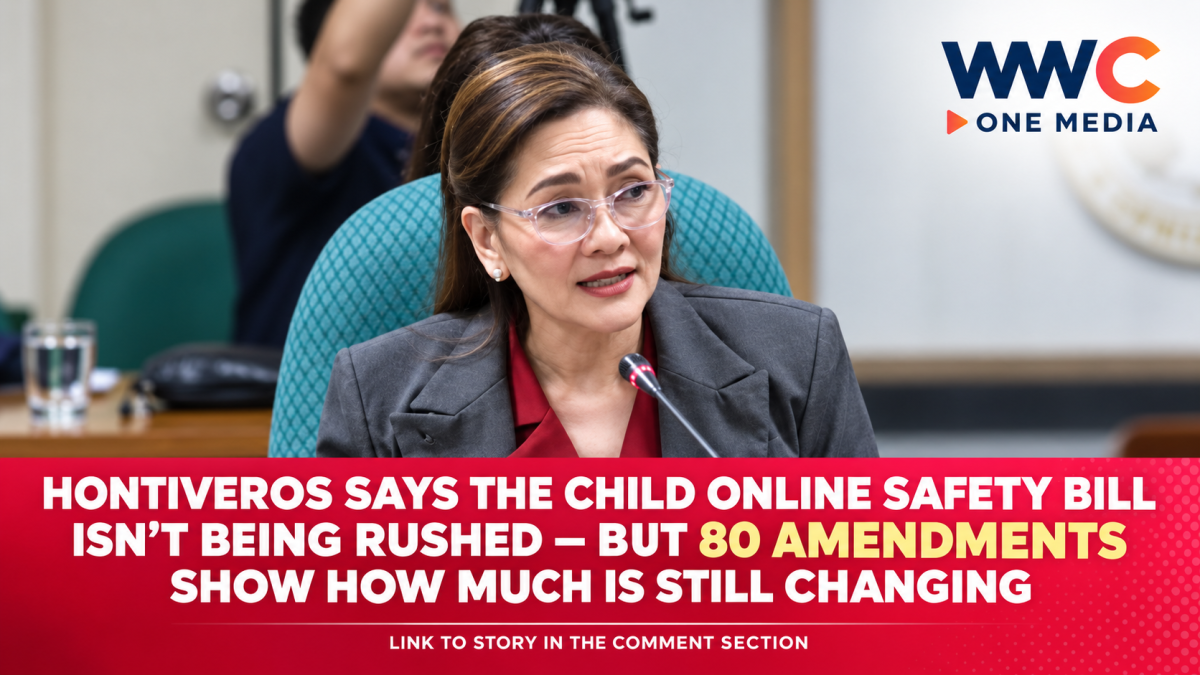
MANILA, Philippines — Senator Risa Hontiveros is pushing back against suggestions that Congress is moving too quickly on tougher child-online-safety legislation, saying senators have already spent weeks rewriting the proposal and accepted dozens of amendments.
But the debate now involves far more than the sexual exploitation of children that prompted the Philippines’ original Anti-OSAEC law.
Lawmakers are weighing how far government should go in policing children’s access to social media, how platforms should verify a user’s age, what information companies should be required to provide investigators, and how authorities should respond to emerging forms of online violence.
Hontiveros said the legislation has already been under the period of amendments for roughly three weeks and that she accepted around 80 amendments during the previous week, while remaining open to additional revisions.
Her argument: lawmakers should continue improving the proposal, but lengthy efforts to produce a perfect bill should not delay measures intended to protect children.
The question confronting the Senate, however, is not simply whether legislation is urgent.
It is also whether the final rules can protect minors without creating new problems involving privacy, identification requirements, implementation and overly broad enforcement.
Hontiveros: ‘Urgent’ does not mean bypassing debate
Hontiveros has argued that urgency should not be confused with railroading legislation.
In a radio interview reported on September 15, she said she remained willing to consider amendments and had already accepted scores of proposed changes.
She warned against allowing a search for the “perfect” bill to postpone protections for children while digital risks continue to evolve.
The legislative history supports the fact that the issue did not appear in the Senate only in September.
Senate Bill No. 1819, the Expanded Anti-OSAEC and Anti-CSAEM Act, was filed on February 10, 2026 by Hontiveros together with Senators Mark Villar, Raffy Tulfo, Joel Villanueva and Loren Legarda.
Official Senate records show the measure seeks to strengthen Republic Act No. 11930 and that it had already reached second-reading deliberations earlier this year.
A February 23 Senate journal records senators questioning Hontiveros about artificial intelligence-generated child sexual abuse materials, the responsibilities of social-media and messaging platforms, evidence preservation and the obligations of financial intermediaries.
Among the proposals discussed were requiring internet companies to maintain representatives in the Philippines and strengthening “safety by design” mechanisms intended to detect or block exploitative material.
So while the legislation is being pushed with urgency, its underlying policy debate has been running for months.
This debate actually started years ago
The current bill also builds on a law that has existed since 2022.
Republic Act No. 11930, the Anti-Online Sexual Abuse or Exploitation of Children and Anti-Child Sexual Abuse or Exploitation Materials Act, became law on July 30, 2022.
It criminalized a wide range of conduct involving OSAEC and child sexual abuse or exploitation materials, including grooming, livestreaming abuse, possession and distribution of illegal materials.
The law also imposed responsibilities on internet intermediaries, social-media platforms, payment systems and other entities whose services can be used in committing or facilitating these crimes.
Hontiveros was one of the principal Senate proponents of that legislation.
The 2026 effort is therefore not an attempt to create the country’s anti-OSAEC framework from scratch.
It is an attempt to revise and expand it as technology—and the perceived threats facing children online—change.
The proposed law is becoming much broader than OSAEC
This is where the current debate gets more complicated.
The legislation now being discussed under the broader Child Online Safety and Protection Act reaches into areas that extend beyond online sexual exploitation.
On August 26, Senator Robinhood Padilla sponsored Senate Bill No. 2424, which would establish 16 as the minimum age for creating and maintaining certain social-media accounts.
According to GMA News, the measure was consolidated from proposals filed by several senators and had obtained the signatures of at least 18 senators when it reached the floor.
Under the Senate proposal being debated, children below 16 would generally be prohibited from registering on covered social-media services.
Users aged 16 to below 18 could access those platforms subject to age-assurance requirements and other child-safety safeguards.
That is a significant expansion of the policy debate.
Congress is no longer considering only what platforms should do when child sexual exploitation occurs.
It is also considering who should be permitted to use certain platforms in the first place.
Now senators are debating whether National ID should be required
One of the newest questions is how platforms could reliably determine a user’s age.
Senator Panfilo Lacson proposed during Senate deliberations that the Philippine Identification System or National ID become the principal form of age verification for social-media access.
Lacson argued that relying on self-declaration, third-party verification or artificial-intelligence-based age estimation could create loopholes and implementation problems.
He has also raised the possibility of extending restrictions beyond the bill’s current under-16 threshold, potentially keeping stricter controls in place until age 18. Those proposals remain amendments under consideration and are not existing law.
That debate highlights one of the central tensions legislators still have to resolve.
Stronger age verification could make it harder for children to bypass restrictions.
But requiring identification for online access also means lawmakers must determine how personal data will be collected, checked, retained and protected.
Those implementation questions help explain why amendments continue even among senators who support stronger child safeguards.
The House already passed its own expanded child-protection measure
The House of Representatives has separately moved ahead with legislation strengthening the country’s OSAEC framework.
On June 2, 2026, the House approved House Bill No. 9461, also titled the Child Online Safety and Protection Act of 2026, on third and final reading.
The vote was 284 in favor, zero against and zero abstentions.
Official House records show the measure seeks to strengthen child-protection safeguards, regulatory rules and enforcement mechanisms against OSAEC and CSAEM and proposes replacing Republic Act No. 11930 with a broader framework.
The House transmitted HB 9461 to the Senate on June 8.
The Department of Social Welfare and Development welcomed the House vote, saying stronger legislation could expand government interventions for victim-survivors and their families.
DSWD is co-chair of the National Coordination Center Against OSAEC and CSAEM.
The Senate’s later debates, however, have brought additional issues—including social-media age limits—into the wider child-online-safety discussion.
Why school violence suddenly became part of the debate
Hontiveros has also linked the urgency of legislation to concern about nihilistic violent extremism, or NVE, and other forms of dangerous online influence involving minors.
She called for urgent action in August, arguing that investigators need stronger legal tools to address threats facilitated through digital platforms.
That push intensified after two deadly school shootings in the Philippines in 2026.
On June 22, a shooting at San Jose National High School in Tacloban killed three students and wounded others. Two minors were arrested.
The Department of Justice said investigators were examining whether the incident could involve a broader pattern of extremism, including possible NVE influence. That was an investigative theory, not a final finding.
Then on August 18, a student opened fire at Ateneo de Zamboanga University’s junior high school, killing another student before dying himself.
Authorities said the attack was livestreamed, and investigators began examining the circumstances surrounding the shooter, including his online activity. Reuters described it as the country’s second fatal school shooting in less than two months.
Those incidents understandably intensified the policy discussion.
But it would be inaccurate to state as established fact that social media or NVE caused either shooting.
Authorities have investigated possible digital influences and extremist connections; those links require evidence on a case-by-case basis.
Hontiveros wants platforms to carry more responsibility
Another major component of the proposed reforms is platform accountability.
The existing Anti-OSAEC law already imposes duties on internet intermediaries and participative network platforms when their services are used for exploitation.
The 2026 proposals would strengthen those responsibilities further.
During Senate debates on SB 1819, Hontiveros argued that platforms and messaging services should cooperate with investigations, preserve evidence and maintain accessible representatives in the Philippines.
The Senate journal also records discussions on proactive detection of CSAEM, including material created using artificial intelligence.
In August, Meta also told lawmakers it would cooperate in situations involving imminent threats, according to Philippine reporting, as legislators scrutinized how online platforms respond to potentially violent content.
The policy question Congress still has to settle is how to translate those obligations into rules precise enough to protect children while preserving lawful communications and personal-data safeguards.
So is the bill really being rushed?
The available legislative record establishes several facts.
The original Philippine Anti-OSAEC law dates to 2022.
Hontiveros’ 2026 proposal to strengthen it was filed in February.
Senate debates on that measure were underway that same month.
The House passed a strengthened child-online-safety bill in June.
A broader Senate child-online-safety proposal reached sponsorship in August and has continued through interpellations and amendments into September.
Hontiveros says around 80 amendments were accepted in the latest phase alone.
Those facts provide context for her rejection of the “rushed” characterization.
They do not, by themselves, resolve whether every provision has received sufficient scrutiny.
That is a legislative judgment senators still have to make—particularly as the proposal expands from combating sexual exploitation into age verification, social-media access and responses to other forms of online harm.
The biggest fight may no longer be over whether children need protection
There appears to be broad legislative support for stronger online child-safety rules.
The harder arguments now concern how those protections should work.
Should 16 be the minimum age for unrestricted social-media use?
Should the threshold be 18?
Should Filipinos have to present a National ID or another government document before opening an account?
How should platforms verify age without retaining unnecessary personal information?
How broadly should laws aimed at sexual exploitation be expanded to cover other forms of digital violence?
And how much responsibility should technology companies bear for harmful activity occurring through their services?
Those questions are why the legislation is still changing.
For Hontiveros, the danger is waiting too long while threats involving children continue to evolve online.
For the Senate as a whole, the task is more complex: acting quickly enough to address emerging risks while making sure the rules lawmakers pass can withstand the much harder test that comes afterward—implementation.




Leave a Reply