
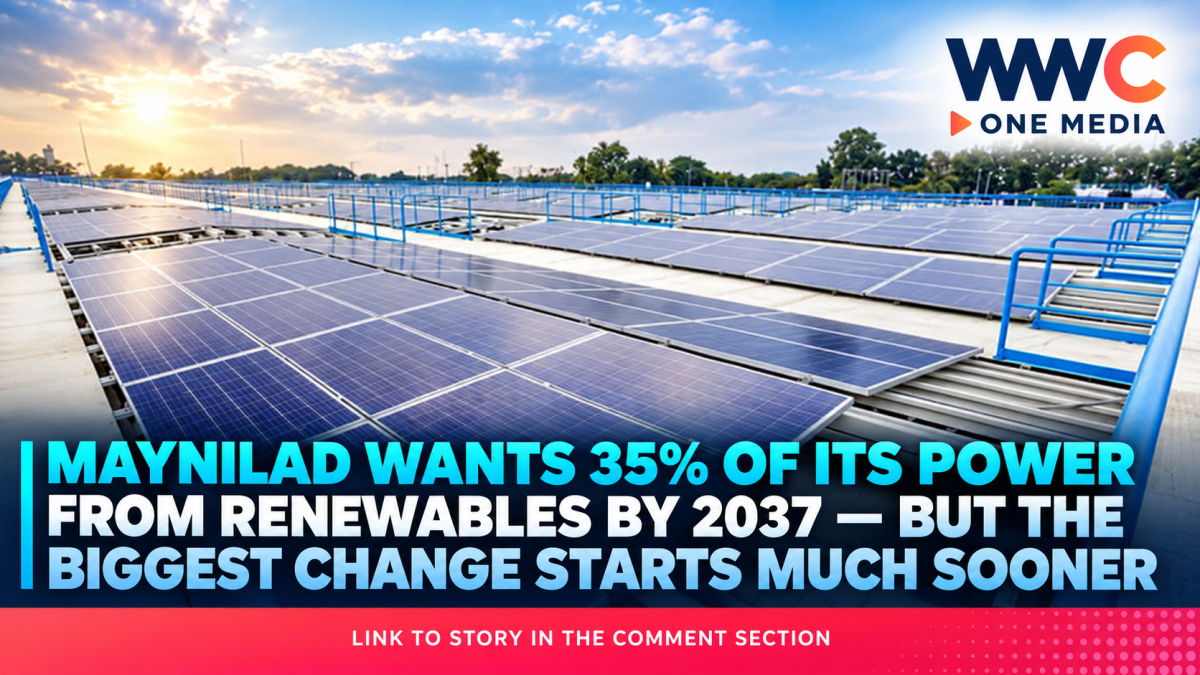
MANILA, Philippines — Maynilad Water Services Inc. is laying out a more concrete path toward cleaner operations, targeting renewable energy for 35% of its total electricity requirements by 2037 as the water concessionaire moves to cut emissions and reduce its dependence on conventional power.
The company has completed a new Renewable Energy Transition Plan, a long-term roadmap covering renewable electricity procurement, additional solar installations and energy-efficiency measures across its water and wastewater facilities.
And the first major change is already on the calendar.
Beginning in 2027, Maynilad plans to double the renewable-energy component of electricity supplied under its arrangement with MPower, Meralco’s retail electricity supplier, from the current 10% to 20%.
Maynilad estimates that the higher renewable share could reduce its carbon emissions by approximately 8,500 metric tons a year.
Solar Expansion Is Coming to 20 More Facilities
Buying cleaner electricity will only be part of the strategy.
Maynilad’s roadmap also calls for new rooftop solar photovoltaic systems at 20 facilities, covering sites such as water treatment plants, pumping stations, reservoirs, wastewater treatment plants and sewage pumping facilities.
Those projects will supplement solar installations Maynilad already operates at its La Mesa Compound, where the company previously developed two one-megawatt solar farms to help supply treatment plants and pumping facilities.
Chief Sustainability Officer Roel Espiritu said the roadmap represents another step in Maynilad’s sustainability program, combining cleaner technologies with efforts to make operations more resilient over the long term.
That energy question is particularly important for water companies.
Treating raw water, moving it through extensive pipe networks, operating pumping stations and then collecting and treating wastewater all require substantial amounts of electricity. Cutting the carbon footprint of a large water utility therefore depends not only on installing renewable generation but also on changing how the company purchases and consumes power.
Maynilad Has Been Building Toward the Shift for Years
The 2037 target is not a sudden change in direction.
Maynilad disclosed in 2023 that it intended to rely increasingly on purchased renewable electricity because the amount of space available for building its own solar facilities was limited. At the time, officials said the company was looking at sourcing roughly 35% to 50% of its power from renewable energy by 2037.
The transition accelerated in 2024 when Maynilad partnered with MPower to supply renewable energy from solar and biomass sources to nine facilities.
That initiative increased renewable-energy use in portions of Maynilad’s operations and was expected to avoid nearly 18,000 metric tons of carbon dioxide emissions annually, according to company figures reported by The Philippine Star and Manila Bulletin.
Maynilad’s 2024 Integrated Report subsequently identified a 35% renewable-energy mix as one of the formal targets under its Climate Neutrality Plan. The same plan includes developing a carbon sink equivalent to 180,000 metric tons of CO₂, converting 50% of its vehicle fleet to electric vehicles, and reforesting 2,615 hectares as part of its longer-term decarbonization program.
That helps explain why the latest roadmap uses 35% as the headline target even though previous company statements sometimes referred to a wider 35%–50% range.
The MPower Partnership Has Also Expanded
Maynilad widened its electricity partnership with MPower in 2025.
Its Poblacion Water Treatment Plant in Muntinlupa was enrolled in the Retail Electricity Supply program with an initial electricity mix of 90% non-renewable and 10% renewable power.
Another 54 water and wastewater facilities, including pumping stations, reservoirs and treatment plants, were brought into the Retail Aggregation Program, which allows electricity demand from multiple sites to be consolidated for power procurement.
The newly announced 2027 increase to 20% renewable energy therefore represents the next measurable step in that arrangement.
Why the 2037 Target Matters
Maynilad’s strategy is unfolding as the Philippines pushes for a much larger renewable-energy sector.
The Department of Energy is targeting renewables to account for 35% of the country’s power-generation mix by 2030 and 50% by 2040, supported by additional Green Energy Auction rounds and new renewable-generation projects.
Maynilad’s target is company-specific and is not directly comparable with the national generation target, but both reflect the same broader shift: large electricity users are facing growing pressure to secure cleaner power while maintaining reliability and managing costs.
For Maynilad, reliability is especially critical. Electricity is not merely an office expense—it keeps treatment plants, pumps and wastewater systems operating across one of the Philippines’ largest urban service areas.
That makes the company’s 35% target more than an environmental pledge.
The real test will be whether Maynilad can turn its roadmap into enough renewable-power contracts, rooftop solar capacity and energy-efficiency gains to reach that figure while its water and wastewater infrastructure continues to expand.
For now, the path has become clearer: 20% renewable supply under its MPower arrangement beginning in 2027, solar installations across 20 additional facilities, and a 35% company-wide renewable electricity target by 2037.




Leave a Reply