
HONG KONG/ZURICH — One of the world’s biggest agricultural companies may finally be getting closer to the stock-market debut it has spent years trying to achieve.
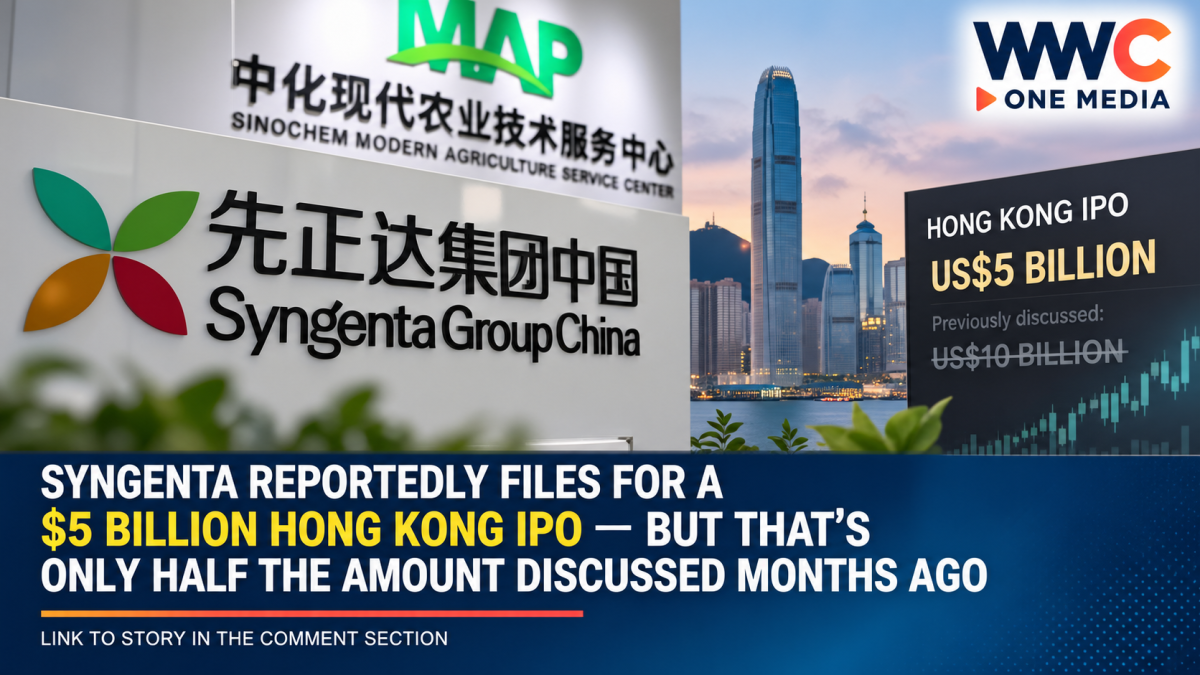
Syngenta Group, the Chinese state-owned agriculture giant with deep Swiss roots, has confidentially filed for an initial public offering in Hong Kong and is considering raising about US$5 billion, Bloomberg News reported Tuesday, citing people familiar with the matter.
If completed anywhere near that size, the offering would rank among the year’s biggest Hong Kong listings and mark a dramatic return to public markets for a company that abandoned a much larger Shanghai IPO after waiting almost three years for approval.
But there is a major caveat.
Syngenta itself has not publicly announced the filing or confirmed the fundraising target, and Reuters said it could not independently verify Bloomberg’s report.
That makes the US$5 billion number a reported target — not a final offering size.
And compared with what bankers were discussing only seven months ago, it is already a striking change.
Earlier this year, Syngenta was talking about raising as much as US$10 billion
In February, Reuters reported that Syngenta was preparing to file for a Hong Kong IPO that could raise up to US$10 billion, with a possible offering in the fourth quarter of 2026.
Sources told Reuters at the time that the company had been speaking with banks including Goldman Sachs, UBS, HSBC, Morgan Stanley and China International Capital Corp, and could sell as much as 20% of its shares depending on market conditions.
A separate Reuters report later said Syngenta planned to lodge its listing application in the second quarter, again describing a potential deal worth up to US$10 billion.
The new Bloomberg figure of around US$5 billion therefore suggests one of several possibilities.
The company may be considering a smaller initial float.
Valuation expectations may have changed.
Its owners may want to sell a smaller percentage.
Or the final structure may simply still be under negotiation.
Without a public prospectus, none of those explanations can yet be confirmed.
What appears to have changed is that the IPO process may finally be moving
That is significant because Syngenta’s listing has repeatedly been delayed, shifted and eventually abandoned.
The company first pursued an enormous domestic Chinese IPO after being acquired by Chinese state capital.
In 2021, Syngenta applied to list in Shanghai.
At one stage, it planned to raise about 65 billion yuan — roughly US$9 billion at the time — in what would have been one of China’s largest offerings in years.
But the IPO became stuck as regulators grew increasingly cautious about enormous equity deals and China’s stock market weakened.
Syngenta ultimately withdrew its application in March 2024.
The company said then that it would consider restarting the process in China or on another global exchange when conditions were right.
Hong Kong now appears to be that alternative.
Syngenta spent almost three years trying to get its Shanghai listing over the line
The abandoned Shanghai transaction is critical context.
Syngenta initially targeted the technology-focused STAR Market before moving the application toward Shanghai’s main board.
The IPO faced repeated delays as Chinese regulators scrutinized new listings and attempted to stabilize domestic equities.
Bloomberg reported in 2024 that the proposed offering had been valued around US$9 billion before Syngenta walked away.
The company’s official statement at the time was deliberately open-ended.
Syngenta said it had decided not to maintain an active Shanghai IPO application but would look to restart a listing “either in China or a different global exchange” when conditions improved.
Two years later, Hong Kong has become far more attractive.
Hong Kong’s IPO market has come roaring back
Timing could be everything.
Hong Kong has undergone a dramatic fundraising revival after several weak years.
Hong Kong Exchanges and Clearing said 87 companies raised HK$212 billion, or roughly US$27 billion, in the first half of 2026, making Hong Kong the world’s second-largest IPO venue during the period.
The momentum has continued.
Reuters reported that total IPO and follow-on fundraising reached HK$651 billion, about US$83.5 billion, during the first eight months of 2026, up 76% from a year earlier.
The boom has been fueled heavily by Chinese companies, particularly firms in advanced manufacturing, technology, semiconductors and artificial intelligence.
Syngenta would bring something different.
Agriculture.
Seeds.
Pesticides.
Biological crop products.
And a global business whose roots stretch far beyond mainland China.
A US$5 billion Syngenta deal would still be enormous
Cutting a possible offering from US$10 billion to US$5 billion does not make it small.
At US$5 billion, Syngenta would still represent a major test of international investor appetite for Chinese state-controlled companies.
It would also provide Hong Kong with a marquee global name during a year when the city has been trying to reassert itself as one of the world’s principal capital-raising centers.
That distinction matters.
A large portion of Hong Kong’s current IPO boom has involved fast-growing Chinese technology businesses.
Syngenta is different.
It is a mature multinational agricultural company with operations in more than 90 countries and more than 50,000 employees.
Its crop-protection products and seeds are used by farmers around the world.
Its management headquarters remain in Switzerland even though Syngenta Group is registered in Shanghai and ultimately controlled by Chinese state-owned Sinochem.
That combination makes the potential IPO unusually international.
Syngenta used to be a Swiss-listed company
Long before Beijing entered the picture, Syngenta was one of Switzerland’s best-known publicly traded corporations.
The modern company was created in 2000 from the agricultural businesses of Novartis and AstraZeneca.
Then came one of the most important Chinese overseas acquisitions ever attempted.
State-owned ChemChina agreed to buy Syngenta for about US$43 billion, completing the transaction in 2017 after a lengthy global regulatory review.
At the time, it was China’s largest overseas corporate takeover.
The transaction reflected Beijing’s concern over food security and its desire to acquire world-class agricultural technology, particularly in pesticides and patented seeds.
ChemChina was subsequently folded into Sinochem Holdings, leaving Syngenta ultimately under the control of one of China’s giant state-owned conglomerates.
The proposed Hong Kong listing would therefore partially reopen a business that has spent nearly a decade under full Chinese ownership to public investors.
That could matter far beyond fundraising
Reuters reported earlier this year that one strategic motivation for an IPO was to broaden Syngenta’s shareholder base and potentially reduce the proportion of Chinese state ownership at a time of increasing geopolitical tension.
That could prove particularly valuable in the United States and Europe.
Agricultural technology has become increasingly politically sensitive.
Seeds influence food security.
Crop chemicals are heavily regulated.
Biotechnology touches genetically modified crops.
And governments are paying more attention to foreign ownership of strategically important companies.
A Hong Kong listing would not suddenly make Syngenta non-Chinese.
Sinochem would remain the controlling shareholder unless a far larger stake were sold than has been publicly contemplated.
But bringing in global institutional investors could make the ownership structure broader and give the company a more market-based valuation.
There is another reason Syngenta may want billions in fresh capital: debt
The 2017 takeover created a large financing burden.
Reuters reported in February that Syngenta’s debt stood at about US$24.8 billion at the end of 2024, and people familiar with the IPO discussions said proceeds could be used partly to reduce leverage while also financing research, development and acquisitions.
That matters because agriculture is capital-intensive.
Developing new crop-protection compounds can take years.
Seed research requires substantial investment.
Biological products are becoming increasingly important.
Regulatory approvals can be expensive and lengthy.
And digital agriculture and AI are creating another investment race.
A multibillion-dollar IPO could therefore improve Syngenta’s balance sheet while preserving money for innovation.
Syngenta is coming to market with profitability improving
The timing also looks considerably better financially than it did two years ago.
Syngenta generated US$28.4 billion in sales during 2025, down just 1% year on year.
More importantly, EBITDA jumped 13% to US$4.4 billion, while its EBITDA margin improved from 13.5% to 15.4%.
The improvement followed a difficult 2024, when lower agricultural commodity prices, excess pesticide inventories and weaker emerging-market currencies pressured the entire industry.
Syngenta responded with restructuring and cost reductions.
The results began to show in 2025.
And the trend has continued into 2026.
First-half profit rose even though sales declined
For the first six months of 2026, Syngenta reported US$12.2 billion in revenue, down 2% from a year earlier.
At constant exchange rates, sales were down 7%.
That sounds weak until the profit numbers are considered.
EBITDA increased 2% to US$2.4 billion, while the EBITDA margin expanded to 19.5% from 18.6%.
Syngenta said the margin improvement reflected its deliberate move away from lower-quality revenue and toward higher-margin products.
One particularly important change was the reduction of lower-margin grain-trading operations in China.
The company has also transferred its Sinofert fertilizer stake to Sinochem, meaning the fertilizer business is no longer consolidated in Syngenta Group’s results from 2026.
That complicates year-on-year sales comparisons but also makes the company more focused as it approaches a potential listing.
Crop protection remains the cash engine
Syngenta’s biggest business remains crop protection.
Sales in that division reached US$6.6 billion in the first half of 2026, up 4% on a reported basis.
The company highlighted strong demand for newer, higher-value technologies including Plinazolin insecticides, Adepidyn fungicides and Tymirium products for nematode and fungal control.
Syngenta said it secured almost 900 new product registrations, re-registrations and label extensions during the six-month period.
That product pipeline matters enormously for any IPO valuation.
Investors buying Syngenta are not simply buying current pesticide sales.
They are buying the expectation that the company can continue developing patent-protected agricultural technologies that command premium prices.
Seeds are another major piece of the valuation
Syngenta Seeds generated US$2.5 billion in first-half sales, up 1%.
The strongest growth came from Brazil, where field-crop sales rose 18%, while Europe and Asia, Middle East and Africa also expanded.
North America was weaker as the company restructured operations and U.S. corn planting declined.
The seeds business is strategically important because proprietary genetics and crop traits can generate long-lived intellectual property and recurring farmer demand.
It is also one area in which global food-security concerns make agricultural technology increasingly geopolitical.
Syngenta is even trying to sell investors an AI story
Artificial intelligence may sound like an unusual selling point for a pesticides-and-seeds company.
Syngenta clearly disagrees.
The group has made AI a significant part of its recent corporate strategy.
Its Cropwise digital platform now incorporates AI tools for agronomy, machinery planning and farm decision-making.
The company says its AI initiatives are being deployed across product development, precision agriculture and commercial operations.
Syngenta described itself in its 2025 results as one of the agricultural-input sector’s leading AI adopters and said some projects were already generating measurable financial benefits.
That messaging is hardly accidental in a Hong Kong market currently hungry for technology and AI-related listings.
Syngenta is essentially arguing that modern agriculture is increasingly a technology business.
The IPO would also arrive under a new chief executive
Syngenta has undergone a leadership transition just weeks before the reported filing.
Hengde Qin took over as chief executive on Aug. 1, succeeding Jeff Rowe.
Qin previously served as chief operating officer and has extensive experience inside Syngenta and the wider Chinese agricultural sector.
The timing means he could become the executive responsible for guiding one of the most consequential capital-market transactions in the company’s history.
For investors, leadership continuity will matter.
Syngenta is a sprawling organization whose businesses span Switzerland, the United States, Israel and China.
Its four major units are Syngenta Crop Protection, Syngenta Seeds, ADAMA and Syngenta Group China.
Running that structure while preparing a multibillion-dollar IPO is not a minor operational task.
Investors will also ask why the proposed raise appears to have been cut in half
This may become the most closely watched question once a prospectus is made public.
In February, sources were discussing up to US$10 billion.
Now Bloomberg is reporting approximately US$5 billion.
That does not necessarily mean investor appetite has weakened.
An IPO can change size because of how much stock an owner wants to sell, market volatility, valuation expectations, cornerstone-investor demand or a decision to stage fundraising over time.
Companies also routinely float preliminary numbers before final book-building begins.
Still, the difference is large enough to matter.
A smaller transaction could mean Sinochem wants to retain tighter control.
It could reduce dilution.
It could also make the IPO easier for Hong Kong investors to absorb during an increasingly crowded listing calendar.
Hong Kong’s success may actually create a new problem: too many companies chasing the same money
The city’s IPO revival is a positive backdrop for Syngenta.
It is also creating competition.
Reuters reported that more than 500 companies were preparing Hong Kong IPOs as of September, while regulators increased scrutiny of questionable allocation and trading practices associated with the fundraising boom.
The Financial Times has reported that the flood of new Chinese technology listings has begun absorbing investor capital that might otherwise have flowed into existing shares.
That means Syngenta may be entering a very strong IPO market that is simultaneously becoming crowded.
A US$5 billion deal needs large institutional buyers.
And those investors are being offered an unusually broad menu of new Chinese stocks.
Syngenta also has a major competitor trying to go public
The timing becomes even more interesting when the agriculture industry itself is considered.
German chemicals giant BASF announced this week that it had appointed Citi, Deutsche Bank, Goldman Sachs and JPMorgan to prepare a Frankfurt IPO of its Agricultural Solutions business.
BASF wants the unit to be ready for a potential listing by mid-2027, though it has not made a final decision to proceed.
That business competes directly with Syngenta in pesticides and seeds.
Other major rivals include Bayer and Corteva.
If both Syngenta and BASF Agricultural Solutions eventually list, investors could receive two unusually large opportunities to value pure or near-pure agricultural technology businesses within months of each other.
That could make comparisons unavoidable.
Growth.
Margins.
R&D.
Debt.
Market share.
And how exposed each company is to cyclical swings in farmer income.
Farming is not a simple growth industry
Syngenta’s scale does not remove the volatility inherent in agriculture.
Farmer purchasing decisions depend heavily on crop prices.
Weather determines pesticide and seed demand.
Currency swings can significantly affect emerging markets.
Brazilian farmers are particularly important customers.
China remains a major market.
Government regulation determines whether new chemicals or genetically modified traits can be sold.
And products can lose value as patents expire or resistance develops.
Syngenta’s 2024 downturn demonstrated that even a global agricultural giant can suffer when distributors carry excessive inventory and farm economics deteriorate.
The recovery since then strengthens the IPO story.
It does not eliminate the cycle.
Food security could nevertheless be Syngenta’s strongest long-term investment pitch
The larger structural argument is much harder to ignore.
The global population continues to demand more food.
Arable land is finite.
Climate change is altering growing conditions.
Farmers face increasing pressure from pests, heat, drought and resistance to older chemicals.
Governments want greater agricultural productivity while simultaneously demanding reductions in environmental impact.
That creates demand for technologies that can produce more food with fewer resources.
Syngenta positions its seeds, crop-protection products, biologicals, precision-agriculture tools and AI platform around precisely that problem.
For long-term investors, that may make Syngenta more compelling than the average cyclical chemicals company.
But its Chinese ownership ensures politics will follow it onto the exchange
There is no separating Syngenta’s commercial story from geopolitics.
The company is globally managed and retains deep Swiss roots.
Its Seeds business is headquartered in the United States.
ADAMA is headquartered in Israel.
Its products are sold around the world.
Yet its ultimate controlling shareholder is Chinese state-owned Sinochem.
That mattered when ChemChina originally bought Syngenta for US$43 billion.
It matters even more now as governments scrutinize food security, biotechnology and Chinese investment more aggressively.
A public listing can diversify shareholders.
It cannot make those geopolitical questions disappear.
The Hong Kong route could actually be a compromise
Shanghai would have anchored Syngenta firmly within mainland China’s capital market.
A listing in New York or London would expose the company to a very different regulatory and political environment.
Hong Kong sits somewhere between those worlds.
It gives Chinese state ownership a familiar jurisdiction.
It offers access to mainland investors through market-connect mechanisms.
And it remains a globally accessible financial center where large international institutions can participate.
That combination may explain why Syngenta’s long-delayed listing effort ultimately migrated south from Shanghai rather than west to Europe or the United States.
And the story may say as much about Hong Kong as it does about Syngenta
A few years ago, convincing a US$5 billion company to list in Hong Kong would have been a major challenge.
IPO fundraising had slumped.
International financial talent was leaving.
Chinese regulatory crackdowns damaged investor confidence.
That picture has changed dramatically.
Hong Kong’s exchange recorded a 24% jump in first-half profit to a record HK$10.57 billion, helped by rising trading volumes and the IPO revival.
Financial institutions are hiring again.
Chinese companies are returning to the market.
And major issuers that previously looked toward mainland exchanges are increasingly considering Hong Kong instead.
Syngenta could become one of the most visible symbols of that recovery.
But Tuesday’s report is still only one step in a long IPO process
A confidential filing does not equal a completed listing.
Regulators must review the application.
Syngenta must decide whether market conditions justify proceeding.
Banks must build an order book.
Potential cornerstone investors may need to be secured.
A valuation must be agreed.
Sinochem must decide how much stock to sell.
And global markets must remain stable enough to absorb a transaction worth billions of dollars.
Terms can change at any stage.
An offering can be postponed.
Its size can shrink.
Its price can fall.
Or the company can decide not to proceed.
Syngenta knows that better than most companies.
It spent years preparing to list in Shanghai and ultimately withdrew.
That is why the most important number is not US$5 billion yet
The real milestone is the reported filing itself.
If Bloomberg’s sources are correct, Syngenta has moved beyond years of speculation and into the formal Hong Kong listing process.
That would bring it closer than at any point since 2024 to becoming a publicly traded company again.
And the backdrop looks considerably stronger this time.
Hong Kong fundraising is booming.
Syngenta’s profitability has recovered.
Its margins are improving.
Its portfolio is becoming more focused.
The company is emphasizing innovation, biologicals and AI.
And investors are once again willing to write very large checks for major Asian listings.
But one mystery remains.
Only seven months ago, people involved in the deal were talking about a Syngenta IPO worth up to US$10 billion.
Today, the number being discussed is about US$5 billion.
Until Syngenta publishes an actual prospectus, investors will not know whether that smaller number reflects strategy, valuation, ownership preferences — or simply another chapter in an IPO that has already been rewritten several times.
And after one failed US$9 billion Shanghai listing, that may be the real question surrounding Syngenta’s latest attempt:
Is Hong Kong finally where one of China’s biggest overseas acquisitions becomes public again — or is the company still negotiating what that return is worth?


Leave a Reply