
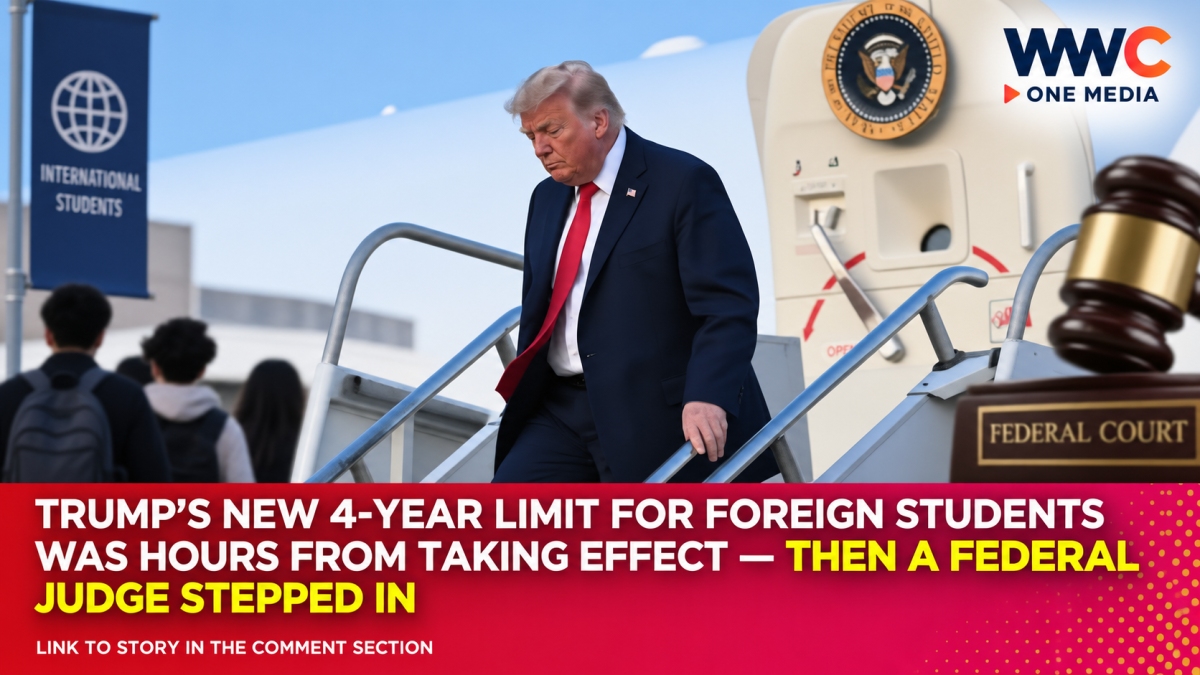
WASHINGTON — Thousands of international students, researchers and foreign journalists were preparing for one of the biggest changes to U.S. immigration rules in decades.
Then, just hours before the new system was supposed to begin, a federal judge stopped it.
U.S. District Judge F. Dennis Saylor IV in Boston on Monday, September 14, issued a preliminary injunction blocking the Trump administration from implementing a Department of Homeland Security rule that would replace the longstanding flexible admission system for foreign students, exchange visitors and journalists with fixed periods of stay.
The regulation had been scheduled to take effect September 15, 2026.
For now, the existing “duration of status” framework survives.
But the ruling is not the end of the fight.
The judge has temporarily halted implementation while the courts determine whether DHS lawfully adopted the sweeping policy change.
What the Trump administration wanted to change
For decades, many international students entering the United States on F visas and exchange visitors on J visas have generally been admitted for “duration of status,” often abbreviated as D/S.
Instead of receiving a fixed immigration expiration date, they can remain while they continue complying with the requirements of their approved academic or exchange program.
That arrangement has existed in broadly similar form for nearly five decades.
DHS wanted to replace it with a much more rigid system.
Under the final rule published in July, F-1 students and J-1 exchange visitors would generally receive admission based on their program length but for no more than four years.
Anyone needing longer — including many doctoral students and researchers — would have to formally apply to U.S. Citizenship and Immigration Services for an extension of stay.
That distinction sounds bureaucratic.
For universities and foreign students, it could have been enormous.
A PhD does not necessarily fit neatly into four years
One reason universities fought the rule is simple: many U.S. academic programs routinely take longer than four years.
Comments submitted during the federal rulemaking process noted that the average time to complete some engineering PhDs is around 6.7 years, while science doctorates can average around 6.1 years.
DHS acknowledged that students frequently need longer than four years, arguing that the new system would not force them to finish within four years because they could request extensions instead.
Critics said that answer missed the point.
A student working on a five- or six-year doctorate would face an additional immigration adjudication simply to continue a degree program in which the student was already enrolled.
If an extension were delayed or denied, the consequences could affect not only the student but also university laboratories, research teams, teaching assignments and employers.
The rule also would have cut the post-study grace period
The final regulation contained another important change.
F-1 students who completed their studies or authorized practical training would generally have received a 30-day departure period, down from the longstanding 60 days in many situations.
DHS argued 30 days was adequate and more consistent with other nonimmigrant categories.
Universities and immigration advocates warned that the shorter window could complicate graduation, Optional Practical Training applications, employment transitions and moves between degree programs.
For students already navigating graduation, job offers and immigration paperwork simultaneously, those extra 30 days can matter.
Journalists faced an even shorter clock
The policy was not limited to universities.
Foreign journalists working in the United States under I visas would generally have been admitted for no more than 240 days at a time.
Journalists needing longer assignments could apply for extensions.
The rule was even stricter for many journalists carrying passports from mainland China.
Their initial admission and individual extensions would generally have been limited to 90 days, with Hong Kong and Macau passport holders excluded from that particular restriction.
China condemned the new limits in July as discriminatory and threatened countermeasures.
For international news organizations, critics argued the system could create additional bureaucracy for correspondents assigned to cover the United States for long periods.
DHS said the old system created security and fraud risks
The Trump administration defended the changes as necessary for stronger immigration oversight.
DHS argued that admitting people without a specific expiration date made it harder for authorities to periodically reassess whether foreign students, exchange visitors and journalists were continuing to comply with immigration requirements.
Under the new regime, people seeking to stay beyond their authorized period would have been required to submit extension applications, giving DHS additional opportunities to review their status.
The government also cited concerns involving visa fraud, overstays and national security.
The administration has described some long-term students as effectively remaining enrolled indefinitely to preserve immigration status.
But Judge Saylor was unconvinced that DHS had adequately justified such a dramatic restructuring.
Judge calls government’s justification exceptionally weak
Saylor ruled in favor of a coalition of education groups and labor organizations that sued DHS in August.
According to Reuters, he characterized the rationales DHS offered for changing the decades-old system as “exceptionally weak.”
The judge found that plaintiffs were likely to succeed on arguments that DHS had not adequately responded to major concerns surrounding the rule or seriously considered less burdensome alternatives.
During earlier oral arguments, Saylor had also questioned the connection between the national-security incidents cited by the government and the sweeping visa-policy change.
He noted that the government had identified only a handful of incidents over decades while proposing a system affecting a vast population of legitimate students and scholars.
That became a central weakness in the government’s case at the preliminary-injunction stage.
Universities warned of massive financial consequences
Saylor also focused on the impact the policy could have on American higher education.
Research universities including MIT and Harvard enroll large numbers of international students, particularly in graduate and doctoral programs.
The judge concluded institutions could face hundreds of millions of dollars in costs and falling enrollment if the rule took effect, and described potential damage to U.S. higher education and the broader economy as potentially “catastrophic.”
That concern is backed by the sheer scale of international education in the United States.
The Institute of International Education reported that American colleges and universities hosted a record 1,177,766 international students in the 2024-25 academic year.
They represented about 6% of the U.S. higher-education population.
More than half were studying in STEM fields.
That makes international students particularly important to American graduate science, engineering and technology programs.
International students are also an economic force
The debate extends well beyond university tuition.
NAFSA estimates that international students contributed about $42.9 billion to the U.S. economy in the 2024-25 academic year and supported more than 355,000 jobs.
Their spending flows through housing, restaurants, transportation, retail, telecommunications, health insurance and other sectors surrounding university communities.
The industry was already expecting a difficult 2026.
NAFSA projected last month that the United States could lose as many as 111,000 international students this fall, potentially cutting about $3.4 billion in economic activity and nearly 40,000 jobs amid visa-processing problems and immigration-policy uncertainty.
Those estimates come from an education advocacy organization and remain projections rather than confirmed losses.
But they illustrate why universities see immigration rules as an economic competitiveness issue rather than merely an administrative one.
The plaintiffs included universities’ allies — and journalists’ unions
The lawsuit was filed on August 18 by a coalition including the Presidents’ Alliance on Higher Education and Immigration, NAFSA: Association of International Educators, the Association of Independent Colleges and Universities in Massachusetts, the American Federation of Teachers, UAW-affiliated groups and The NewsGuild-CWA.
The plaintiffs argued that DHS violated the federal Administrative Procedure Act.
Among their claims: the agency failed to properly assess the rule’s costs and benefits, did not adequately address public comments, neglected less burdensome alternatives and exceeded its authority.
The government rejected those claims and defended its authority to impose fixed admission periods.
The underlying case remains unresolved.
So what happens to students on September 15?
This is the most important practical point.
The new rule does not take effect on September 15 while the preliminary injunction remains in force.
Foreign students and exchange visitors therefore do not suddenly switch to the new four-year fixed-admission system merely because the original effective date has arrived.
The longstanding duration-of-status regime remains operative for now.
That means international students should not assume that their immigration status automatically received a new September 2030 cutoff or another fixed deadline under the blocked rule.
Universities had spent weeks preparing students for precisely that possibility.
Georgia Tech, for example, had warned students that those maintaining F or J status on September 15 would have received new “admit until” dates based on their program documents, with a maximum period extending four years from implementation.
The injunction halted that transition before it began.
But students should not assume the rule is dead
A preliminary injunction is powerful, but it is temporary.
Judge Saylor has effectively determined that the plaintiffs have made a sufficiently strong case, and that allowing the policy to take effect while litigation proceeds could cause irreparable harm.
He has not issued a final judgment permanently invalidating the entire regulation.
The Trump administration can continue defending the rule in district court.
It could also seek appellate review of the injunction.
That means the fixed-period system could potentially return if the government ultimately prevails or secures relief from a higher court.
For foreign students planning multi-year degrees, that uncertainty itself has consequences.
A student considering a six-year doctorate beginning in 2027 has to think not only about tuition, research opportunities and housing, but also about whether U.S. immigration rules may change midway through the program.
The fight is bigger than a four-year cap
The case reflects a much larger argument over what international education should look like in the United States.
The Trump administration sees greater immigration review as a way to strengthen oversight and reduce opportunities for abuse.
Universities argue that excessive uncertainty and bureaucracy make America less attractive to the world’s strongest students and researchers.
That competition matters because the U.S. is not the only country trying to recruit global talent.
Canada, Britain, Australia, Germany and other nations actively compete for international students, researchers and highly skilled graduates.
If students believe the American system has become unpredictable, universities fear some will simply choose another country.
And once researchers establish laboratories, careers and professional networks elsewhere, attracting them back can be considerably harder.
Journalists face a parallel concern
For international media organizations, the principle is similar.
News outlets often station correspondents in Washington, New York and other U.S. cities for several years.
Those reporters build sources, develop specialist knowledge and provide audiences abroad with sustained coverage of American politics, diplomacy, economics and society.
Requiring repeated extensions every 240 days would not necessarily prevent that reporting.
But it would create additional immigration checkpoints at which a journalist’s ability to remain and work in the country must be reconsidered.
Press unions involved in the lawsuit argue that such uncertainty could interfere with foreign media operations.
DHS counters that most I-visa holders remain in the United States for less than 240 days and that journalists needing longer stays could apply for extensions.
That disagreement now remains for the courts to examine more fully.
A rule years in the making stopped one day before launch
The Trump administration first pursued a similar fixed-admission concept during its first term.
The latest version progressed much farther.
DHS issued the proposal in 2025.
A final rule was published on July 17, 2026.
Universities began preparing students for implementation.
The September 15 effective date approached.
Then, on September 14, the federal court intervened.
For international students and journalists, that timing made Monday’s order especially dramatic.
They did not receive months to adjust to another change.
They received a court ruling essentially at the deadline.
The immediate answer is clear — the long-term one is not
For now:
The old system stays.
The four-year student cap is paused.
The 240-day general journalist limit is paused.
The additional extension requirements tied to the new system are paused.
But none of that guarantees they are gone forever.
The legal battle over whether DHS can fundamentally rewrite the way America admits foreign students, exchange visitors and international journalists is still alive.
That makes Monday’s ruling both a major victory for universities and only the opening phase of a much larger immigration fight.
Foreign students were hours away from entering a radically different U.S. visa system. A judge stopped the clock — but whether it starts running again may now depend on the next court.


Leave a Reply