
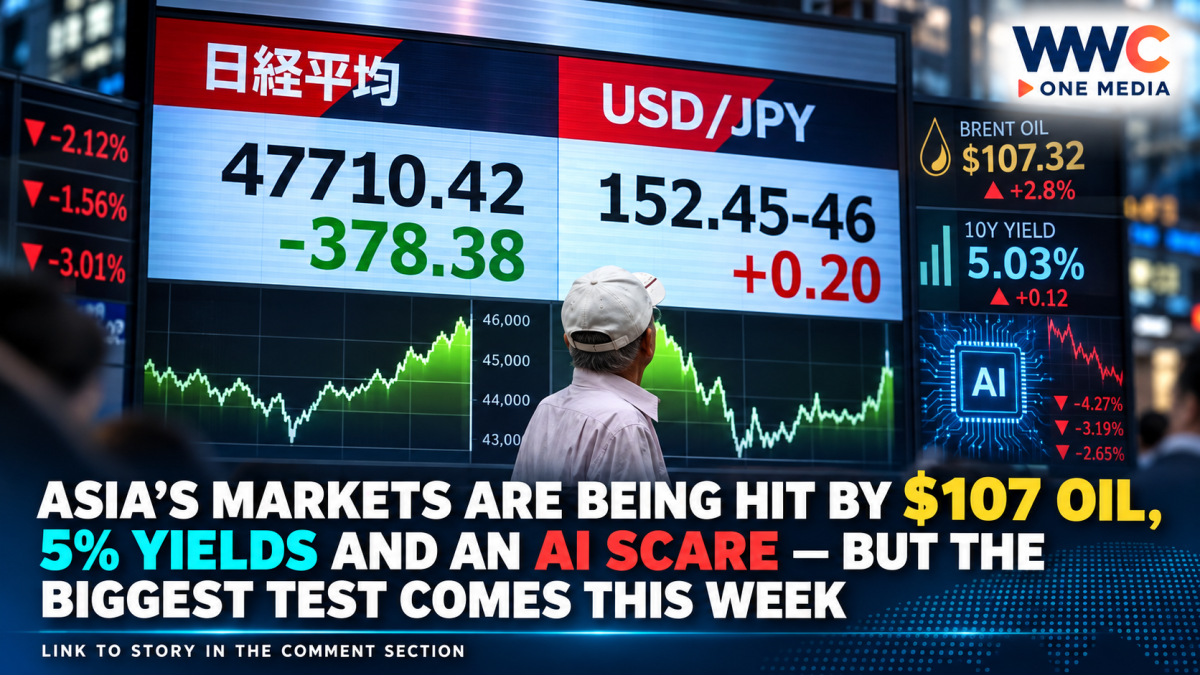
TOKYO — Asian markets struggled to find direction Tuesday as investors faced an unusually combustible mix of rising oil prices, surging government-bond yields, renewed doubts over the artificial-intelligence boom and the prospect of interest-rate increases from both the U.S. Federal Reserve and the Bank of Japan.
South Korea provided one of the clearest examples of the uncertainty.
The benchmark KOSPI initially fell nearly 1% before recovering, gaining 0.15% to 6,694.11 in early afternoon trading as bargain hunters returned to beaten-down semiconductor stocks.
That tentative rebound followed a brutal Monday session in which the KOSPI plunged 3.26%, extending its decline to a third straight day as investors dumped technology and AI-linked shares.
Across the broader region, however, there was little sign that investors were ready to declare the selloff over.
MSCI’s broadest gauge of Asia-Pacific shares outside Japan slipped around 0.12%, while Japan’s Nikkei reversed early losses to trade approximately 0.19% higher.
The problem is that Asia is no longer dealing with just one market threat.
It is dealing with several at once.
Oil is back above $100 — and inflation fears are back with it
Brent crude climbed another 1.21% to $106.96 a barrel, while U.S. crude rose 1.27% to $102.68 as investors reacted to escalating security concerns in the Middle East.
Yemen’s Iran-aligned Houthi forces launched another attack on Saudi Arabia after Riyadh blamed Iran-backed Iraqi fighters for an earlier strike on the kingdom’s East-West oil pipeline.
Saudi authorities have said disruptions involving the pipeline could affect infrastructure linked to as much as 4% of global oil supply, while Gulf Arab states also postponed planned talks with Iran.
That is bad news for markets for a simple reason.
Oil above $100 does not stay confined to petrol stations.
Higher energy prices can raise costs for airlines, factories, shipping companies, chemical producers, farmers and ultimately consumers.
That makes it harder for central banks to declare victory over inflation — and increases the risk that interest rates remain higher for longer.
Mitsubishi UFJ Bank analyst Yokoo Akihiko said markets are increasingly focused on the possibility that expensive crude will add to inflation and, in turn, force borrowing costs even higher.
Then the U.S. 10-year yield hit 5%
The bond market is reinforcing that message.
The benchmark 10-year U.S. Treasury yield briefly touched 5% Monday, its highest level since 2023.
Germany’s equivalent yield rose above 3.51%, the highest since 2009, while Japan’s 10-year government-bond yield moved back to around 3% Tuesday.
Those numbers matter far beyond bond desks.
Government yields serve as reference points for borrowing costs across global financial markets.
When the supposedly low-risk return available from Treasury bonds rises toward 5%, investors have less incentive to pay extremely high valuations for stocks — particularly technology companies whose profits may be expected years into the future.
That creates an especially uncomfortable environment for AI shares.
The AI boom suddenly has a new problem
Technology stocks were already vulnerable before yields climbed.
A fresh debate erupted after Anthropic CEO Dario Amodei called for the industry to slow the pace of AI development, citing safety concerns.
The comments triggered selling across AI-linked shares.
On Monday, South Korea’s KOSPI fell about 3.3%, while the U.S. Nasdaq lost 0.8%. Semiconductor companies absorbed some of the heaviest pressure as traders considered what slower AI development could mean for spending on chips and data centers.
The debate matters enormously for Asian markets.
South Korea, Japan and Taiwan host many of the companies supplying the memory chips, manufacturing equipment, components and materials powering the global AI buildout.
If hyperscalers and AI developers significantly slow investment, companies supplying that infrastructure could feel the impact much faster than software firms.
That helps explain why South Korean equities have become particularly sensitive to any change in sentiment surrounding AI.
KOSPI tries to recover — but Samsung remains under pressure
Tuesday brought at least some bargain hunting.
After falling nearly 1% early in the session, South Korea’s index reversed course.
But individual semiconductor stocks remained mixed.
Samsung Electronics fell around 0.2%, while Japanese memory-chip company Kioxia gained 3.3%.
Monday’s sharp KOSPI decline had capped a three-session losing streak, making some technology shares cheaper and tempting investors back into the market.
That does not necessarily mean confidence has returned.
It may simply mean traders believe Monday’s reaction was too violent.
Reuters analysts offered sharply different interpretations of the AI selloff.
Some argued that a slowdown in AI infrastructure spending could materially hit chipmakers and equipment suppliers.
Others described the decline as a knee-jerk reaction and a possible buying opportunity, arguing there was little evidence yet that major technology companies were actually abandoning their AI investment plans.
That disagreement is exactly why the market remains volatile.
The Fed could raise rates Wednesday
The next major test arrives in Washington.
The Federal Reserve began its two-day policy meeting Tuesday, with financial markets pricing roughly a 90% probability of a quarter-point interest-rate increase on Wednesday.
Such a move would be the Fed’s first rate hike since mid-2023.
That represents a remarkable reversal.
Only days earlier, many economists expected policymakers to leave rates unchanged.
But hotter inflation data, resilient economic activity and surging oil prices have rapidly shifted expectations.
Major banks including Goldman Sachs, JPMorgan, HSBC and Deutsche Bank have moved toward forecasting a September increase.
Morgan Stanley expects the Fed to raise rates by 25 basis points this week and again in December.
Its analysts pointed to the possibility of second-round effects from higher energy costs, powerful AI-related investment demand and concerns that the Fed could lose credibility if inflation remains above target.
But because a September increase is already heavily priced into markets, the rate decision itself may not be the biggest event.
Investors want to know what the Fed says next.
Does it signal one defensive hike?
Or the beginning of another tightening cycle?
The answer could have major consequences for stocks, bonds and currencies across Asia.
Then comes the Bank of Japan
Just two days after the Fed decision, investors face another major event.
The Bank of Japan is widely expected to raise its benchmark policy rate by 25 basis points to 1.25% on Friday, September 18.
That would take Japanese interest rates to their highest level in 31 years.
The BOJ only raised its policy rate to 1% in June.
Another move just three months later would signal that Japan’s central bank is becoming more aggressive in responding to inflation after decades of ultra-low borrowing costs.
Reuters sources say BOJ policymakers are increasingly concerned that expensive energy, previous yen weakness and domestic wage pressures could keep inflation elevated.
Annual Japanese wholesale inflation reached 7.6% in August, further intensifying those concerns.
The BOJ projects core consumer inflation of around 2.5% in the fiscal year ending March 2027 and 2.4% the following year before easing toward 2%.
A rate hike to 1.25% is widely expected.
What markets do not know is how quickly Governor Kazuo Ueda could tighten again.
That uncertainty matters particularly for the yen and Japanese stocks.
The yen adds another layer of risk
The dollar strengthened around 0.17% Tuesday to approximately 154.61 yen.
The broader dollar index stood near 99.53.
Japan’s currency has already become a major policy concern.
The yen had previously fallen to levels that prompted coordinated intervention involving Japanese and U.S. authorities, after which it rebounded significantly.
The BOJ is now trying to balance two risks.
Tighten too slowly and renewed yen weakness could make imported oil and food more expensive.
Tighten too aggressively and the bank risks destabilizing Japan’s economy and financial markets after decades in which investors became accustomed to near-zero interest rates.
That makes Friday’s message almost as important as the rate increase itself.
China has now added another warning sign
Another major piece of economic data arrived after the initial Asian-market snapshot Tuesday.
China reported that industrial production rose 5.2% from a year earlier in August, improving from 4.5% growth in July.
At first glance, that appears encouraging.
But beneath the headline, domestic demand looked much weaker.
Retail sales increased just 0.4%, below forecasts, while fixed-asset investment fell 7.2% during the first eight months of the year.
That creates another problem for regional equities.
China’s factories are producing more, helped partly by overseas demand and technology exports, but Chinese consumers remain cautious and businesses are reluctant to invest.
The property market is also still struggling.
New-home prices fell 0.1% in August from the previous month and were about 3% lower than a year earlier, according to Reuters calculations based on official data.
For Asian exporters that depend on Chinese consumers and businesses, stronger factory output does not entirely compensate for weak domestic spending.
Asia now faces an unusual combination of risks
The forces pressing on markets would each normally deserve attention on their own.
This week, they are arriving together:
- Brent crude near $107
- U.S. Treasury yields around 5%
- A possible Federal Reserve rate increase Wednesday
- A likely Bank of Japan hike Friday
- New concerns about whether AI development will slow
- Weak Chinese consumption and investment
That combination makes it much harder for investors to decide where the safest returns are.
If oil keeps climbing, inflation could worsen.
If central banks respond with more aggressive rate hikes, bond yields could climb further.
If yields rise, richly valued technology shares face more pressure.
And if AI investment slows at the same time, one of the biggest engines behind Asian equity gains could weaken.
The KOSPI’s rebound may therefore be only the beginning
Tuesday’s tentative recovery in South Korea may look reassuring after Monday’s 3.26% plunge.
But the next several days could matter much more than a single session.
The Fed speaks Wednesday.
The BOJ decides Friday.
Oil markets remain exposed to developments in the Middle East.
And investors are still trying to determine whether calls to slow AI development amount to a genuine change in industry strategy or merely another bout of market anxiety.
That leaves Asia at an unusual crossroads.
The KOSPI has already shown that buyers are willing to step back in after a sharp selloff. What nobody knows yet is whether those bargain hunters are buying the bottom — or simply buying before the next shock arrives.




Leave a Reply