
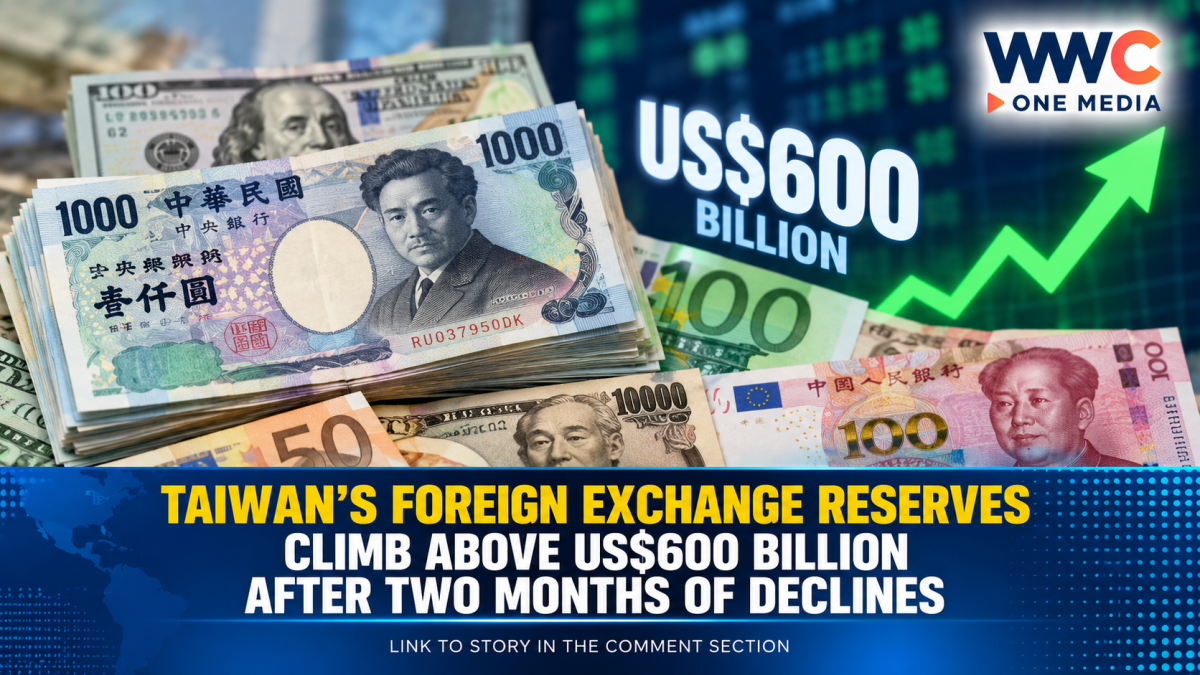
TAIPEI, Taiwan — Taiwan’s foreign exchange reserves climbed back above the US$600 billion mark in August, ending two consecutive months of declines as investment gains, a weaker US dollar and central bank intervention boosted the country’s holdings.
Taiwan’s foreign exchange reserves rose by US$7.633 billion from July to US$601.904 billion, marking the largest monthly increase in more than a year, the Central Bank of the Republic of China (Taiwan) said.
The rebound came after two months of falling reserves and reflected a combination of favorable market movements and gains from the central bank’s management of its foreign currency assets.
Investment Gains and Currency Movements Drive Rebound
Department of Foreign Exchange Director-General Eugene Tsai said the increase was mainly driven by investment returns on the central bank’s foreign currency assets, the appreciation of major currencies against the US dollar and intervention in the foreign exchange market to maintain orderly trading.
The US Dollar Index fell 0.49 percent in August, while several major currencies strengthened against the greenback.
The euro and British pound each gained 0.68 percent, while the Canadian dollar rose 0.91 percent. The Japanese yen advanced 0.49 percent, and China’s yuan appreciated 0.35 percent, according to central bank data.
New Taiwan Dollar Leads Major Currency Gains
The New Taiwan dollar emerged as the strongest performer, appreciating 2.51 percent against the US dollar during August.
Tsai said foreign investors recorded net inflows of approximately US$1.2 billion into Taiwan as investors sought opportunities in the local stock market.
To help maintain stability in the foreign exchange market, the central bank intervened by purchasing US dollars and selling New Taiwan dollars to moderate the US currency’s decline against the local currency.
The central bank did not disclose the amount involved in its August intervention. Taiwan’s central bank and the US Department of the Treasury previously agreed that intervention figures would be released quarterly.
Foreign Investors’ Taiwan Holdings Surge to US$1.861 Trillion
Central bank data also showed a sharp increase in the value of Taiwan assets held by foreign investors.
As of the end of August, foreign investors held approximately US$1.861 trillion in Taiwan-listed stocks, bonds and New Taiwan dollar-denominated deposits.
That was up significantly from US$1.663 trillion at the end of July.
The value of those holdings represented 309 percent of Taiwan’s total foreign exchange reserves, compared with 280 percent a month earlier.
The increase was supported by a strong rebound in Taiwan’s stock market, with the TAIEX rising 6.98 percent during August.
Taiwan’s Markets Continue to Benefit From AI Investment
Taiwan’s financial markets have been attracting increasing attention as the global artificial intelligence boom drives demand for semiconductors and technology-related investments.
The island’s technology industry remains central to global supply chains, particularly in advanced chip manufacturing and AI hardware.
Taiwan Semiconductor Manufacturing Co and other major technology companies have helped fuel investor interest in the local market, while the government is also seeking to expand Taiwan’s role as a regional financial and asset-management center.
President William Lai recently said Taiwan aims to turn its industrial strength into greater financial influence and international competitiveness as the country develops its ambition to become an Asian asset-management hub.
What the Rising Reserves Mean for Taiwan
Foreign exchange reserves are overseas assets held by a central bank that can be readily deployed when needed. They typically include foreign currency deposits, government securities and other highly liquid assets.
Large foreign exchange reserves can help a country manage financial shocks, stabilize its currency and maintain confidence in its financial system.
Taiwan’s return above the US$600 billion level highlights the scale of the financial resources available to its central bank, even as currency markets continue to be influenced by changing expectations over global interest rates, economic growth and geopolitical developments.
However, the latest figures also underline Taiwan’s significant exposure to global financial markets.
With foreign investors holding assets worth more than three times the country’s foreign exchange reserves, major movements in international capital flows and equity markets could have a substantial impact on Taiwan’s financial environment.
Central Bank Keeps Watch on Currency Markets
The central bank said currency movements ultimately depend on individual supply-and-demand conditions.
Tsai said it remained unclear whether the Japanese yen’s recent appreciation was caused by official intervention or short-covering, noting that the yen has unique characteristics as both a major international currency and a traditional safe-haven asset.
The yen is also widely used in carry trades, meaning sharp movements can influence other currencies and broader financial markets.
For Taiwan, the central bank’s immediate priority remains maintaining orderly conditions in the foreign exchange market.
After two months of declining reserves, August delivered a significant reversal.
Taiwan’s foreign exchange reserves are once again above US$600 billion — supported by investment gains, a weaker US dollar, strong foreign inflows and a rebound in the country’s stock market.
WWC ONE MEDIA J.M.D




Leave a Reply