
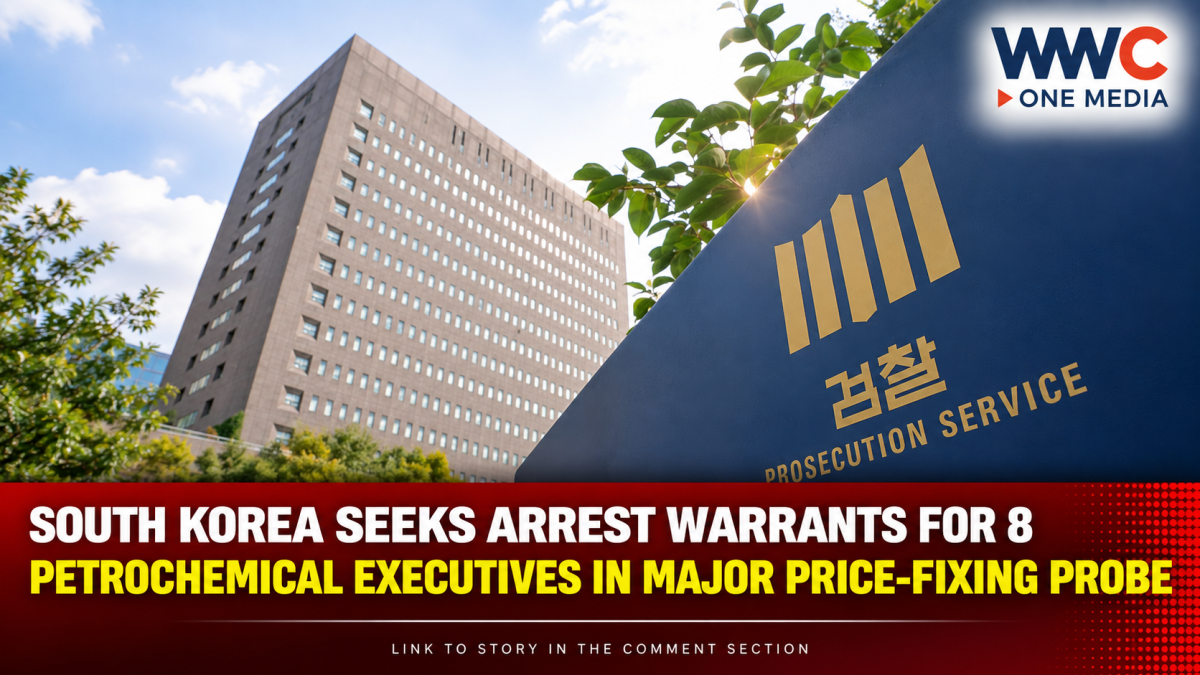
SEOUL — South Korean prosecutors have requested arrest warrants for eight current and former petrochemical executives accused of participating in a years-long price-fixing scheme involving several major industrial chemicals.
The Seoul Central District Prosecutors’ Office made the move Monday, September 14, as investigators intensified a probe into allegations that seven major petrochemical companies coordinated prices on eight products, potentially generating illicit profits worth trillions of won.
The suspects include OCI CEO Kim Yoo-shin and former PKC CEO Jang Young-soo, according to prosecutors.
Seven Companies Under Investigation
The companies named in the investigation are LG Chem, Hanwha Solutions, Aekyung Chemical, OCI, Lotte Fine Chemical, PKC and Unid.
Prosecutors suspect executives from the companies coordinated to raise or maintain prices for petrochemical products over several years.
The products under investigation include polyvinyl chloride (PVC), plasticizers, caustic soda, hydrochloric acid, chlorine, hypochlorite, TDI and ECH.
PVC is widely used in construction materials, pipes and wire insulation, while plasticizers are added to PVC and other materials to make them softer and more flexible.
Because these chemicals are used throughout construction and manufacturing, coordinated price increases can potentially affect costs far beyond the petrochemical industry.
Prosecutors Allege Trillion-Won Gains
Investigators suspect the companies took advantage of disruptions in naphtha supplies following conflict in the Middle East to coordinate prices and increase their profits.
According to prosecutors, the alleged scheme generated several trillion won in illicit gains.
The investigation escalated on August 5, when prosecutors simultaneously searched the seven companies. More than 80 individuals connected to the case were reportedly subject to investigation, while executives were subsequently summoned for questioning.
Reuters reported at the time that the raids formed part of a broader government effort to investigate alleged practices that could contribute to higher prices for petroleum-related products.
Executives Questioned as Probe Intensifies
The latest development follows questioning earlier this month.
Prosecutors questioned Kim and Jang, along with other executives, as investigators sought to establish how the alleged coordination was organized and whether senior executives were directly involved.
The request for arrest warrants represents a significant escalation, but it does not mean the executives have been found guilty. A court will determine whether the warrants should be issued.
The companies and individuals involved remain subject to the ongoing legal process.
Why the Case Matters
The investigation has attracted attention because of the size of the companies involved and the number of petrochemical products allegedly affected.
Petrochemicals are foundational materials for countless industries. PVC, for example, is used in everything from construction products to electrical applications, meaning sustained price increases can potentially ripple through supply chains.
The case also comes at a time when geopolitical instability has already created uncertainty around energy and raw-material supplies.
For prosecutors, the central question is whether companies merely responded independently to supply disruptions—or whether executives coordinated their actions in violation of South Korea’s competition laws.
That distinction could determine the next stage of the investigation.
What Happens Next?
The immediate issue is whether a court will approve the requested arrest warrants.
If warrants are issued, prosecutors could detain and further investigate the executives while building a potential case for prosecution. If they are rejected, the broader investigation can still continue.
For now, prosecutors are alleging a large-scale collusion scheme—not announcing a final judgment.
The case could ultimately become one of South Korea’s most significant recent corporate price-fixing investigations, particularly if investigators establish that coordinated pricing affected multiple major petrochemical markets over an extended period.
And as prosecutors pursue the executives, the biggest question remains unanswered: how far up the corporate chain did the alleged price-fixing scheme reach?




Leave a Reply