
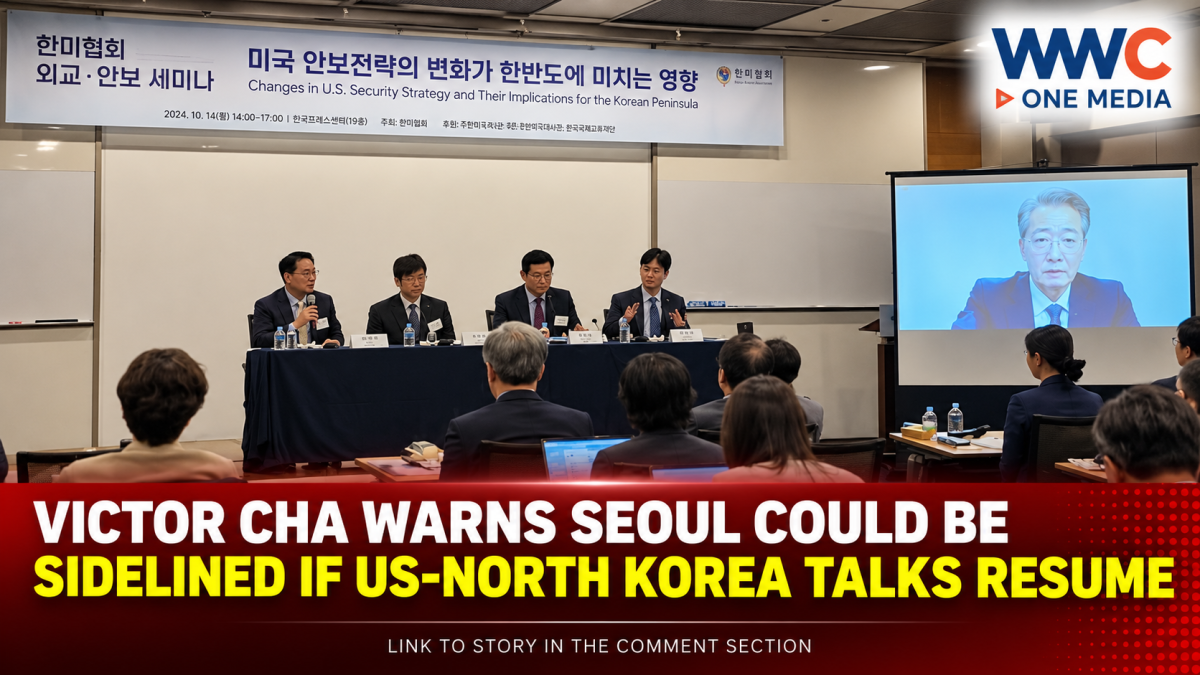
SEOUL — South Korea could face a difficult diplomatic position if Washington and Pyongyang restart direct negotiations, with veteran Korea analyst Victor Cha warning that Seoul may struggle to secure a seat at the table.
Cha, the Korea Chair at the Center for Strategic and International Studies (CSIS), has raised concerns that North Korean leader Kim Jong-un would have little interest in allowing South Korea to participate directly in renewed talks with Washington.
The potential scenario has become known in policy circles as “Korea passing”—a situation in which major decisions affecting the Korean Peninsula are negotiated between the United States and North Korea while Seoul finds itself on the sidelines.
Why Seoul Could Be Left Out
Cha has argued that North Korea could actively seek to exclude South Korea if direct talks with Washington restart.
In his assessment, Pyongyang continues to hold South Korea responsible for contributing to the failure of the 2019 Hanoi summit between then-U.S. President Donald Trump and Kim. North Korea’s position toward Seoul has also hardened significantly in recent years.
That creates a complicated situation for the South Korean government: Seoul would have a direct stake in any agreement involving North Korea’s nuclear program, sanctions, military posture or a potential peace arrangement, but Pyongyang may not want Seoul involved in negotiations.
Cha has therefore warned that South Korea’s ability to participate could depend heavily on whether Washington chooses to insist on Seoul’s involvement.
Trump Still Interested in Talking to Kim
The possibility of renewed diplomacy cannot be dismissed.
U.S. President Donald Trump has repeatedly expressed an interest in reengaging with Kim, while North Korea has so far shown little enthusiasm for returning to the negotiating table.
Yonhap reported in 2025 that analysts viewed a renewed Trump-Kim meeting as possible, particularly around major diplomatic gatherings, although Pyongyang’s growing relationship with Russia and China could reduce Kim’s incentive to negotiate with Washington.
More recently, Cha himself has examined the possibility of another Trump-Kim summit, arguing that changing strategic circumstances could potentially create an opening for renewed diplomacy.
That does not mean a summit is imminent. Rather, the possibility of renewed engagement is enough for South Korean policymakers to consider what could happen if Washington and Pyongyang begin talking again.
North Korea’s Position Has Changed
Any new U.S.-North Korea negotiations would also take place under very different circumstances from the first Trump administration.
North Korea has strengthened its strategic relationship with Russia, while its ties with China remain important. At the same time, Pyongyang has continued expanding its nuclear and missile capabilities and has increasingly rejected the idea of improving relations with Seoul.
That means a future negotiation could be substantially different from the Trump-Kim summits of 2018 and 2019.
Analysts have also debated whether Washington should continue insisting on complete denuclearization or pursue more limited agreements aimed at reducing nuclear and missile risks. Yonhap reported in July that the debate over how to address North Korea’s nuclear capabilities has intensified amid stalled diplomacy.
Seoul Faces a Diplomatic Test
For South Korea, the challenge is not simply getting Washington and Pyongyang to talk.
It is ensuring that any agreement reached between the two countries does not undermine Seoul’s own security interests.
Issues such as military exercises, U.S. troop deployments, sanctions, nuclear weapons and a possible peace arrangement would have direct consequences for South Korea—even if Seoul were not formally included in every negotiating session.
Recent tensions surrounding the U.S.-South Korea alliance have made the issue even more sensitive. Changes to joint military exercises and Washington’s broader efforts to engage Pyongyang have raised questions about how Seoul can maintain influence while also preserving its security relationship with the United States.
The Bigger Risk for South Korea
The prospect of “Korea passing” highlights a fundamental diplomatic dilemma.
Seoul needs Washington’s security commitment, but it also needs a direct voice in negotiations over the future of the Korean Peninsula.
If Trump and Kim eventually return to the negotiating table, South Korea will likely push strongly to ensure that it is not merely informed about the outcome—but involved in shaping it.
For now, however, renewed U.S.-North Korea talks remain a possibility rather than a confirmed diplomatic process.
And that uncertainty may be precisely why Cha’s warning matters: Seoul may need to prepare for a diplomatic opening before it knows whether that opening will include South Korea.

Leave a Reply