
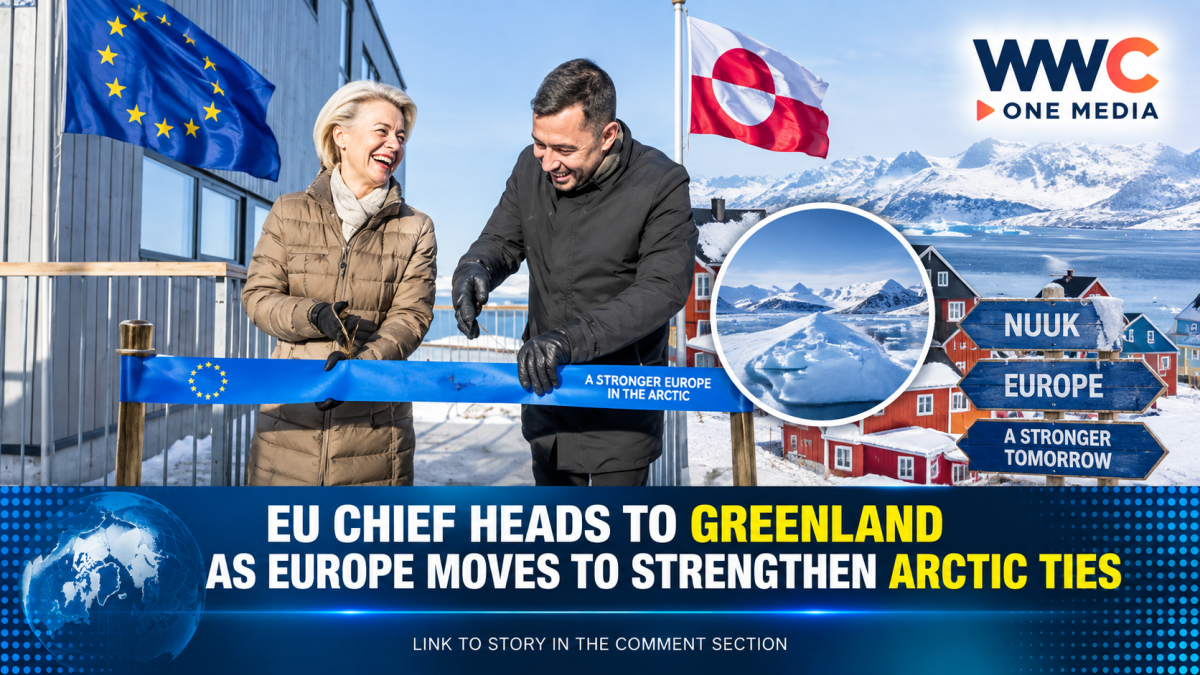
NUUK, Greenland — European Commission President Ursula von der Leyen has arrived in Greenland for a two-day visit aimed at strengthening ties between the European Union and the strategically vital Arctic territory, as geopolitical competition over the region continues to intensify.
Von der Leyen is due to sign a joint declaration with Greenlandic leaders, reinforcing the EU’s long-term political and economic commitment to the Danish autonomous territory.
The visit comes as Greenland’s strategic importance continues to grow, driven by its location in the Arctic, its vast reserves of critical raw materials and its increasingly important role in regional security.
“Greenland is becoming increasingly important to the EU as a gateway to the Arctic and because of its geopolitical location, critical raw materials and role in Arctic security,” Royal Danish Defence College researcher Marc Jacobsen said.
Visit Comes as Global Interest in Greenland Grows
Greenland has become the focus of growing international attention as major powers look toward the Arctic for security, trade routes and access to natural resources.
US President Donald Trump has repeatedly argued that Washington needs greater control over Greenland for national security reasons, although he later ruled out annexing the territory by force.
A Danish-Greenlandic-US working group has since held regular meetings to discuss future cooperation.
Trump’s earlier statements prompted a strong show of support for Greenland and Denmark from European countries.
In January, von der Leyen pledged what she described as “massive” EU investment to strengthen Greenland’s security and Europe’s broader presence in the Arctic.
EU Plans Major Financial Support
Although Greenland is part of the Kingdom of Denmark, it is not a member of the European Union.
Brussels has nevertheless sought to deepen its relationship with the territory through investment and development programs.
The EU has proposed doubling its direct financial assistance to Greenland to 530 million euros (US$615 million) under the bloc’s proposed 2028-2034 budget.
Additional support could also be announced during von der Leyen’s visit, with reports suggesting she may propose another 200 million euros in funding.
The investment would support Greenland’s development while also helping Europe secure closer economic and political ties with the strategically important territory.
Arctic Security Takes Center Stage
Von der Leyen’s visit coincides with the start of NATO’s Arctic Shield military exercise, involving soldiers from 10 countries.
The timing has drawn attention from geopolitical experts.
University of Quebec researcher Mikaa Blugeon-Mered said the overlap was far from accidental, describing the timing as a significant signal of international support.
European countries have increased their focus on Arctic security following concerns that the region had not received sufficient investment and military attention.
Denmark has since increased spending in the region, while NATO launched its Arctic Sentry mission earlier this year.
The EU cannot offer Greenland the same type of military guarantee provided through NATO, but analysts say Brussels can offer something politically important: a clear message that Greenland has international support and is not isolated.
Critical Minerals Could Transform Greenland’s Future
Greenland’s enormous mineral potential is another major reason behind Europe’s growing interest.
The territory holds significant deposits of critical raw materials that could become increasingly important for electric vehicles, renewable energy, defense technologies and other advanced industries.
Greenland also sees mining as a possible path toward greater economic independence from Denmark.
However, turning that potential into a functioning mining industry remains a major challenge.
About 135 mining permits are currently held by more than 60 companies, yet only two mines are operating, highlighting the difficulties of developing projects in Greenland’s remote and challenging environment.
For Greenland, European investment could provide the infrastructure, financing and access to markets needed to develop its mineral resources.
For the EU, closer cooperation could help diversify supply chains and reduce dependence on a limited number of countries for critical materials.
Europe Seeks Long-Term Partnership
Experts say Greenlandic and European interests are increasingly aligned.
Greenland needs investment, infrastructure and international markets if it is to expand its mining industry and strengthen its economy.
Europe, meanwhile, is seeking more secure and diversified access to critical raw materials while increasing its influence in the Arctic.
Von der Leyen’s visit — her second to Greenland in two years — is intended to demonstrate that Europe’s interest is not temporary.
The challenge now will be turning political promises and geopolitical momentum into long-term investment and practical development.
Greenland at the Center of a New Arctic Rivalry
The growing competition over Greenland reflects a much wider transformation taking place across the Arctic.
Climate change is making parts of the region increasingly accessible, while new shipping routes and previously difficult-to-reach resources are drawing greater attention from governments and businesses.
Security concerns have also intensified.
For Europe, Greenland is no longer simply a remote Arctic territory.
It is becoming a critical gateway to the region, a potential source of strategic raw materials and an increasingly important part of discussions about NATO and Arctic security.
Von der Leyen’s visit sends a clear message as competition for influence grows:
Europe wants Greenland to know that it does not stand alone — and that the EU intends to remain a long-term partner as the Arctic becomes one of the world’s most important geopolitical frontiers.
WWC ONE MEDIA J.M.D



Leave a Reply