
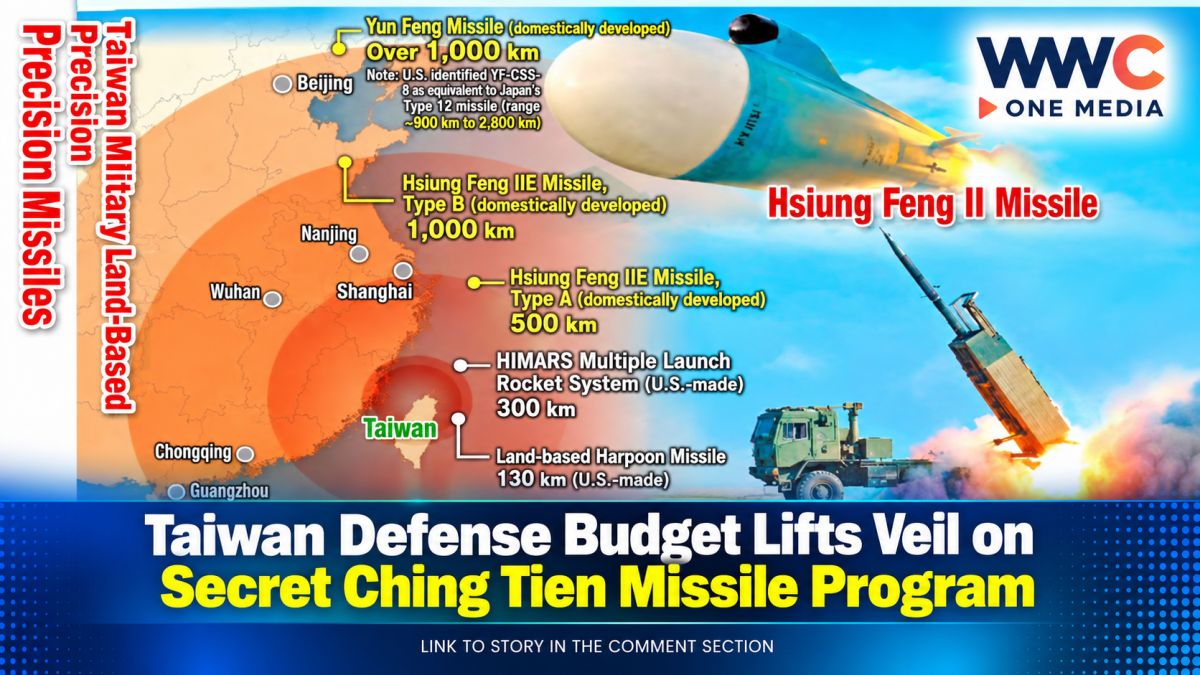
TAIPEI, Taiwan — Taiwan’s proposed defense budget has offered the clearest public indication yet that the military has moved a long-rumored long-range missile program into operational service — while also pointing to the development of a more advanced successor capable of reaching deeper into China.
The non-classified portion of Taiwan’s proposed defense budget for next year includes a new spending item for the “Fei Chi II weapons system and equipment maintenance program,” scheduled to run from next year through 2031.
The reference has drawn intense attention because Chinese-language media and defense observers have linked Fei Chi II to the development of the Ching Tien II, a reported hypersonic missile program. The budget disclosure also indirectly suggests that the earlier Ching Tien I missile has completed production and entered service.
Taiwan’s Ministry of National Defense has not publicly provided full technical details about either system. However, the budget item represents a significant shift for missile programs that have long been surrounded by secrecy and speculation.
Long-Rumored Missile Program Moves Into View
For years, Taiwan’s development of long-range strike weapons has remained one of the most closely guarded areas of its defense planning.
Following the 1996 Taiwan Strait Crisis, Taiwan reportedly began secret work on the Yun Feng medium-range supersonic cruise missile program.
According to the Washington-based Center for Strategic and International Studies, parts of the program were concealed within other missile development efforts, including work associated with the Hsiung Feng III program.
Chinese-language media have reported that the Yun Feng program was curtailed in 2014 after a limited production run.
The design and technology from that program reportedly helped form the basis for the later Ching Tien I system, whose existence had not previously been formally acknowledged by Taiwan’s military.
The latest defense budget has now fueled speculation that Taiwan is gradually lifting the veil on a family of long-range missiles developed to strengthen its ability to deter military threats from across the Taiwan Strait.
Ching Tien I Reportedly Capable of Reaching Deep Into China
The Ching Tien I is reported to be a supersonic cruise missile powered by a ramjet engine.
According to details cited in the Taipei Times report, the missile is believed to have a top speed of about Mach 3, or roughly 3,700kph, and an estimated range of 1,200km to 1,500km.
If those reported figures are accurate, the system would be capable of reaching military targets well beyond China’s coastal areas, including what analysts describe as the People’s Liberation Army’s second-echelon bases in eastern and central China.
However, the reported size and design of the missile could also present operational challenges.
The system is believed to rely primarily on fixed launch sites, including silos or mountain-based missile installations.
Such facilities could be vulnerable to modern satellite surveillance and long-range targeting because their locations are more difficult to conceal than mobile missile systems.
That limitation may explain the development of a more advanced successor.
Fei Chi II May Point to a Hypersonic Successor
The newly disclosed defense spending item has focused attention on what could be Taiwan’s next-generation long-range missile.
The system, reportedly developed under the codename Fei Chi II, has been linked by Chinese-language media to the Ching Tien II.
Unlike its predecessor, the Ching Tien II is reportedly designed to use a scramjet engine, potentially allowing it to travel at speeds of around Mach 5.
The missile is also reported to have an effective range exceeding 2,000km.
Those specifications have not been independently confirmed by Taiwan’s Ministry of National Defense.
However, if accurate, they would represent a major expansion of Taiwan’s reported long-range strike capabilities.
A missile with that range could potentially reach military and strategic targets far inside China.
The development would also place Taiwan among a relatively small group of countries pursuing advanced hypersonic missile technology.
Mobility Could Be the Key Difference
One of the most important reported differences between the Ching Tien I and its possible successor is mobility.
The Ching Tien II is reportedly being designed for launch from a mobile vehicle rather than relying primarily on fixed facilities.
According to sources cited in the report, Taiwan’s military has been considering a European-made 12×12 military utility truck as a possible launch platform.
A mobile system could provide a significant survivability advantage.
Instead of remaining in a known location, launch vehicles could move along highways and heavy-duty roads before and after firing.
That could make them more difficult for an adversary to locate and destroy.
The report also said a railway-based launch platform is being explored, potentially providing another way to relocate missile systems and complicate enemy targeting.
For Taiwan, mobility has become an increasingly important principle in military planning as satellite surveillance, drones and precision-guided weapons make fixed military infrastructure more vulnerable.
Taiwan’s Defense Strategy Is Becoming More Visible
The reported emergence of the Ching Tien missile family comes as Taiwan continues to reshape its military strategy around deterrence, mobility and survivability.
Taiwan’s armed forces have increasingly emphasized asymmetric capabilities designed to complicate and delay any potential military attack.
Recent military exercises have also highlighted urban defense, decentralized operations, rapid troop movement and the protection of critical infrastructure.
The reported missile developments would add another layer to that strategy by providing Taiwan with the potential ability to threaten military assets beyond its immediate coastline.
Defense analysts have long argued that long-range strike capabilities can strengthen deterrence by increasing the potential cost of military action against Taiwan.
However, such systems also remain politically sensitive because of concerns about regional escalation and Beijing’s reaction.
From Secrecy to Strategic Deterrence
The appearance of the Fei Chi II maintenance program in a public defense budget may signal a deliberate change in how Taiwan approaches secrecy around its advanced weapons.
Taiwan has traditionally kept many sensitive military capabilities out of public view.
But allowing the existence of certain programs to become known can also serve a strategic purpose.
Deterrence depends not only on possessing a capability.
An opponent must also believe that the capability exists and could be used.
The gradual public acknowledgment of the Ching Tien missile family could therefore be intended to send a message without revealing critical technical or operational details.
Taiwan appears to be trying to strike a careful balance: disclose enough to strengthen deterrence, while keeping the most sensitive information classified.
A New Layer in Taiwan’s Defense Arsenal
The proposed defense budget does not provide a complete picture of Taiwan’s missile programs.
Many questions remain unanswered.
Taiwan’s military has not publicly confirmed the reported specifications, production numbers or operational deployment of the Ching Tien systems.
What the budget does reveal, however, is that programs once discussed only through rumors and unofficial reports are becoming increasingly difficult to hide.
The Ching Tien I appears to have moved closer to public acknowledgment.
The Fei Chi II program suggests that development of a successor is continuing.
And Taiwan’s military is increasingly focused on weapons that can survive, move and impose greater costs on any potential attacker.
For years, Taiwan’s long-range missile ambitions existed largely in the shadows. Now, a single line in the defense budget may have revealed that one of the military’s most secretive weapons programs is stepping into the light.
WWC ONE MEDIA J.M.D


Leave a Reply