
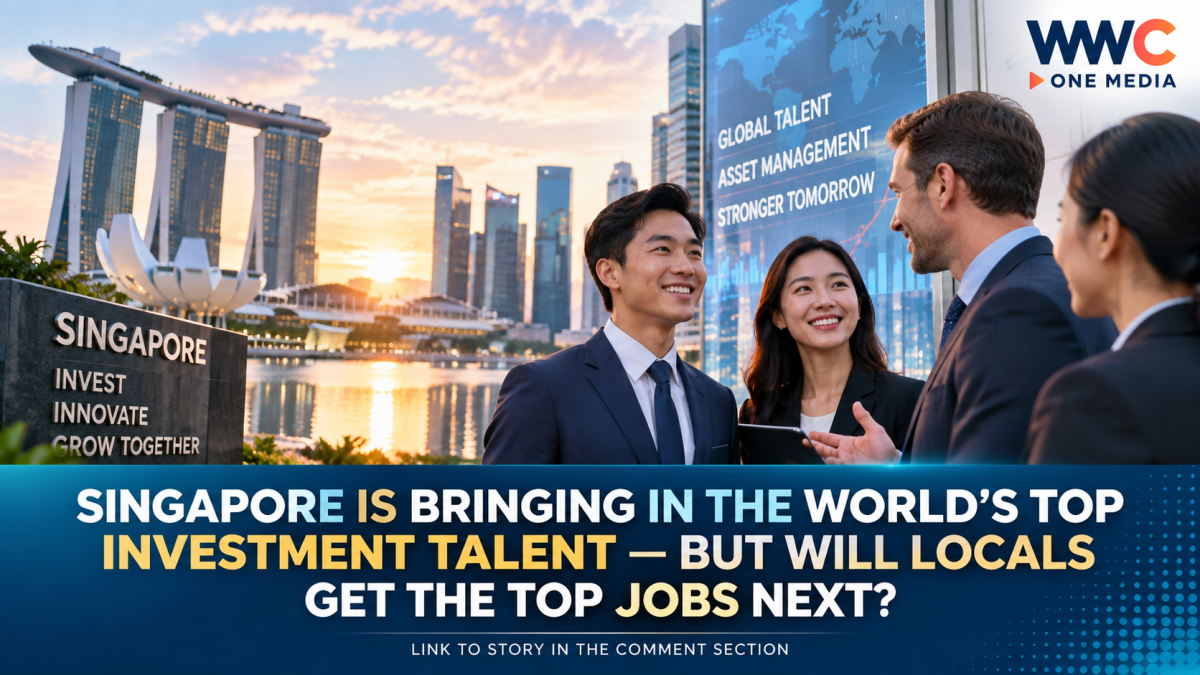
SINGAPORE — Singapore is stepping up its campaign to attract some of the world’s most experienced investment professionals, but the country’s latest push comes with a bigger question: Will bringing global talent into Singapore help more locals eventually secure senior roles in the financial industry?
Industry experts say Singapore’s strategy is not simply about creating more jobs or importing high-profile fund managers. The long-term goal is to build a deeper investment ecosystem — and ensure Singaporeans working alongside global experts gain the experience needed to eventually lead portfolios, teams and international investment businesses.
Singapore’s asset management industry currently employs close to 25,000 people, with around 80 per cent of the workforce made up of locals, according to industry observers cited by Channel NewsAsia.
The challenge, however, is at the very top.
The Global Race for Elite Investment Talent
Singapore is competing with major financial centres including New York, London and Hong Kong for a relatively small pool of highly experienced investment professionals.
These are not simply finance workers with technical qualifications. Senior portfolio managers and investment leaders often bring decades of experience, established track records and the ability to make high-stakes decisions across multiple market cycles.
Kher Sheng Lee, co-head for Asia Pacific at the Alternative Investment Management Association, compared senior investment professionals to race car drivers — highly visible figures supported by much larger teams working across research, trading, technology, operations, risk and compliance.
That means attracting one experienced investment leader could potentially generate opportunities across a much wider ecosystem.
Those opportunities can extend beyond fund management to analysts, traders, compliance specialists, technology professionals, lawyers, auditors, fund administrators and other financial services roles.
Singapore’s Strategy: Anchor First, Then Multiply
The country’s approach can be summed up as “anchor first and then multiply”, according to Professor Lawrence Loh of the National University of Singapore Business School.
The strategy is to persuade globally recognised investment professionals and firms to establish deeper operations in Singapore, then build teams, investment capabilities and supporting services around them.
Singapore’s government has recently backed that strategy with fresh incentives.
In August, the Monetary Authority of Singapore announced new measures aimed at strengthening the Republic’s position as a global asset management hub. These include an Investment Management Track under the Overseas Networks and Expertise, or ONE Pass, framework, designed to attract global leaders and senior investment professionals. Singapore also announced tax-related incentives and a hedge fund investment programme intended to anchor more global and regional players in the country.
The moves come as competition between Singapore and other financial centres for capital, fund managers and wealthy investors intensifies.
The Financial Times previously reported that Singapore was considering additional measures to maintain its competitiveness against Hong Kong, highlighting the increasingly fierce regional battle for top investment professionals and global capital.
But Creating Jobs May Not Be Enough
For Singaporeans, the real measure of success may not be the number of new positions created.
Experts say the bigger question is whether local professionals can gain meaningful exposure to high-level investment decision-making and eventually move into senior regional and global roles.
Khairil Baharudin, a senior professional at the Institute for Human Resource Professionals, said working alongside experienced investment leaders provides lessons that cannot easily be replicated through traditional classroom training.
Professionals can observe how seasoned investors assess risk, respond to volatile markets and make difficult decisions when there is no obvious answer, according to CNA’s report.
That makes capability transfer a key part of Singapore’s long-term strategy.
Industry observers say genuine progress should be measured by whether local professionals receive greater responsibility, manage increasingly complex portfolios and eventually move into leadership positions.
Demand for Specialist Finance Skills Is Growing
The push also comes as Singapore’s finance job market becomes increasingly specialised.
Recruiters and industry observers have pointed to continuing demand for professionals with expertise in investment management, private wealth, quantitative finance, artificial intelligence, data, cybersecurity, risk management and compliance.
Recent job listings also show continued demand across Singapore’s asset management sector, including investment analysts, portfolio management professionals, compliance specialists and senior product managers.
Global financial institutions are also continuing to expand their presence.
Barclays, for example, recently announced plans to more than double banker headcount in its Singapore private banking operations by 2030 as it deepens its commitment to the Asia-Pacific region.
The expansion reflects a broader trend: Singapore remains a key base for firms looking to capture Asia’s growing wealth and investment market.
The Bigger Test Is Still Ahead
Singapore’s strategy appears clear — attract world-class talent, convince global investment firms to deepen their operations, and build a larger ecosystem around them.
But experts warn that the policy’s long-term success should not be judged solely by the number of foreign investment professionals who relocate to Singapore.
The bigger test will be whether their knowledge, experience and networks help develop a stronger pipeline of homegrown leaders.
Can Singaporean analysts become portfolio managers?
Can local investment professionals move into regional and global leadership roles?
And will the next generation of Singapore-based fund managers eventually become the talent other financial centres are competing to attract?
Those questions may ultimately determine whether Singapore’s global talent strategy produces more than new jobs — and whether it creates the next generation of investment leaders from within its own workforce.
Singapore may be winning the battle to attract the world’s investment stars. The real challenge now is making sure local talent gets the chance to become the next ones.
WWC ONE MEDIA J.M.S




Leave a Reply