
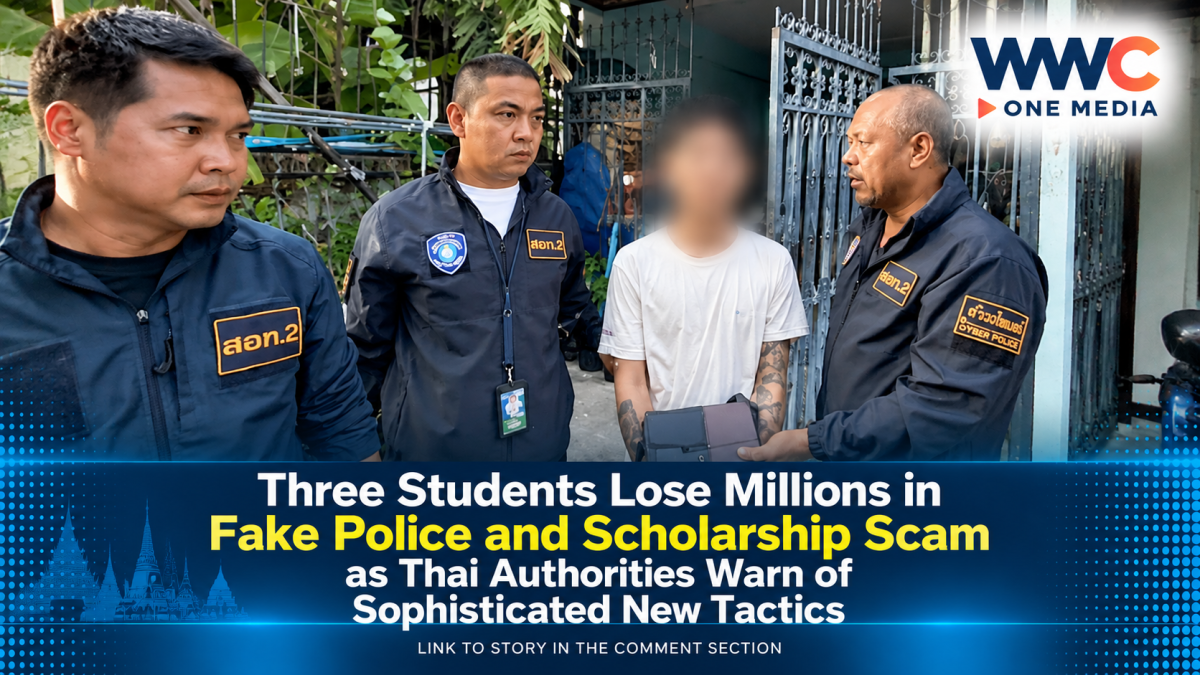
BANGKOK, Thailand — Three students have lost more than 2.7 million baht after falling victim to sophisticated scams involving criminals posing as police officers and scholarship representatives, highlighting the growing threat facing young people in Thailand.
The cases were reported to Thailand’s Anti Cyber Scam Centre, where investigators found that the fraudsters used different stories but relied on the same strategy: create fear, gain the victim’s trust and pressure them into handing over money before they have time to verify the claims.
In some cases, scammers posed as police officers and falsely accused victims of being connected to criminal activity. In others, they used fake scholarship opportunities to lure students hoping to continue their education abroad.
The result was devastating.
Three young victims lost millions of baht before realizing they had been deceived.
Fake Police Calls Turn Fear Into Financial Loss
One of the most common tactics used by call-centre gangs is impersonating law enforcement officers.
Victims may first receive a call from someone pretending to represent a government agency, telecommunications company or financial institution.
The caller then claims the victim’s name, phone number or bank account has been connected to a serious crime.
The call is often transferred to another person posing as a police officer.
That is when the pressure begins.
Victims may be told they are being investigated for money laundering, identity fraud or other crimes. The scammers then convince them that they must transfer money into a supposedly secure government account for “verification.”
But the account is fake.
And once the money is transferred, it can quickly disappear.
A similar case reported in Thailand last month involved a first-year university student who lost more than 3.6 million baht after scammers impersonated telecommunications employees and police officers and falsely claimed she was linked to a money-laundering case.
Fake Scholarships Become Another Trap
The second tactic is particularly alarming because it targets students’ ambitions.
Scammers offer what appears to be a legitimate scholarship, often involving opportunities to study overseas.
Victims may be told they have qualified for funding or that they need to complete an urgent financial process before their scholarship can be approved.
The fraudsters then demand money for supposed application fees, document processing, deposits or other expenses.
Thai authorities have previously warned that criminals are increasingly using fake scholarship offers to exploit students and families dreaming of international education.
Officials have urged applicants to verify scholarship offers directly with universities, government agencies or officially recognized organizations before sending money or personal information.
Why Students Are Becoming Targets
Young people can be particularly vulnerable to sophisticated scams because criminals often exploit situations involving education, career opportunities and financial uncertainty.
A student applying for an overseas scholarship may be eager to believe they have received good news.
Another student may panic when someone claiming to be a police officer says they are facing a criminal investigation.
Scammers understand those emotions.
They deliberately create urgency.
Victims are told not to contact their parents.
They are warned not to speak with friends.
They may be told that discussing the case could interfere with a police investigation.
The isolation is part of the scam.
The longer a victim remains alone with the fraudster, the easier it becomes for criminals to control the situation.
Scam Gangs Are Using Increasingly Sophisticated Methods
Recent cases show that call-centre gangs are becoming more sophisticated in the way they manipulate victims.
Some operations use multiple people playing different roles.
One person may pretend to be a telecommunications employee.
Another may pose as a police officer.
A third person may claim to represent a government agency or university.
The use of multiple identities can make the story appear convincing.
In some cases, scammers have also manipulated students into isolating themselves or participating in staged kidnapping scenarios while demanding money from their families.
Thai police recently rescued university students who were allegedly manipulated by scammers using a fake overseas scholarship scheme and forced into a staged ransom plot.
The growing sophistication of these operations has made verification more important than ever.
Thai Authorities Intensify the Crackdown
Thailand has made the fight against transnational scam networks a national priority.
The government has expanded cooperation with international law enforcement agencies as scam operations increasingly operate across borders and target victims through phones, social media and digital platforms.
Thailand’s government said it has seized assets worth tens of billions of baht linked to criminal networks as authorities intensify operations against transnational scams.
Technology companies and law enforcement agencies have also increased cooperation to disrupt scam infrastructure operating across Southeast Asia.
A joint operation announced earlier this year involved major technology companies and law enforcement agencies sharing information to target online accounts and infrastructure linked to criminal scam networks.
What Students and Families Should Watch For
Authorities have repeatedly warned the public about several major red flags.
A legitimate police officer should not pressure someone to secretly transfer money into a personal or unknown account to prove their innocence.
A genuine scholarship provider should not demand urgent payments without allowing applicants to independently verify the program.
Victims should also be suspicious when callers:
- Claim immediate action is required.
- Tell them not to contact family or friends.
- Threaten arrest unless money is transferred.
- Ask them to move money into a so-called “safe” or “verification” account.
- Request passwords, one-time verification codes or banking details.
- Promise scholarships or overseas opportunities in exchange for urgent payments.
The Anti Cyber Scam Centre advises victims not to delay reporting fraud, noting that quick action can improve the chances of tracing or freezing stolen funds.
Thailand’s official Anti Cyber Scam Centre provides a 1441 hotline and online reporting channels for suspected scams and fraud cases.
A Costly Warning for Young People
The latest cases are a reminder that modern scams are no longer limited to suspicious messages promising easy money.
Today’s fraudsters can impersonate police officers.
They can create convincing government stories.
They can offer fake university scholarships.
And they can use fear and urgency to push victims into making decisions within minutes.
For the three students who lost more than 2.7 million baht, the consequences were severe.
But authorities hope the cases will serve as a warning to others.
When a caller creates fear, demands secrecy and asks for money, the safest response is not to panic — it is to stop, verify and contact the real organization directly before transferring a single baht.
WWC ONE MEDIA J.M.D




Leave a Reply