
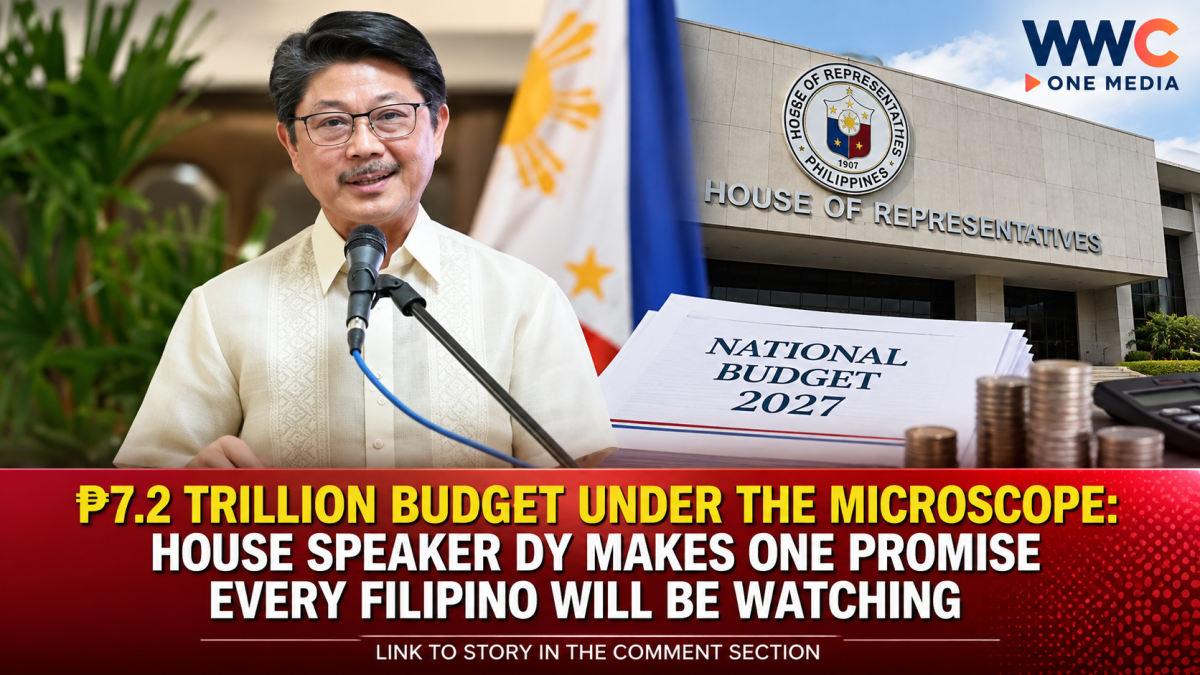
MANILA — The House of Representatives is promising tougher scrutiny of the proposed ₱7.2-trillion national budget for 2027, with Speaker Faustino “Bojie” Dy III saying lawmakers must ensure that public funds are properly allocated and translated into concrete benefits for ordinary Filipinos.
Dy said the national budget is among the most important measures before Congress because its allocations directly affect government services and programs across the country.
His message comes as lawmakers continue examining the proposed 2027 National Expenditure Program, or NEP, submitted by the Marcos administration to Congress.
“Hindi sapat na sabihin kung magkano ang ginagastos. Dapat maipakita kung ano ang nagagawa ng bawat piso,” Dy said, stressing that lawmakers must look beyond the size of agency requests and determine what Filipinos will actually receive in return.
The proposed ₱7.2-trillion spending plan was formally submitted to Congress on August 11, 2026. It is about ₱407 billion higher than the ₱6.8-trillion national budget for 2026.
House to ask agencies: Where will the money go?
Dy said lawmakers will examine the proposed appropriations by asking government agencies not only how much money they are requesting but also how those funds will be used and what measurable results they are expected to produce.
The Speaker said the budget review should ultimately answer three questions: Where will the money go? What concrete changes will it produce? And how will ordinary Filipinos feel its impact?
The approach is particularly significant as Congress reviews a spending plan covering major priorities such as education, health care, infrastructure, food security, agriculture, employment, social protection and disaster preparedness.
The Department of Education has the largest proposed allocation among government departments at about ₱976 billion, according to GMA News. The proposed budget also includes substantial funding for local governments, infrastructure and social services.
Budget rises, but most of the increase is tied to mandatory obligations
The Department of Budget and Management has said the increase in the 2027 proposal is largely driven by mandatory government obligations.
According to Acting Budget Secretary Kim Robert de Leon, around ₱316 billion—or nearly four-fifths of the overall increase—comes from obligations such as higher National Tax Allotment for local governments, salary adjustments for civilian government personnel, adjustments for military and uniformed personnel, and other existing fiscal commitments.
President Ferdinand Marcos Jr. has also described the proposed budget as an investment in Filipinos while directing agencies to focus on measurable outcomes, align programs with national development priorities and eliminate unnecessary or inefficient spending.
Flood-control spending faces renewed scrutiny
One of the most closely watched portions of the proposed budget is infrastructure spending, particularly flood-control projects.
The government has proposed ₱107.4 billion for flood-control projects in 2027, including funding for continuing, repairing and improving existing infrastructure. The allocation comes after widespread scrutiny of alleged irregularities involving flood-control projects in previous years.
Budget officials said projects included in the proposal underwent tighter evaluation, with efforts made to ensure that project locations are properly identified and supported by actual programs of work.
The government has also pointed to digital monitoring and satellite-based verification as additional safeguards against so-called ghost projects.
That means the House’s promise to scrutinize every peso will face an important test as lawmakers examine infrastructure allocations and determine whether proposed projects can produce measurable results.
House targets October 9 for budget approval
The budget review is already moving forward.
The House Committee on Appropriations completed its agency-level deliberations on September 8, clearing the way for plenary discussions. House leaders are targeting October 9 for approval of the proposed 2027 General Appropriations Bill on third and final reading.
The timeline gives lawmakers several weeks to debate the proposed spending plan, raise questions about agency allocations and potentially seek changes before the measure advances through the legislative process.
Dy has also emphasized transparency in the congressional budget process, citing reforms such as the Budget Amendments and Review Subcommittee and the livestreaming of bicameral meetings.
The real test comes after the promises
For Filipino taxpayers, however, the biggest question may not simply be how large the 2027 budget becomes.
The real test will be whether the billions of pesos approved by Congress result in better schools, functioning health services, stronger infrastructure, support for farmers and workers, improved disaster preparedness and other services that Filipinos can actually see and feel.
Dy said the House intends to keep Filipinos at the center of the budget process and ensure that public spending produces tangible results.
With ₱7.2 trillion now under congressional scrutiny, the coming weeks will determine which proposals survive, which allocations are changed and whether the House can turn its promise of accountability into concrete safeguards for taxpayers.
For now, lawmakers have made their position clear: every peso must have a purpose—and every peso must deliver.




Leave a Reply