
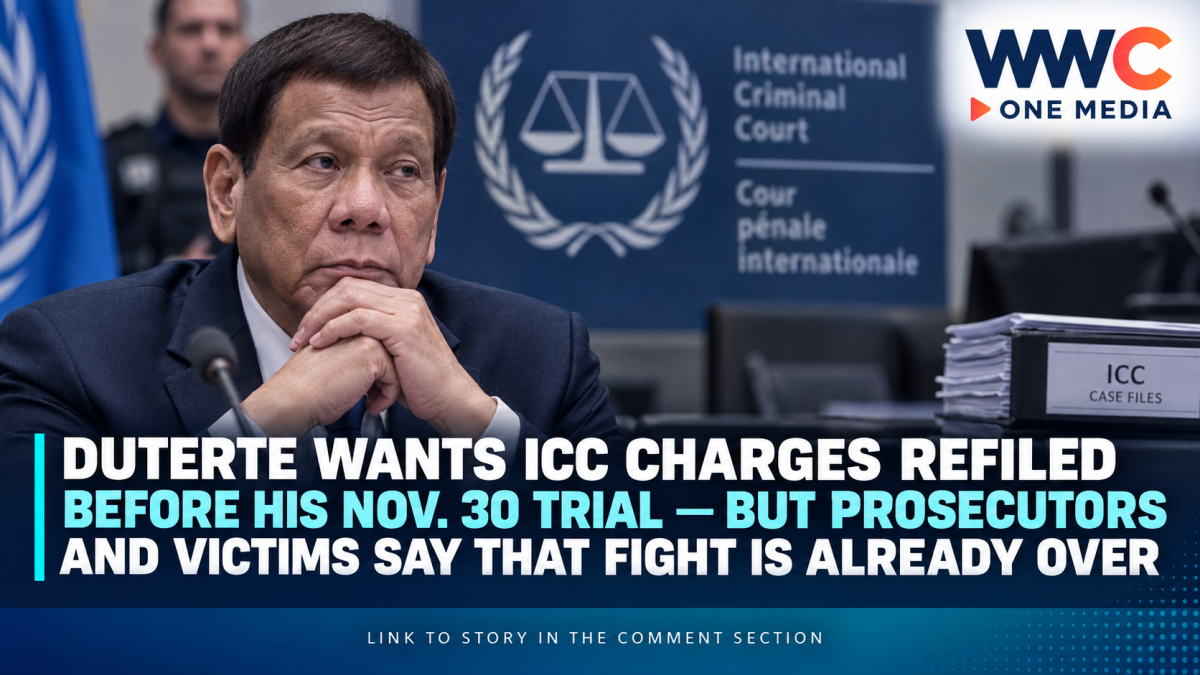
MANILA, Philippines — Former President Rodrigo Duterte’s lawyers are trying to force prosecutors at the International Criminal Court to redraw the way the crimes-against-humanity case against him is presented — but both the prosecution and lawyers representing participating victims say the defense is attempting to reopen a legal battle that has already been decided.
In separate filings dated September 10, ICC prosecutors and the Common Legal Representatives of Victims urged Trial Chamber III to reject Duterte’s request to require the prosecution to refile or reformulate its charging document before his trial begins. The ICC currently schedules the opening of Duterte’s trial for November 30, 2026.
The dispute may sound highly technical, but it goes directly to one of the most important questions facing Duterte’s defense: exactly what alleged criminal conduct must it answer at trial?
Duterte defense says charges are too broad
In an 11-page motion filed on August 31, Duterte lead counsel Peter Haynes KC argued that the existing Document Containing the Charges does not give the former president sufficiently precise notice of the accusations against him.
The defense contends that prosecutors structured the case around what they describe as “illustrative” and “non-exhaustive” incidents rather than a closed list of individually specified killings. Haynes argued that this makes it difficult for Duterte’s lawyers to know the precise boundaries of the prosecution case and prepare a defense.
Duterte’s lawyers have also complained about the rapidly expanding volume of disclosed material. In their filing, they said the prosecution’s disclosures had risen from roughly 5,000 items around the confirmation stage to more than 25,000, while noting that prosecutors had provided notice concerning additional incidents beyond those originally identified. Those figures represent the defense’s characterization of the material before the court, not a judicial finding that the charges themselves have expanded without limit.
That distinction is crucial.
Prosecutor: The charging issue was already litigated
Acting Prosecutor Mame Mandiaye Niang rejected the defense argument, telling Trial Chamber III that questions concerning the form and adequacy of the charges belonged primarily to the confirmation stage — a stage Duterte has already passed.
The prosecution pointed out that Pre-Trial Chamber I confirmed the charges in April and that Duterte’s defense had participated extensively in those proceedings. The defense subsequently sought permission to appeal aspects of the confirmation decision, including concerns over how broadly the allegations were framed.
According to Niang, the legal adequacy of the charges was therefore already addressed during confirmation. Prosecutors want Trial Chamber III to dismiss the new motion rather than order another charging document.
Victims’ lawyers make the same argument
The lawyers representing victims took a similar position.
Joel Butuyan, Gilbert Andres and Paolina Massidda, who form the common legal representation team for authorized victims in the case, argued that the confirmation decision already established identifiable temporal, geographical and material limits for the three counts.
They asked judges to dismiss the defense motion at the outset or, alternatively, reject it on its merits. Their position is that Duterte’s lawyers should not be allowed to revive essentially the same objections merely by presenting them now as a dispute about the “form” of the charges.
The ICC says 539 victims have been authorized to participate in the proceedings, represented by the common legal team. Participation does not make those individuals prosecutors; under ICC procedure, participating victims have separate rights and representation alongside the prosecution and defense.
What exactly has Duterte been charged with?
On April 23, 2026, Pre-Trial Chamber I unanimously confirmed three counts of crimes against humanity involving alleged murder and attempted murder and committed Duterte to trial.
The judges found “substantial grounds to believe” that Duterte bears criminal responsibility for crimes allegedly committed as part of a widespread or systematic attack against civilians in the Philippines in connection with the anti-drug campaign. The relevant period before the ICC runs from November 1, 2011 to March 16, 2019.
The confirmation proceedings focused on 49 incidents involving 78 victims — 76 alleged murders and two alleged attempted murders. Prosecutors have maintained that those incidents represent a non-exhaustive selection within the alleged broader attack rather than the full number of people allegedly harmed during Duterte’s anti-drug campaign.
The three confirmed counts broadly cover alleged killings around Davao during Duterte’s mayoral period, alleged killings of so-called “high-value targets” after he became president, and alleged murders and attempted murders connected with barangay-level anti-drug operations during his presidency.
Those remain allegations to be tested at trial. Confirmation of charges is not a conviction and does not establish Duterte’s guilt beyond reasonable doubt.
Why this procedural fight matters
For the defense, the issue is fundamentally one of fair-trial rights.
Duterte’s lawyers argue that an accused person cannot adequately prepare for trial if prosecutors can rely upon an open-ended universe of incidents without sufficiently identifying which alleged acts form the criminal charges.
For prosecutors and victims’ representatives, however, the defense is trying to revisit an argument considered during the confirmation process. They maintain that the court has already set boundaries for the case and that additional evidence or illustrative incidents do not automatically amount to entirely new charges.
Trial Chamber III will ultimately decide which interpretation prevails.
The clock is now running toward November 30
The procedural battle comes at a critical stage. Trial Chamber III, headed by Judge Joanna Korner alongside Judges Keebong Paek and Nicolas Guillou, has scheduled Duterte’s trial to open on November 30. The chamber still has pending procedural and evidentiary questions to resolve before then.
Duterte has been in ICC custody since March 2025 after Philippine authorities arrested him pursuant to an ICC warrant and transferred him to The Hague. The case has since moved from preliminary proceedings through confirmation of charges and into the trial phase.
What happens next will therefore not simply determine whether prosecutors must rewrite paperwork.
The ruling could help establish how narrowly the prosecution must define the acts Duterte will be required to answer at trial — and how much room prosecutors have to use additional incidents and evidence to prove their broader allegation of a widespread or systematic attack.
With November 30 approaching, that question has become one of the most consequential procedural fights remaining before the first evidence is formally heard at trial.



Leave a Reply