
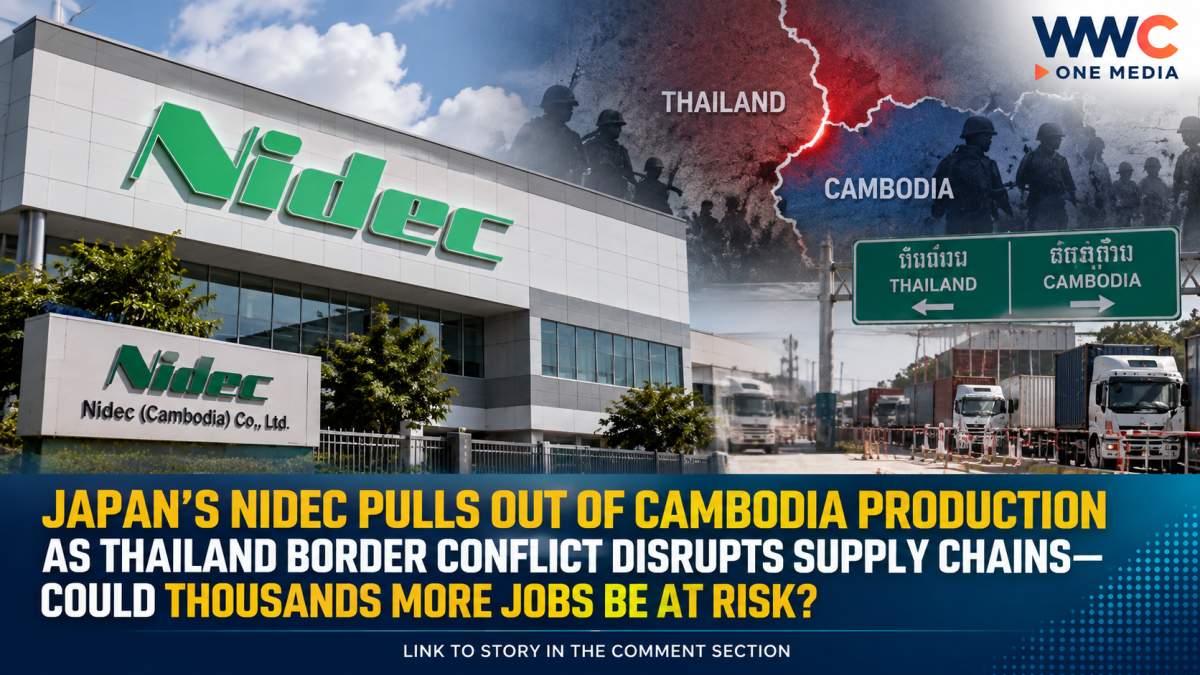
Japanese manufacturing giant Nidec is moving to exit production in Cambodia after the prolonged disruption caused by the Thailand-Cambodia border conflict, highlighting how geopolitical tensions are now hitting businesses, supply chains and workers far beyond the battlefield.
The decision affects Nidec Die-casting Cambodia Co., Ltd., a Japanese-owned manufacturing operation in the border city of Poipet, according to reporting by Nikkei Asia. The company’s move comes as the closure and disruption of the Cambodia-Thailand land border have made it increasingly difficult and expensive for factories to transport components and finished products.
But Nidec may not be the only company facing trouble.
Recent reports indicate that multiple factories in Poipet have either closed or prepared to suspend operations as the prolonged border disruption raises logistics costs, weakens orders and threatens thousands of jobs.
Border Conflict Creates a Manufacturing Shock
Poipet has long been one of Cambodia’s most important gateways for trade with Thailand. Its location near the border made it attractive to manufacturers dependent on the movement of raw materials, industrial components and finished products between the two countries.
However, the border conflict and the resulting restrictions on cross-border movement have disrupted that advantage.
Factories that once relied on relatively efficient land transportation have been forced to deal with longer routes, higher logistics costs and uncertainty over deliveries. For manufacturers operating on tight margins and highly integrated supply chains, those disruptions can quickly become financially unsustainable.
Cambodianess reported in August that three manufacturers in Poipet had either closed or were preparing to cease operations, placing roughly 4,000 workers under growing financial pressure. The report specifically identified the shutdown announcement involving Japanese-owned Nidec Die-casting Cambodia.
The closures demonstrate how a border dispute can spread rapidly into the wider economy, affecting not only governments and soldiers but also factory workers, suppliers, transport companies and local businesses.
Why Nidec’s Exit Matters
Nidec is one of Japan’s major manufacturing groups, with operations and customers connected to industries ranging from automotive components to electronics, appliances and industrial equipment.
Its decision to stop production in Cambodia is therefore significant because it sends a warning about the growing vulnerability of cross-border manufacturing networks in Southeast Asia.
Modern factories rarely operate in isolation. A component produced in one country may be transported across the border for assembly, before the finished product is shipped to another market. When a major land border suddenly becomes unreliable or inaccessible, the entire production chain can be affected.
Nidec’s move suggests that companies operating near the Cambodia-Thailand border may now be reassessing whether their existing supply chains remain viable.
Thousands of Workers Face Uncertainty
The impact is particularly severe for workers in Poipet.
Cambodianess reported that the closures and planned shutdowns could affect around 4,000 workers, while Cambodia’s Ministry of Labour and Vocational Training has said affected employees should receive benefits and compensation required under labor laws. The ministry has also pointed to tens of thousands of job vacancies available elsewhere in the country.
However, finding another job is not always simple.
Workers may face the cost of relocation, family responsibilities and the challenge of finding employment that offers similar wages or skills requirements. Businesses surrounding the factories could also suffer if thousands of workers suddenly lose or reduce their income.
A Conflict With Major Economic Consequences
The economic damage from the Thailand-Cambodia conflict has been building since tensions escalated along the disputed border.
An analysis by Fulcrum at the ISEAS-Yusof Ishak Institute said the conflict had caused severe economic losses because of the deep economic interdependence between Thailand and Cambodia. The border crisis disrupted trade, tourism, labor movement and other commercial activities, magnifying the economic consequences for both countries.
The conflict that reignited in 2025 led to major humanitarian and economic disruption, with border communities among the hardest hit. Even after ceasefire and de-escalation efforts, the economic effects have continued because restoring normal trade and transportation networks can take much longer than ending active fighting.
That prolonged uncertainty is now becoming a serious problem for companies deciding where to invest and manufacture.
Could More Companies Follow?
The biggest question now is whether Nidec’s departure will remain an isolated case.
If border restrictions continue to make transportation unpredictable and expensive, other companies may also consider relocating production or restructuring their supply chains. Businesses have to balance the benefits of lower costs and strategic locations against the growing risks created by geopolitical instability.
For Cambodia, that could become a major concern.
Foreign investment and manufacturing employment are crucial to the country’s economy. A perception that border regions are becoming unreliable for production could affect future investment decisions, particularly among companies that depend heavily on connections with Thailand.
The situation also highlights a broader issue facing Southeast Asia: economic integration has made countries more interconnected, but that same interconnectedness means political and military disputes can quickly disrupt factories, jobs and investment.
The Bigger Picture
The Nidec case is more than a story about one Japanese company shutting down production.
It is a warning about how quickly geopolitical conflict can enter the factory floor.
A border closure can mean delayed shipments. Delayed shipments can lead to canceled orders. Canceled orders can force factories to cut production. And factory closures can leave thousands of workers searching for new jobs.
For Poipet and other communities dependent on cross-border commerce, the stakes are especially high.
As Thailand and Cambodia continue efforts to manage their long-running border dispute, businesses will be watching closely for signs that trade routes and transportation networks can return to stability.
Until then, Nidec’s decision could become a symbol of a much larger problem: when borders become battle lines, the economic damage does not stop at the frontier.
And if other manufacturers decide the risks are simply too high, Cambodia’s factory sector could be facing an even bigger test in the months ahead.



Leave a Reply