
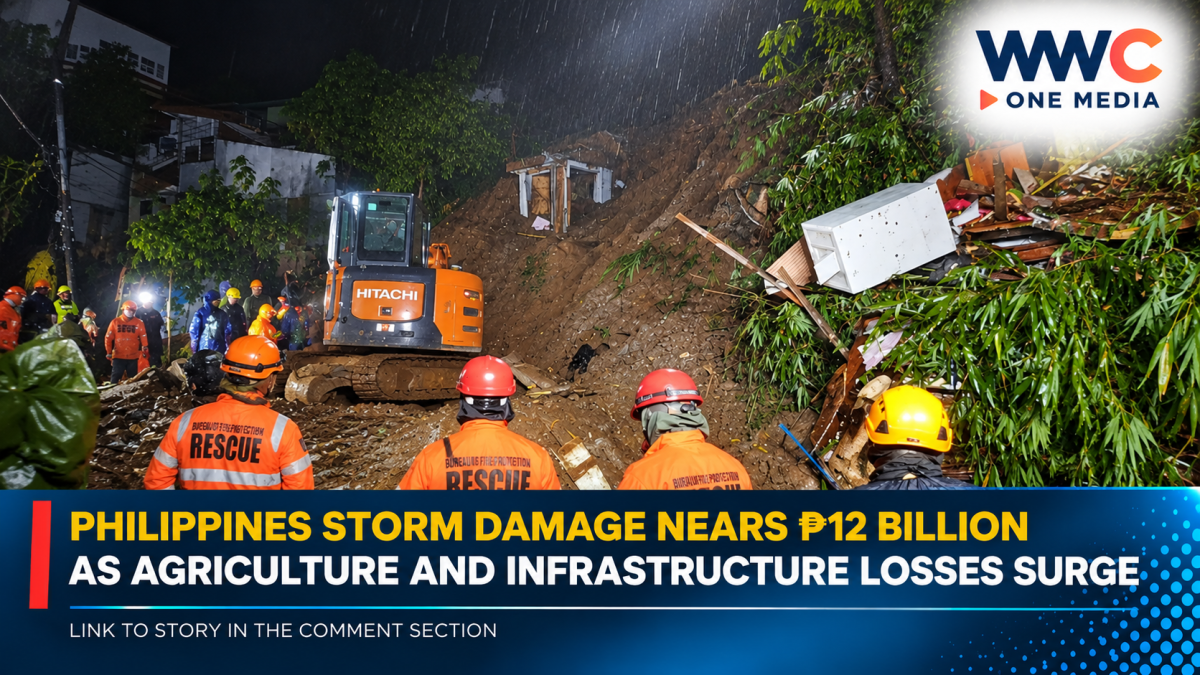
MANILA — The economic damage from a string of tropical cyclones and the enhanced southwest monsoon has climbed to nearly ₱12 billion, underscoring the growing cost of extreme weather on Philippine farms, roads and other infrastructure.
The latest combined estimate puts damage at approximately ₱11.92 billion, with ₱7.79 billion attributed to infrastructure and another ₱4.13 billion to agriculture, according to disaster officials cited by the Philippine News Agency and Manila Bulletin.
The assessment covers the impact of four tropical cyclones and the southwest monsoon, or Habagat, across affected areas of the country.
But the number could still increase.
Damage assessments remain subject to validation as government teams continue documenting losses in farms, fisheries and infrastructure.
Agriculture alone loses ₱4.13 billion
The Department of Agriculture’s September 6 assessment put agricultural damage at ₱4.13 billion, affecting 97,589 farmers and fisherfolk across 81,383 hectares.
Estimated production losses have reached about 100,602 metric tons.
Rice accounts for the largest share of the agricultural losses.
The DA estimates that 73,307 hectares of rice areas were affected, with production losses of about 65,106 metric tons, valued at approximately ₱2.04 billion.
High-value crops, corn, fisheries and other agricultural activities were also affected.
Agriculture Secretary Francisco Tiu Laurel Jr. warned that localized disruptions could put pressure on prices, particularly for vegetables and fish, where even temporary supply interruptions can quickly affect local markets.
Rice supply may be less vulnerable
Despite the size of the agricultural damage, the DA says the impact on overall rice supply is expected to be limited.
The estimated rice losses represent less than 1% of the country’s projected 20.3 million metric tons of annual rice production, according to the department.
That does not mean individual farmers escaped serious losses.
In fact, much of the damaged rice was reportedly close to harvest, making the destruction particularly painful for producers who were approaching the point when months of farm work would have generated income.
The government is therefore facing two different problems: protecting national food supply while helping individual farmers whose livelihoods have been hit by the storms.
Infrastructure damage is nearly twice the agricultural bill
The larger component of the combined ₱11.92-billion estimate is infrastructure.
Approximately ₱7.79 billion in infrastructure damage has been recorded, according to the latest disaster assessment reported by Manila Bulletin.
The infrastructure losses add another layer to the recovery challenge.
When roads, bridges and other public facilities are damaged, the consequences can extend beyond repair costs.
Farmers may struggle to move crops to markets, communities can become harder to reach and relief operations can become more complicated.
Infrastructure damage can therefore amplify the original economic impact of a storm by disrupting transportation and commerce even after floodwaters recede.
Thousands of farmers now need financial support
The government’s response is already moving beyond emergency relief.
The Philippine Crop Insurance Corp. (PCIC) has set aside ₱187 million in insurance payments for farmers affected by flooding and other damage from three typhoons and the enhanced southwest monsoon.
The payouts cover losses reported from August 1 to 26 across eight regions and are expected to benefit 24,987 farmers.
Rice farmers account for the biggest share of the insurance claims at ₱132.9 million, followed by high-value crops at ₱42.1 million and corn at ₱9.3 million.
The move is designed to help farmers recover faster and return to production.
Emergency loans are also being accelerated
Insurance is not the only financial lifeline being offered.
The Department of Agriculture’s Agricultural Credit Policy Council (ACPC) has streamlined emergency financing for farmers and fisherfolk affected by recent flooding.
Through the calamity-loan component of its AGRI-RECOVER Program, qualified small farmers and fisherfolk registered with the Registry System for Basic Sectors in Agriculture can borrow up to ₱35,000, with zero interest and repayment over as long as three years.
The simplified process is designed to allow approved loans to be credited as quickly as the same day.
Existing borrowers affected by flooding may also qualify for loan restructuring, refinancing and possible debt-service moratoriums, subject to program rules.
That assistance could prove particularly important for farmers who need money immediately to purchase seeds, fertilizer, fuel or other inputs before the next planting cycle.
The damage bill has been climbing rapidly
The latest ₱4.13-billion agricultural figure illustrates how quickly the damage estimates have grown.
Earlier in August, the DA reported only about ₱135.3 million in agricultural damage from Tropical Cyclones Luis and Maymay and the enhanced southwest monsoon, affecting 6,010 farmers and 4,516 hectares at that stage of assessment.
The department stressed at the time that the figure was preliminary and could rise as field validation continued.
That warning has now proven significant.
The latest assessment is many times larger, demonstrating how damage figures can increase as government teams gain access to previously unassessed areas and additional weather events are included.
Food prices are another concern
The immediate concern for consumers is whether the agricultural losses will translate into higher food prices.
The DA believes vegetables and fish could face more localized price pressure because supply disruptions can quickly affect markets.
Rice, however, is considered less vulnerable at the national level because of existing domestic supplies and imports.
Still, the situation remains fluid.
If repeated storms disrupt planting, harvesting, transportation and market access, temporary losses can develop into longer-lasting supply problems.
That is why the speed of recovery will matter almost as much as the size of the initial damage.
A bigger climate-resilience challenge
The latest disaster bill also highlights a larger problem facing the Philippines.
Extreme weather repeatedly damages the same economic foundations that communities depend on to recover: farms, roads, bridges, fisheries and local livelihoods.
The government has been pursuing several measures aimed at reducing that vulnerability.
The DA, for example, is working on stronger disaster preparedness, climate-resilient agriculture and improved risk assessment. It has also explored technologies including satellite data and artificial intelligence-driven drones to improve agricultural monitoring and disaster response.
The goal is increasingly shifting from simply responding after a disaster to identifying risks earlier and helping farmers prepare before losses become catastrophic.
The final bill may not be in yet
For now, ₱11.92 billion is the latest combined estimate—not necessarily the final cost.
Agricultural assessments are still being validated, while infrastructure agencies continue documenting and evaluating damage.
That means the number could move higher as more affected communities are assessed.
For farmers, however, the damage is already more than a headline figure.
It represents lost harvests, damaged livelihoods and another costly recovery effort.
For the government, the immediate task is to repair infrastructure, compensate eligible farmers and prevent temporary supply disruptions from becoming prolonged food and income problems.
And with the Philippines continuing to face repeated tropical cyclones and monsoon-driven flooding, the ₱11.9-billion damage bill may be less a final total than a warning of how expensive the next storm could become.




Leave a Reply