
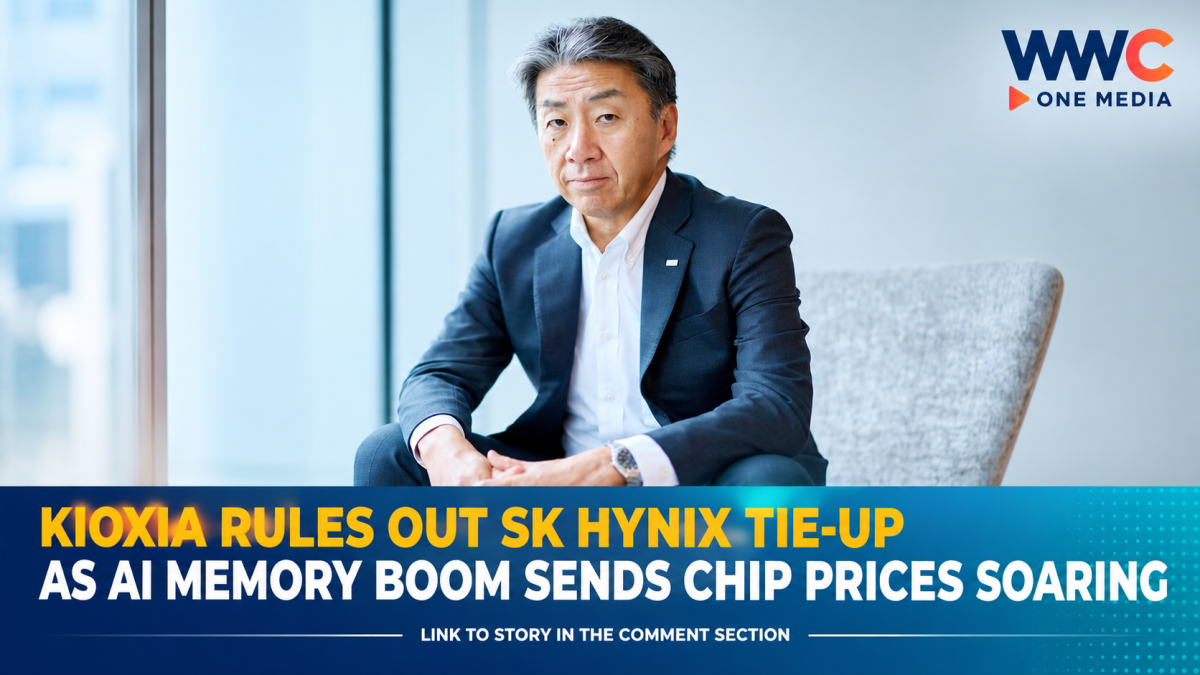
TOKYO — Japanese memory chipmaker Kioxia Holdings Corp has poured cold water on speculation about a deeper manufacturing alliance with South Korea’s SK Hynix, saying the companies are not holding talks even as the artificial intelligence boom drives memory prices sharply higher and forces major producers into a multibillion-dollar race to expand capacity.
Kioxia chief executive Hiroo Ota said a potential tie-up involving Kioxia, SK Hynix and Kioxia’s manufacturing partner Sandisk would face major antitrust and operational challenges.
The comments come as the global memory chip industry enters one of its most intense investment cycles in years, with AI data centers consuming massive volumes of NAND flash and other memory products.
Kioxia Says No Talks Are Underway
Speculation about a possible manufacturing partnership emerged after SK Inc chairman Chey Tae-won mentioned a Kioxia-SK Hynix tie-up as one possible way to reduce the risks associated with huge semiconductor investments.
But Kioxia’s leadership has now made its position clear.
Ota said Kioxia and SK Hynix are not in discussions about joint production, while an SK Hynix representative also said Chey’s earlier comments were made in general terms and that no negotiations were taking place.
A deeper alliance would also be complicated by Kioxia’s existing jointly owned manufacturing facilities with Sandisk.
“We can’t just say: ‘Well then, let’s make it three companies,'” Ota said when discussing the hypothetical partnership.
AI Boom Sparks Massive Memory Chip Spending
The bigger story behind the speculation is the extraordinary surge in demand for memory chips.
AI service providers and hyperscale data center operators are placing increasingly large orders for memory products, triggering sharp price increases and forcing the world’s biggest manufacturers to dramatically expand production capacity.
Kioxia and Sandisk are planning to spend more than ¥5 trillion, or about US$33 billion, to expand their jointly operated manufacturing facilities in Japan.
SK Hynix, meanwhile, is planning a 54 trillion won, or roughly US$40 billion, expansion of its semiconductor facilities in South Korea and is also building an advanced memory packaging plant in West Lafayette, Indiana.
The enormous investment figures underline just how aggressively memory manufacturers are positioning themselves for what could become a prolonged AI infrastructure boom.
Kioxia: Memory Prices Have Already Risen Enough
But Kioxia is also warning that there is a danger in pushing prices too far.
The company’s average NAND flash memory prices rose 70% in the June quarter from the previous three-month period, after prices had already more than doubled in the earlier quarter.
Despite those gains, Ota said he has instructed Kioxia’s sales teams not to aggressively seek substantially higher prices from data center customers.
His concern is simple: if memory becomes too expensive, the very AI investment boom driving demand could begin to slow.
“Prices have already risen enough,” Ota said
He added that even the world’s largest cloud and technology companies have financial limits.
Another 70% quarter-on-quarter price increase appears unlikely, according to the Kioxia CEO.
Why AI Companies Are Driving the Memory Crunch
AI systems require far more computing infrastructure than traditional applications.
Massive data centers running and training advanced AI models require huge quantities of high-performance processors, storage and memory.
That demand is spreading across the semiconductor supply chain, benefiting companies producing:
- NAND flash memory
- DRAM
- High-bandwidth memory
- AI servers
- Data center storage systems
- Advanced semiconductor packaging
Taiwan’s own technology sector is also experiencing the impact of this AI-driven surge, with the country’s exports recently reaching a record as demand spread across semiconductors, servers and other high-tech products.
Kioxia Chases Long-Term AI Contracts
Kioxia said demand from the world’s largest technology companies remains strong, with some customers seeking supply agreements extending all the way to 2030.
The company is working toward having 50% of its shipment volume covered by long-term contracts.
That strategy could give Kioxia greater visibility over future demand while protecting customers from the uncertainty of a volatile spot market.
The Japanese chipmaker is also focusing increasingly on the higher-margin AI data center business rather than simply chasing market share in lower-cost consumer electronics.
That shift comes as China’s Yangtze Memory Technologies Co gains a stronger position in lower-priced flash memory products.
Kioxia Pushes Ahead With New 332-Layer Memory
Kioxia is also moving aggressively on technology.
In July, the company began shipping its latest high-density 332-layer 10th-generation 3D flash memory chips, which are designed to offer improved transmission speeds and efficiency.
The company is simultaneously developing new memory technology with Taiwan’s Nanya Technology Corp, exploring chips that use metal-oxide materials instead of silicon as a potential alternative to conventional DRAM.
For now, the Kioxia-Nanya partnership remains focused on research and development.
However, Ota said the companies could consider further options if the technology eventually produces a commercially viable product.
The Bigger Battle Is Just Beginning
Kioxia’s rejection of an immediate SK Hynix manufacturing tie-up does not mean the pressure on the global memory industry is easing.
In fact, the opposite appears to be happening.
AI companies are demanding more storage, more memory and more computing power, while chipmakers are committing tens of billions of dollars to new facilities and technology.
But the industry’s next challenge may be balancing opportunity with discipline.
Raise prices too little, and manufacturers could miss out on enormous profits.
Raise them too aggressively, and the companies building the AI infrastructure boom could start cutting spending.
The Bottom Line
Kioxia has ruled out an active manufacturing partnership with SK Hynix, despite growing speculation that major memory chipmakers could join forces to handle the enormous costs of the AI boom.
Instead, Kioxia and Sandisk are preparing more than US$33 billion in new capacity spending, while SK Hynix is pursuing an expansion worth around US$40 billion.
At the same time, Kioxia is warning that memory prices may already be approaching dangerous territory after NAND prices surged dramatically.
The AI boom is making memory chips more valuable than ever — but Kioxia’s warning raises an even bigger question: if prices keep climbing, could the chip shortage that is fueling the industry’s biggest expansion eventually threaten the AI boom itself?
WWC ONE MEDIA J.M.D




Leave a Reply