
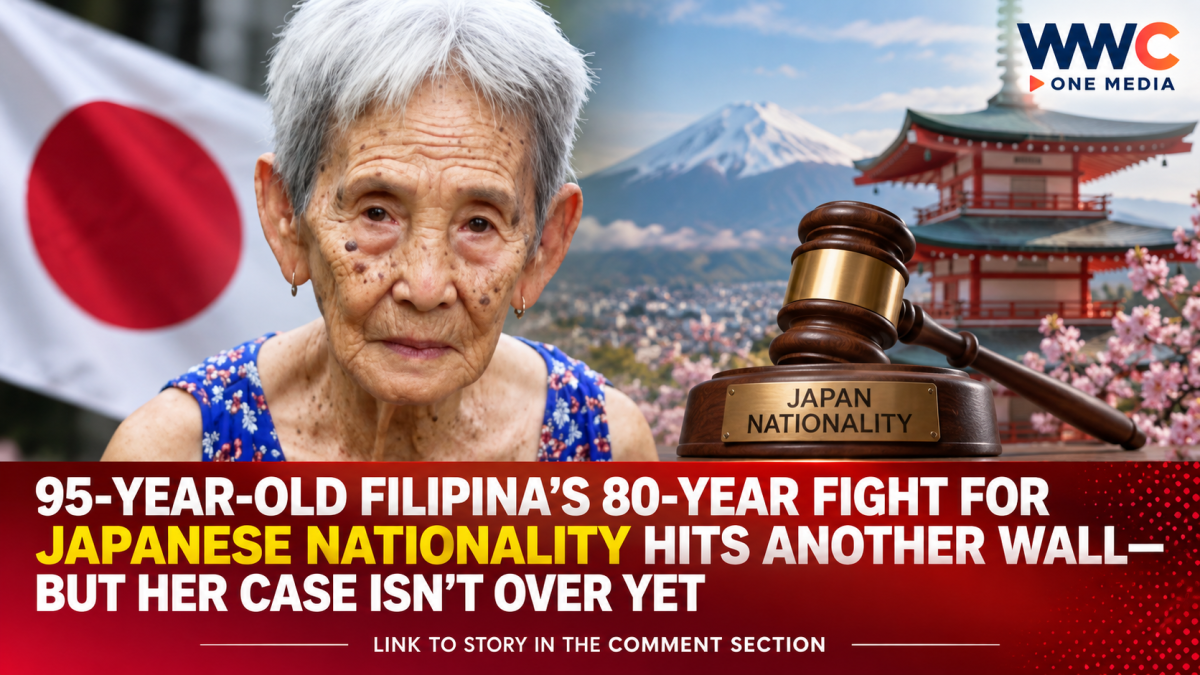
A 95-year-old woman of Japanese-Filipino descent who spent virtually her entire life in the Philippines after World War II has suffered another legal setback in her decades-long fight to be recognized as Japanese.
Rosalina Kamba Fernandez, a second-generation Japanese descendant left in the Philippines after the war, was denied Japanese nationality by the Hiroshima High Court’s Matsue branch, which upheld an earlier ruling rejecting her petition to establish a family registry in Japan.
The high court’s decision, dated September 9, 2026, found that although there was a high probability that Fernandez’s alleged father was her biological father and was a Japanese national when she was born, the available evidence did not establish the legally recognized parent-child relationship required under the applicable nationality rules.
But Fernandez’s fight is not over.
Her legal team and the Philippine Nikkei-jin Legal Support Center say they plan to file a special appeal with Japan’s Supreme Court, potentially turning her case into another major test of how Japan’s courts treat descendants of Japanese nationals separated from their families by the chaos of World War II.
A family separated by war
Fernandez was born in the Philippines to a Filipino mother and Rita Kamba, a Japanese man originally from what is now Hoki, Tottori Prefecture.
Her father had moved to the Philippines before the war. After Japan’s defeat, he was repatriated to Japan, leaving Fernandez and her mother behind.
Fernandez has said she met her father only once, when she was around 10 years old.
The problem that followed was bigger than simply being separated from her father.
Important documents that could have established her parents’ relationship were reportedly lost or destroyed during the war. That left Fernandez without the documentary evidence Japanese courts have required to establish the legal relationship between her and her Japanese father.
DNA evidence was not enough
Fernandez’s case gained renewed attention after evidence emerged connecting her to Kamba’s family in Japan.
A DNA test supported the biological relationship, while information about her father’s identity and memories from her childhood helped investigators trace his family in Tottori.
During a government-supported trip to Japan in January 2026, Fernandez visited Hoki, her father’s hometown, met people who had known him and visited his grave. The Japanese Foreign Ministry officially supported the trip as part of its continuing assistance to Filipino-Japanese descendants seeking recognition of their Japanese nationality.
Despite those developments, the courts maintained that biological evidence alone did not establish the legal parent-child relationship required for her petition.
The Hiroshima High Court reportedly acknowledged the high probability that Kamba was Fernandez’s biological father and that he held Japanese nationality when she was born. However, it concluded that there was insufficient evidence of a legally recognized relationship, including evidence concerning the parents’ marriage.
This was not her first rejection
Fernandez had already tried to secure Japanese nationality in 2024, when the Tokyo Family Court rejected her earlier petition because evidence concerning her parents’ marital status was considered insufficient.
She maintained that documents that could have proven the marriage had been destroyed during the war.
She filed another petition with the Yonago branch of the Tottori Family Court in March 2026 after her January trip to Japan and the discovery of additional evidence connected to her father. That petition was rejected in June.
She then appealed to the Hiroshima High Court’s Matsue branch.
The September ruling has now closed another door—but her lawyers intend to try the Supreme Court.
Fernandez is not alone
Her case is part of a much larger and painful postwar story.
After World War II, Japanese men who had settled in the Philippines were separated from Filipino families as Japan repatriated many of its nationals. Some children remained in the Philippines with their Filipino mothers.
Many descendants subsequently struggled to prove their Japanese ancestry because wartime destruction, separation and the loss of family records made documentation extremely difficult.
The Philippine News Agency reported in 2025 that Japan and support organizations estimated that thousands of Japanese descendants had been left in the Philippines after the war. At that time, around 50 living second-generation descendants were still hoping to obtain Japanese nationality, while many others had already died without securing recognition.
Japan has assisted many descendants over the years. The Nippon Foundation previously reported that hundreds had obtained Japanese nationality through shuseki, a family-court procedure allowing a person to establish a family registry.
The Philippine Nikkei-jin Legal Support Center continues to assist descendants with family tracing, documentation and legal recognition.
A legal battle over what makes someone a Japanese child
At the heart of Fernandez’s case is a difficult legal question: Should biological evidence be enough to establish Japanese nationality when the documents needed to prove a legal family relationship were destroyed by war?
That question is also appearing in other cases involving Filipino descendants of Japanese fathers.
Japanese media have reported that several other second-generation descendants are pursuing cases before the Supreme Court after lower courts rejected their nationality claims.
Supporters and legal experts have argued that modern DNA testing can establish biological relationships that were impossible to document decades ago, while the courts have continued to wrestle with the requirements of Japan’s historical nationality law.
Fernandez’s case therefore goes beyond one woman’s personal search for recognition.
It raises a question about how far the Japanese legal system should go in addressing the consequences of a war that ended more than 80 years ago—particularly when the missing documents were themselves casualties of that conflict.
For Fernandez, however, the issue is deeply personal.
At 95, she is still fighting to have the country of her father’s birth recognize the connection she says war took from her as a child.
And now, her final legal battle may move to Japan’s Supreme Court.


Leave a Reply