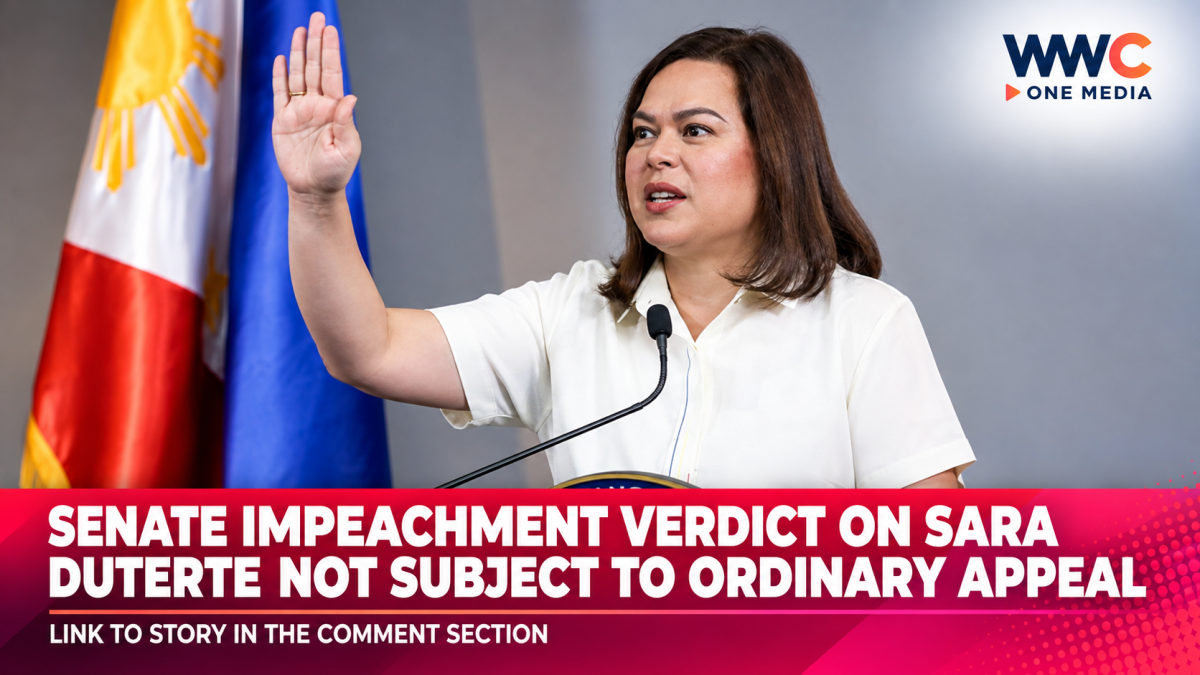
A final verdict by the Senate Impeachment Court in Vice President Sara Duterte’s impeachment trial would not be subject to an ordinary appeal, according to House lead prosecutor Gerville Luistro, although the Supreme Court could still examine claims of grave abuse of discretion amounting to lack or excess of jurisdiction.
Luistro made the clarification as the Senate prepares to continue Duterte’s impeachment trial, following the court’s recent ruling on how the constitutional two-thirds voting requirement will be calculated. She said the Constitution gives the Senate the sole power to try and decide impeachment cases.
Under the Constitution, an impeachment judgment is limited to removal from office and disqualification from holding public office. Such a judgment does not prevent separate criminal or civil proceedings under ordinary law when applicable.
Luistro said this means there is no ordinary mechanism for Duterte or the prosecution to appeal a final acquittal or conviction by the Senate Impeachment Court. She distinguished this from the Supreme Court’s authority to review whether the impeachment court committed grave abuse of discretion amounting to a jurisdictional defect.
The issue comes after the Senate Impeachment Court on September 23 overturned its earlier interpretation that 16 of the 24 senators would always be required to convict. By a 13-1 vote, with six senator-judges not participating, the court ruled that the two-thirds requirement would be calculated using senators who are legally and factually capable of participating when judgment is rendered.
The ruling did not change the Constitution’s two-thirds requirement. Instead, it changed the basis for determining the number of senators included in the denominator. Under the court’s example, if 20 senator-judges are legally and factually capable of participating at the time of judgment, 14 votes would be required for conviction.
The court identified circumstances that could exclude a senator from the voting base, including detention or suspension, legal restraint, unknown whereabouts while being sought by authorities, physical or medical incapacity, or situations in which the senator is beyond the Senate’s coercive processes. Any fractional result in the two-thirds calculation would be rounded up.
The ruling was expressly limited to Duterte’s impeachment trial and was described as pro hac vice, or applicable only to the present case. It does not establish a binding rule for future impeachment courts, although it may serve as persuasive guidance.
Luistro said the prosecution welcomed the clarification but stressed that the new voting formula should not be interpreted as an indication of how the Senate will eventually rule on the charges. The prosecution is continuing to present its evidence, and the witness list remains unchanged.
The threshold ruling is also facing a separate legal challenge. A petition has been filed before the Supreme Court seeking to void the Senate court’s revised interpretation of the voting requirement.
The impeachment trial is scheduled to resume with the presentation and examination of witnesses and evidence. The final number of votes required for conviction or acquittal will depend on which senator-judges are legally and factually capable of participating when the Senate Impeachment Court eventually votes on the verdict.