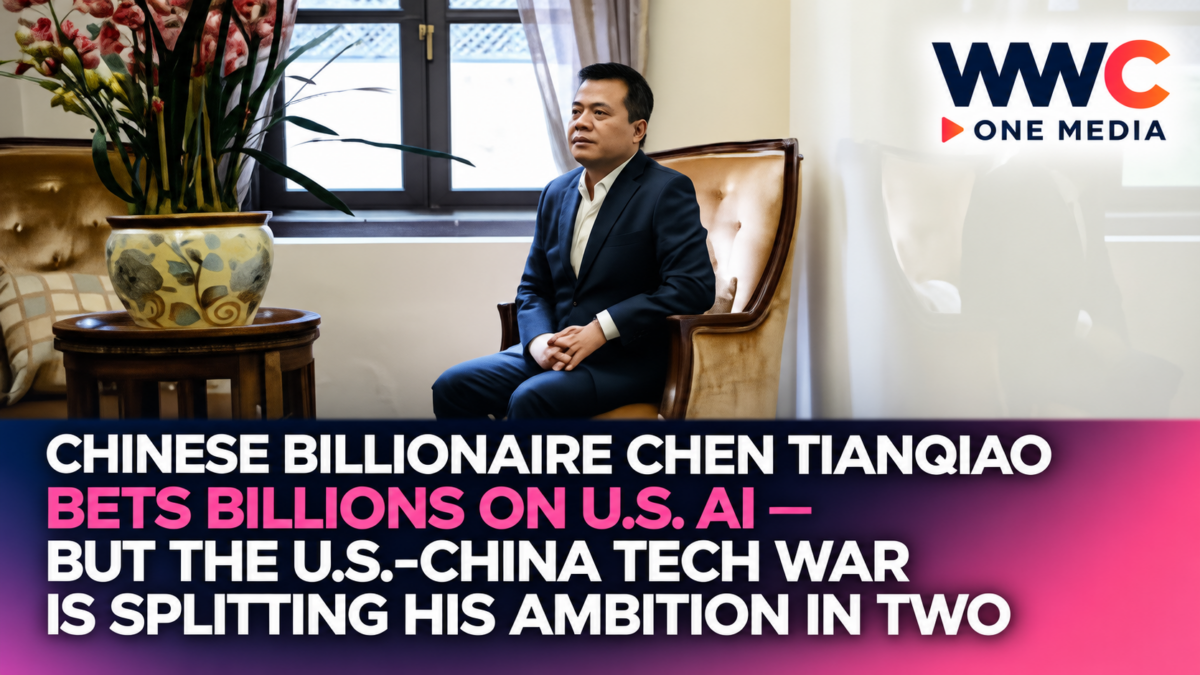
SILICON VALLEY/SINGAPORE — Chinese gaming billionaire Chen Tianqiao is betting billions of dollars of his personal fortune on artificial intelligence, but his second act in technology has run into a force even money cannot easily overcome: the widening technological wall between the United States and China.
Chen, best known for creating online-gaming pioneer Shanda, has spent the past two years trying to build a global AI company capable of combining American capital and computing power with Chinese engineering talent and a base in Singapore.
His startup, MiroMind, initially spread operations across California, Singapore, Beijing and Shanghai.
On paper, the structure looked powerful.
Silicon Valley offered access to frontier AI infrastructure and researchers.
China offered one of the deepest pools of engineering talent in the world.
Singapore provided a neutral regional base between the two.
But as Washington and Beijing tightened controls over advanced technology, talent and cross-border data flows, that global structure became increasingly difficult to maintain.
By 2026, Chen had pulled MiroMind’s operations out of mainland China, separated teams and technology across jurisdictions, and rebuilt the company largely around the United States and Singapore.
The experience has become a case study in how the U.S.-China AI rivalry is changing the way global technology companies are built.
Chen Tianqiao already built one Chinese technology empire
Chen is not a typical AI founder.
He created Shanda in 1999 and became one of the pioneers of China’s online-gaming industry.
The company’s success eventually produced several public listings, while Chen became one of China’s earliest internet billionaires.
Shanda’s parent company was taken private in 2012 and transformed into a family-owned global investment group with holdings spanning technology, healthcare, finance and real estate.
Chen and his wife, Chrissy Luo, also committed $1 billion to neuroscience research through the Tianqiao and Chrissy Chen Institute, working with institutions including Caltech.
For years, Chen appeared to have largely stepped away from the kind of operating role that made him famous during China’s early internet boom.
Artificial intelligence brought him back.
He is willing to spend billions personally
The Financial Times reports that Chen has committed around $2 billion of his own money to his AI push, with another $2 billion potentially available if necessary.
Bloomberg had earlier reported that Chen was personally financing a multibillion-dollar attempt to build what he describes as AI capable of going beyond ordinary language generation toward what he calls “discoverative intelligence.”
That makes his strategy very different from the standard Silicon Valley startup model.
Most AI founders spend enormous amounts of time raising money.
Chen already has capital.
His bigger constraints are now:
talent;
compute;
regulation;
and geopolitics.
Those problems are harder to solve with a cheque.
MiroMind was designed as a cross-border AI company
MiroMind originally embodied Chen’s global strategy.
The company was based in California but had development activities spread across Singapore and China.
Its research focused heavily on AI reasoning and autonomous research agents rather than consumer chatbots.
MiroMind described its systems as capable of repeatedly planning, executing, verifying and improving their work rather than simply generating a single answer.
The company launched mobile and web products in March and promoted its models as tools for complex research, science and financial analysis.
At first, Chen believed the geographic split could give MiroMind the best of multiple ecosystems.
Then the political environment changed.
The Manus episode became a warning
One major trigger was Beijing’s scrutiny of Manus, another Chinese-founded AI company that moved operations abroad.
Chinese authorities became increasingly concerned that valuable AI technology and technical talent could be transferred overseas without government oversight.
That scrutiny spread across companies attempting what became informally described as “China-shedding”—moving legal entities, employees or technology outside the country to gain better access to Western investment and infrastructure.
MiroMind found itself caught directly in that environment.
Chen said his company began erecting internal barriers between regional teams after Chinese authorities raised concerns about cross-border technology transfers.
Code, information and personnel increasingly had to be separated according to jurisdiction.
For an AI laboratory built around collaboration, that created an obvious problem.
MiroMind ultimately stopped serving China
In May, MiroMind suspended its services in mainland China, Hong Kong and Macau, officially citing business adjustments.
South China Morning Post reported that some employees had already been relocated to Singapore as the company reorganized itself around compliance requirements.
That represented a dramatic reversal.
A company founded by one of China’s most famous technology entrepreneurs was effectively withdrawing from the very market that produced its founder’s first fortune.
And the decision was not simply commercial.
It reflected growing uncertainty over whether an AI company could simultaneously operate inside China and remain fully integrated with American research, financing and computing infrastructure.
Chen also lost part of his original Chinese team
The restructuring reportedly created internal conflict.
The FT says prominent Chinese AI scientist Dai Jifeng, who had worked within MiroMind’s broader research organization, remained in China and later formed a separate company with former colleagues.
That episode demonstrates one of the hidden costs of geopolitical fragmentation.
A company can move its corporate registration.
It can move servers.
It can move financing.
Moving people is harder.
Researchers have families, careers, academic networks and personal ties.
When governments force companies to choose jurisdictions, some of the talent may choose differently from management.
That can split research teams that were originally designed to work together.
Singapore became the middle ground
Singapore has become increasingly important to Chen’s strategy.
Reuters reported earlier this year that the city-state is emerging as a neutral base for AI companies navigating the U.S.-China technology rivalry.
More than 50 Chinese-linked AI companies had established or expanded operations there since 2024, while major U.S. companies including OpenAI and Anthropic also strengthened their presence.
Singapore offers several advantages:
political stability;
strong intellectual-property protections;
English-language business culture;
access to Asian talent;
relatively quick immigration processes;
and relationships with both Washington and Beijing.
For companies uncomfortable choosing completely between the U.S. and China, Singapore can appear to offer a third option.
But even that neutrality has limits.
Singapore cannot erase U.S.-China restrictions
Reuters warned that Beijing has already become more sensitive to companies using Singapore as a way to distance themselves from Chinese regulatory oversight.
Washington is also watching whether Singapore could become a route around U.S. technology restrictions.
That means the city-state can reduce geopolitical friction.
It cannot eliminate it.
A company using advanced U.S. chips still has to obey U.S. export rules.
Chinese employees may remain subject to Chinese laws governing data and technology.
Investors may still scrutinize founders’ national backgrounds.
Governments may still ask where intellectual property was created.
MiroMind’s experience shows that simply placing a headquarters in Singapore does not magically turn a cross-border AI company into a geopolitically neutral one.
Chen’s focus has now shifted toward Apodex
As MiroMind’s structure changed, Chen also began emphasizing a new AI system called Apodex.
Apodex describes itself as an AI platform built for scientific and industrial discovery rather than simple conversation.
The company says its models are designed to conduct long-horizon research by:
planning investigations;
retrieving evidence;
using tools;
testing hypotheses;
cross-checking sources;
and verifying conclusions.
Apodex 1.0 launched in June.
Its heavier research mode uses teams of agents that specialize, check one another and audit evidence before producing answers.
The company says development is centered in the United States and Singapore.
That geographic description is revealing.
China is no longer part of the core positioning.
Chen wants AI to discover things humans do not yet know
Most current generative AI is exceptionally good at reorganizing existing information.
Chen wants something more ambitious.
He argues that the next stage should involve AI systems capable of producing genuinely new discoveries.
Apodex frames this goal as moving from “reasoning” toward “discovery.”
Chen has written that he wants the system eventually to contribute to discoveries worthy of the world’s highest scientific prizes.
The aspiration is enormous.
Potential applications include:
drug discovery;
materials science;
biology;
chemistry;
engineering;
and complex industrial research.
Instead of competing directly with ChatGPT as a mass-market chatbot, Chen appears to be aiming at extremely difficult, high-value research problems.
That could be a smarter commercial niche
The consumer AI market is already crowded.
OpenAI.
Google.
Anthropic.
Meta.
xAI.
Alibaba.
DeepSeek.
ByteDance.
Competing directly with those companies for ordinary chatbot users would require enormous marketing and infrastructure spending.
Scientific and industrial AI offers a different route.
If Apodex can genuinely help:
pharmaceutical companies discover molecules;
researchers solve complex scientific problems;
engineers optimize difficult designs;
or companies complete months of research in days,
customers could potentially pay far more per task than consumers pay for chatbot subscriptions.
That may explain Chen’s decision to reposition the business around discovery.
Chen reportedly wants $1 billion in revenue
The FT says Chen has set extraordinarily aggressive commercial goals.
He wants the company to reach roughly $1 billion in annual revenue and pursue a public listing by the end of 2027.
That timeline is extremely ambitious.
Apodex is still a young product.
AI research tools must earn trust from scientists and enterprises.
Benchmark success does not automatically translate into commercial adoption.
And many potential customers will demand:
security;
reliability;
auditability;
technical support;
and proof that AI-generated research is actually correct.
The jump from promising research system to billion-dollar business is enormous.
AI talent may be harder to buy than Chen expected
Chen has money.
But the FT reports he has still struggled to recruit some of the world’s best AI researchers.
The competition is intense.
Meta, OpenAI, Google DeepMind, Anthropic, xAI and other companies are already offering extraordinary compensation packages.
Researchers with frontier-model experience can command packages worth millions of dollars.
That means a new lab needs to offer more than salary.
It needs:
prestige;
compute;
interesting research;
top colleagues;
career security;
and confidence the company will survive.
Chen’s Chinese background can add another layer of uncertainty in the United States as policymakers scrutinize technology links with China.
Even citizenship and identity now matter to AI recruiting
The global AI race has transformed individual engineers into strategic assets.
Governments increasingly view researchers the way they once viewed semiconductor factories or military technology.
That creates uncomfortable questions for internationally minded founders.
Where was the researcher trained?
What nationality do they hold?
Which government funded their work?
Can they access American chips?
Can they move code across borders?
Can they publish certain technology?
Can they work with colleagues in China?
Those questions barely mattered during the early internet boom.
They now shape how AI companies are structured from day one.
Chen’s first empire benefited from globalization
The contrast with Shanda is striking.
Chen built his first technology fortune during an era when the internet was becoming more global.
Capital flowed across borders.
Technology companies listed overseas.
Chinese internet firms accessed U.S. markets.
Foreign software and games entered China.
American investors eagerly funded Chinese growth.
Shanda itself had Nasdaq-listed businesses before its parent was later taken private.
Artificial intelligence is emerging under almost the opposite conditions.
The two largest technology powers increasingly treat AI as national strategic infrastructure.
Chips have become a geopolitical weapon
Advanced semiconductors are one of the clearest examples.
Washington has spent years restricting China’s access to leading AI chips and chipmaking technology.
Beijing has responded by accelerating domestic semiconductor development and strengthening controls around strategically important technology.
That forces globally distributed AI laboratories to think carefully about where training actually occurs.
A model trained on American-controlled Nvidia systems may face restrictions if the technology is transferred to certain Chinese entities.
An AI company operating in China may face Chinese controls when moving valuable technology abroad.
A founder trying to bridge both sides can become trapped between the two regulatory systems.
That is essentially what happened to Chen.
Data create another border
AI systems also depend on enormous amounts of information.
Different countries impose different rules around:
privacy;
cybersecurity;
cross-border data transfers;
national-security information;
and intellectual property.
A global AI research team may therefore discover that even when engineers can collaborate, the underlying datasets cannot move freely.
That reduces one of the fundamental advantages of multinational research:
putting the best people and resources together regardless of geography.
Chen’s response has been to split the company
Rather than continue operating one deeply integrated U.S.-China structure, MiroMind increasingly separated its jurisdictions.
That reduces regulatory risk.
But it also sacrifices efficiency.
Engineers may not share everything.
Infrastructure may need to be duplicated.
Legal costs rise.
Compliance becomes more complicated.
Management becomes harder.
And some of the economic advantage of having a global team disappears.
This is the hidden tax of technological decoupling.
Nobody sends the company an invoice for it.
But the company pays anyway.
America risks losing access to Chinese AI talent
The U.S. also faces a contradiction.
It wants to prevent sensitive technology from strengthening Chinese competitors.
But Chinese-born researchers have played major roles across American universities and technology companies.
If restrictions become too broad, talented researchers may decide the U.S. is no longer welcoming.
That could ultimately weaken American innovation.
Singapore is already benefiting from some of that uncertainty.
Reuters found U.S. and Chinese-linked AI companies increasingly using the city-state to hire talent that is difficult to move directly between the two superpowers.
China faces the opposite risk
Beijing wants to prevent valuable AI technology and researchers from leaving.
But aggressive restrictions can encourage companies to relocate even earlier.
If a Chinese entrepreneur believes expanding abroad later will become difficult, they may choose to establish the company outside China from the beginning.
That could deprive China of:
future tax revenue;
jobs;
intellectual property;
and corporate headquarters.
This is the paradox of technology controls.
They can protect strategic assets.
They can also push those assets away.
MiroMind may be an early warning
Chen’s company is unusual because its founder has enough money to absorb the cost of restructuring.
Most startups do not.
A smaller company trying to maintain separate:
Chinese teams;
American teams;
Singapore operations;
legal structures;
data systems;
and computing environments
could simply run out of money.
That may eventually produce a much more divided global AI ecosystem.
Companies will increasingly choose one strategic bloc.
U.S.-aligned AI.
Chinese AI.
And perhaps a smaller group operating through countries such as Singapore, the UAE or other relatively neutral markets.
Apodex could benefit from the split
There is another possibility.
Being forced to simplify the structure may actually help Chen.
A business concentrated in the U.S. and Singapore has a clearer regulatory identity.
That could make it easier to win American enterprise and government customers.
Apodex openly describes itself as being developed in those two markets.
For customers concerned about Chinese technology exposure, that distinction may matter.
Chen may have lost access to part of his original Chinese operation.
But he may have gained a cleaner path toward Western commercialization.
The biggest question is whether customers will trust the separation
Corporate restructuring does not instantly erase political perception.
U.S. companies and government agencies may still ask about Chen’s Chinese background, previous operations and historical relationships.
Chinese authorities may continue to scrutinize whether technology created by Chinese researchers is being moved abroad.
That leaves Chen in the unusual position of potentially having to prove two opposite things simultaneously:
to American customers, that his AI company is sufficiently independent from China;
and to Chinese authorities, that valuable Chinese-origin technology was not improperly transferred.
That is the real difficulty of trying to operate between rival superpowers.
Chen is betting the opportunity is still worth it
Despite the setbacks, he has not retreated from AI.
He is pouring billions into compute.
MiroMind previously discussed plans for infrastructure involving more than 10,000 Nvidia Blackwell GPUs.
Apodex continues releasing new research systems.
Chen continues talking publicly about building AI capable of genuine scientific discovery.
And the FT says he remains determined to build a major American AI company despite the geopolitical complications.
That confidence may ultimately be his biggest advantage.
He can afford to take risks that most startup founders cannot.
But billions cannot buy geopolitical neutrality
That is the larger lesson from Chen Tianqiao’s second technology career.
His first fortune was built when technology globalization was accelerating.
His second is being built while globalization in strategic technology is fragmenting.
The engineering problem may be difficult.
The political problem may be harder.
You can buy GPUs.
You can recruit engineers.
You can open offices in California and Singapore.
You can spend billions developing better models.
What you cannot easily buy is permission for technology, talent and data to move freely between rival superpowers.
Chen Tianqiao wanted to build an AI company that could draw strength from both China and the United States.
Instead, he has become one of the clearest examples of why the industry may increasingly be forced to choose.
And if MiroMind and Apodex eventually succeed, the bigger story may not simply be that a former Chinese gaming billionaire built another technology empire.
It may be that he managed to build one after the global AI market had already begun splitting in two.