
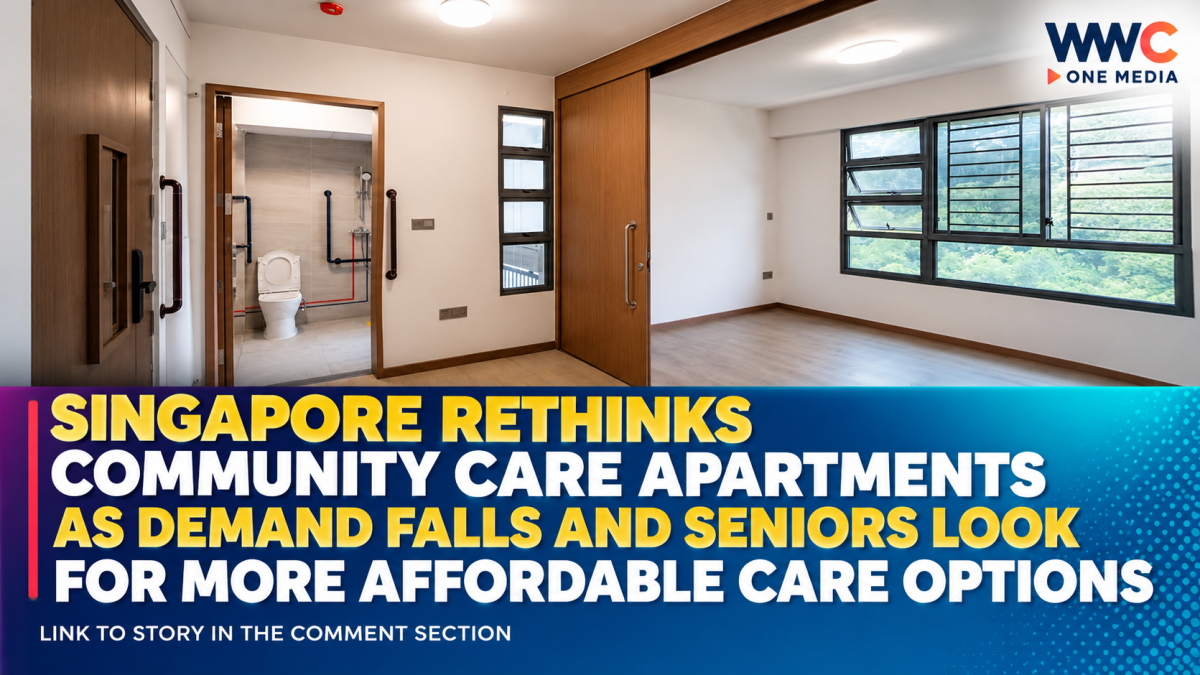
SINGAPORE — Singapore’s Community Care Apartments were once seen as a promising new answer to one of the country’s biggest challenges: how to help a rapidly ageing population live independently while still having care close at hand.
But demand for newer projects has weakened sharply.
Now, the Government is making major changes.
The eligibility age is being lowered from 65 to 55, monthly Basic Service Package fees are being reduced, and some services are being streamlined as Singapore tries to make Community Care Apartments — or CCAs — more affordable and attractive to older residents.
The changes come after application rates fell dramatically across successive projects, raising a bigger question about how Singaporeans want to spend their later years.
Do seniors want to move into purpose-built assisted living communities — or would they rather stay in the homes and neighbourhoods they already know?
That question is becoming increasingly important as Singapore enters its super-aged era.
From oversubscribed to undersubscribed
Singapore’s first Community Care Apartment project, Harmony Village @ Bukit Batok, generated strong demand when it was launched.
About 706 applicants competed for 169 units, producing an application rate of approximately 4.2.
In other words, more than four applicants were competing for every available flat.
The second project in Queenstown was also oversubscribed.
But the application rate dropped to around 1.6.
Then demand weakened further.
The next three projects were undersubscribed.
The latest project, Fernvale Plains in Sengkang, recorded the lowest application rate at just 0.7.
That means there were fewer applicants than available units.
The trend has forced policymakers to take a closer look at the model.
Singapore’s Health Minister Ong Ye Kung said earlier this year that CCAs had initially been popular, but demand had moderated significantly as more assisted-living and community-care options became available.
The Government subsequently indicated that it would slow the launch of new Community Care Apartments while reviewing how the model could be improved.
What exactly are Community Care Apartments?
Community Care Apartments are a specialised form of public housing designed for seniors who want to continue living independently but may need easier access to care and support.
Introduced in 2021, CCAs combine:
- Senior-friendly flat designs
- Care and support services
- Social activities
- Emergency response
- Optional care services
- Access to nearby community amenities
The model is designed to help seniors remain independent while allowing their care needs to increase over time.
Every resident must subscribe to a Basic Service Package, or BSP, while additional optional services can be added depending on individual needs.
The apartments are designed for seniors with low to moderate care needs rather than people who require intensive, permanent assistance.
But the cost became a major concern
One of the biggest issues appears to have been affordability.
The cost of the Basic Service Package increased significantly over the years, particularly when measured over the full duration of a lease.
At Harmony Village @ Bukit Batok, the first completed project, a resident choosing a 15-year lease originally had options involving lower upfront and monthly payments.
But the costs later rose substantially.
For newer projects, the Basic Service Package could cost tens of thousands of dollars over the lease period.
For some seniors, that meant the combined cost of the flat and mandatory services could become a significant financial commitment.
The AsiaOne report, citing The Straits Times, noted that a senior taking up a 35-year lease at Fernvale Plains could face a total cost of around S$290,000, including approximately S$122,000 for the flat.
The remaining cost included the Basic Service Package.
For many older Singaporeans, the question became simple:
Why move and pay more when other care options are available?
Singapore cuts fees and lowers the age limit
The Government’s response is now underway.
From the October 2026 Build-To-Order exercise, the minimum age to apply for a Community Care Apartment will be lowered from 65 to 55.
The move gives Singaporeans who want to right-size their homes more options earlier.
Instead of waiting until 65, eligible residents from 55 can consider:
- A short-lease two-room Flexi flat
- A Community Care Apartment
- Other ageing-in-place arrangements
The Government said the change will give seniors more time to plan for their future housing and care needs.
Monthly Basic Service Package fees will also fall.
Depending on eligibility and the services involved, the changes are expected to reduce monthly payments by between 18 per cent and 75 per cent.
The Government is also introducing subsidies for eligible residents for specific components of the service package.
Some services are being streamlined
The Government is also changing how care and social services are delivered.
For Community Care Apartments that begin operating from 2026 onwards, some services will be streamlined based on feedback from seniors.
One example is the emergency alert device feature, which can be made optional.
Authorities are also looking at ways to reduce costs by running activities through nearby Active Ageing Centres or shared community spaces instead of maintaining separate facilities inside every CCA development.
The goal is to preserve important support while reducing the overall cost of the service package.
But existing services at Harmony Village @ Bukit Batok are expected to continue operating as normal.
The bigger problem may not just be money
Lower fees could help.
But analysts say affordability may not be the only reason demand has weakened.
Many seniors simply do not want to leave the places they already call home.
A person may have lived in the same HDB estate for decades.
Their friends may live nearby.
Their favourite coffee shop is downstairs.
Their doctor is familiar.
Their neighbours know them.
Moving into a new development — even one designed specifically for seniors — can feel emotionally difficult.
Associate Professor Wee Shiou Liang of the Singapore University of Social Sciences told CNA that the decline in demand reflects a preference among many older residents to age in place, rather than a fundamental problem with the apartments themselves.
Another analyst described the barriers as partly mental, with CCAs tending to appeal most strongly to seniors who already have mobility or health concerns.
That creates a difficult challenge.
A Community Care Apartment may make perfect practical sense.
But emotionally, many seniors may still prefer to stay where they are.
Singapore now has more choices for seniors
When Community Care Apartments were first introduced, they were a relatively new model.
Today, seniors have more options.
Singapore has been expanding a broader range of housing and care arrangements, including:
Age Well Neighbourhoods
Neighbourhood-based programmes designed to help seniors remain active, connected and supported in their existing communities.
Shared Stay-In Senior Caregiving Services
Arrangements allowing seniors to share caregiving support while remaining in a home environment.
Two-room Flexi flats
Smaller HDB flats with shorter lease options for older residents who want to right-size.
Home-based care
Seniors can increasingly access care services without permanently leaving their homes.
Domestic helpers and private caregiving
Some households may choose to bring care directly into the home instead.
The growing range of choices is good news for seniors.
But it also means Community Care Apartments now face much stronger competition as a housing-and-care option.
The first CCA was popular — but the market changed
When Singapore first announced plans to expand Community Care Apartments, the Government had ambitious expectations.
Earlier plans suggested that up to 30 CCA projects could be launched by 2030 if the model proved effective and scalable.
At the time, the first projects received strong interest.
But the landscape has changed.
Singapore now has:
- More community-based care
- More ageing-in-place programmes
- More housing choices
- More home-care services
- More alternatives to institutional care
As these options have expanded, the appeal of moving into a specialised senior housing development appears to have weakened for some older Singaporeans.
The Government has now said it plans to slow down future launches.
A sixth project is still coming
Despite weaker demand, Community Care Apartments are not being abandoned.
Singapore has already launched five projects in:
- Bukit Batok
- Queenstown
- Bedok
- Geylang
- Sengkang
A sixth project is scheduled to launch in Toa Payoh during the October 2026 BTO exercise.
The project will be located near Caldecott MRT station and is expected to offer about 260 Community Care Apartments.
The new lower age limit could significantly expand the pool of potential applicants.
Instead of targeting only residents aged 65 and above, the Toa Payoh launch will also be open to eligible Singaporeans aged 55 and above.
Singapore is getting older — and the housing challenge is getting bigger
The issue extends far beyond Community Care Apartments.
Singapore’s population is ageing rapidly.
The country has now reached super-aged status, with seniors making up a growing share of the population.
At the same time, more elderly residents are living alone.
According to Singapore’s Family Trends Report 2026, the number of residents aged 65 and above who live alone has more than doubled over the past decade.
That creates a major challenge.
How can Singapore ensure seniors remain:
- Safe
- Independent
- Socially connected
- Financially secure
- Close to care when they need it
There is unlikely to be one single solution.
Community Care Apartments are one part of a much bigger strategy.
Why moving at 55 may make more sense than moving at 65
One reason behind the lower age limit is practical.
A person who becomes eligible at 65 may not actually move into a newly built apartment until several years later.
By then, the physical and emotional demands of relocating could become more difficult.
Property analysts have suggested that giving people access to CCAs from 55 allows them to plan earlier and settle into a new environment while they are still relatively active and independent.
Christine Sun, chief researcher and strategist at Realion Group, told The Straits Times that moving at an earlier age could make the adjustment easier.
The broader pool of potential residents could also help create economies of scale that improve affordability over time.
But will lower prices actually bring seniors back?
That remains the big question.
Analysts are cautious.
CNA reported that the lower age threshold and reduced fees may increase interest, but they are unlikely to suddenly create overwhelming demand.
The strongest obstacle may still be the desire to remain in familiar surroundings.
For many seniors, ageing independently does not necessarily mean moving into a purpose-built senior development.
It means:
Staying in the same home.
Keeping the same neighbours.
Visiting the same market.
Remaining close to family.
Singapore’s future senior-care strategy may therefore need to focus just as much on bringing services into existing neighbourhoods as building new places for seniors to move into.
The future may be about choice, not one housing model
Singapore appears to be moving away from the idea that there is a single best solution for ageing.
Some seniors may want a Community Care Apartment.
Others may prefer a two-room Flexi flat.
Some may stay in their existing homes with home-care support.
Others may choose shared caregiving arrangements.
And some families may continue to rely heavily on family members and domestic helpers.
The challenge for policymakers is making sure these choices remain:
Affordable.
Accessible.
Flexible.
And available before a crisis happens.
The bottom line
Singapore’s Community Care Apartments were designed to help seniors age independently with care close by. But after demand dropped sharply in newer projects, the Government is now changing the model.
The eligibility age will fall from 65 to 55.
Monthly service fees will be reduced.
Eligible residents will receive additional subsidies.
And some services will be streamlined to lower costs.
The changes could make Community Care Apartments more attractive.
But they may not solve the biggest challenge of all.
Many Singaporeans simply do not want to leave the homes and neighbourhoods where they have built their lives.
That means the future of senior living in Singapore may not be about convincing everyone to move into one type of housing.
Instead, it may be about giving every senior something far more important:
The freedom to choose how — and where — they want to grow old.
WWC ONE MEDIA J.M.D




Leave a Reply