
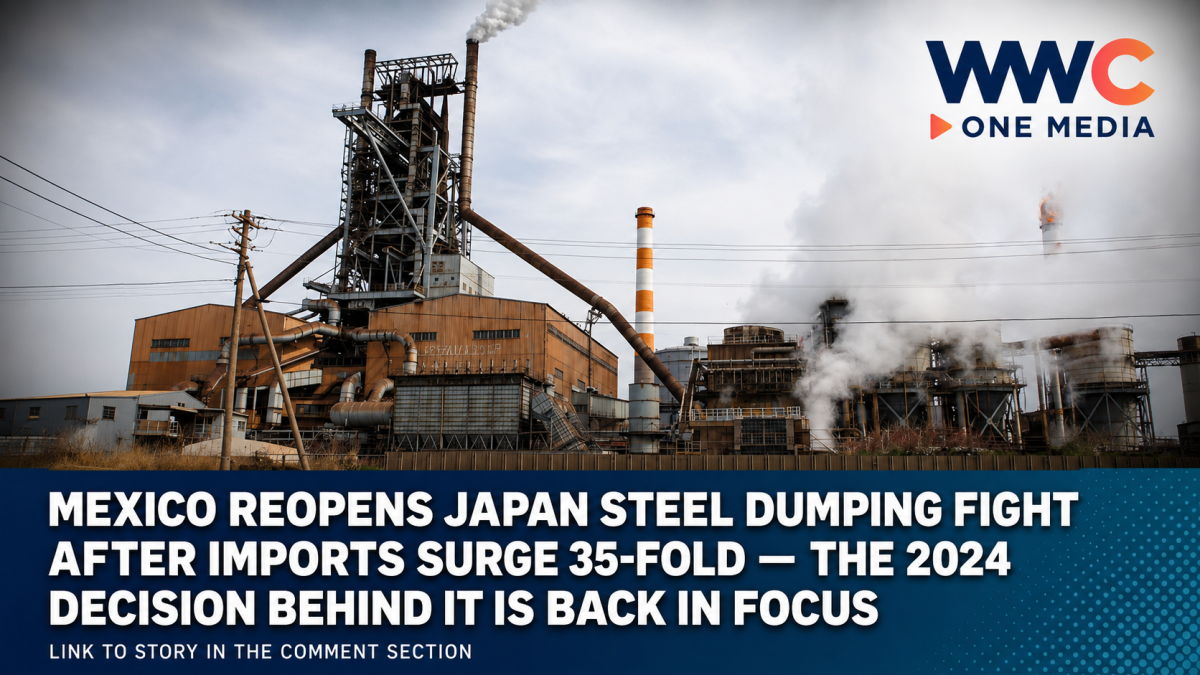
MEXICO CITY — Mexico has reopened a potentially consequential trade battle with Japan over steel, launching an anti-dumping investigation after authorities found preliminary evidence that imports of Japanese steel plate surged dramatically while entering the Mexican market at prices substantially below those charged by domestic producers.
Mexico’s Economy Ministry formally opened the investigation in a resolution published in the Diario Oficial de la Federación on September 2, following a complaint filed by Mexican producer Grupo Acerero.
The investigation covers certain hot-rolled, non-alloy carbon steel plate originating in Japan, regardless of the country from which it is ultimately shipped into Mexico. Reuters first reported the opening of the investigation internationally, with Channel NewsAsia carrying the report.
But the official Mexican filing reveals a much bigger story than the initial announcement.
JAPANESE IMPORTS ALLEGEDLY GREW 35-FOLD
According to the Economy Ministry’s preliminary analysis, imports of the Japanese steel products under investigation increased approximately 35 times between 2023 and 2025.
Japanese imports represented only about 0.2% of Mexico’s total imports of the investigated product in 2023. By 2025, that share had climbed to 8.3%.
Their share of Mexico’s apparent domestic consumption also rose sharply, from roughly 0.1% in 2023 to 4.5% in 2025. The ministry said Japanese imports increased about 21-fold in 2024 alone before growing another 61% during the 2025 investigation period.
That growth happened even as Mexico’s overall market for the product was shrinking.
Mexican apparent consumption of steel plate covered by the investigation fell 20% in 2024 and another 12% in 2025, producing a cumulative contraction of roughly 29% across the 2023–2025 analysis period.
Domestic production fell about 31% over the same period.
The contrast is central to Mexico’s case: while much of the market was contracting, Japanese imports were gaining ground.
THE PRICE GAP THAT TRIGGERED ALARM
Volume alone is not what prompted the investigation.
Mexican authorities said their preliminary analysis found Japanese steel plate entering the market at prices below those charged by the domestic industry.
The estimated price gap widened over the three-year period.
In 2023, Japanese imports were approximately 15% cheaper than Mexico’s domestic product. The gap widened to 17% in 2024 and reached about 24% in 2025.
Compared with steel plate imported from other countries, Japanese products were estimated to be 20% cheaper in 2023, 29% cheaper in 2024 and 27% cheaper in 2025.
Mexico’s Economy Ministry therefore concluded at the initiation stage that there was sufficient evidence to investigate whether the price difference reflected dumping — the practice of exporting goods at prices unfairly below their normal value.
That conclusion is preliminary.
Mexico has not yet made a final determination that Japanese companies violated anti-dumping rules, and the opening of an investigation does not automatically mean new anti-dumping duties will ultimately be imposed.
THE MOST IMPORTANT DETAIL: MEXICO HAS BEEN HERE BEFORE
The new investigation is particularly significant because Mexico previously imposed an anti-dumping duty on essentially the same category of Japanese steel plate.
A previous investigation resulted in Mexico imposing a definitive anti-dumping duty of US$0.236 per kilogram on Japanese-origin steel plate.
That measure remained in place until 2024.
Under trade rules, Mexico could have reviewed and potentially extended the measure before its five-year expiration. But Mexican authorities said no domestic producer submitted the required written request for a sunset review before the deadline.
As a result, Mexico formally eliminated the Japanese anti-dumping duty effective May 1, 2024.
That timeline is now impossible to ignore.
The old protection disappeared in May 2024. Mexico’s new filing says Japanese imports had already risen dramatically in 2024 and then increased another 61% in 2025.
The investigation will now determine whether that rise resulted from legitimate competition, changing market conditions or renewed dumping.
GRUPO ACERERO SAYS DOMESTIC PRODUCERS WERE HURT
Grupo Acerero filed the new case on April 21, 2026, alleging that Japanese-origin steel plate had entered Mexico under discriminatory pricing conditions and caused material injury to Mexican producers.
The Economy Ministry accepted 2025 as the formal dumping investigation period and January 2023 through December 2025 as the period for examining economic damage.
Grupo Acerero accounted for an estimated 56% of Mexican production of the relevant product over the broader analysis period and 62% during 2025. Ternium supported the petition, meaning producers representing the ministry’s calculation of 100% of Mexican production supported the investigation.
Authorities also cited deteriorating financial indicators.
The domestic industry’s operating margin linked to the product fell from positive 4.7% in 2023 to negative 5.8% in 2024 and negative 32.1% in 2025, according to the ministry’s preliminary calculations.
The industry moved from operating profits in 2023 to losses in the following two years.
Those figures will be closely scrutinized during the investigation because Japanese exporters and Mexican importers will have an opportunity to challenge the methodology, product comparisons, pricing calculations and alleged connection between imports and domestic losses.
JAPAN REMAINS A STEEL POWERHOUSE
The scale imbalance between the two countries adds another dimension to the case.
World Steel Association data show Japan produced approximately 80.7 million tonnes of crude steel in 2025, ranking fourth globally, while Mexico produced around 13.5 million tonnes.
For the specific steel plate market examined by Mexican authorities, the government said Japan held roughly 6.2% of global production in 2025.
More importantly, the investigation estimates Japan had around 6.4 million tonnes of unused production capacity for the relevant steel plate category in 2025 — more than seven times the size of Mexico’s apparent domestic market for the product.
Its calculated export potential was even larger, at approximately 8.1 million tonnes.
Mexico argues that this capacity increases the risk of Japanese exports continuing to expand if dumping is ultimately confirmed.
Again, those assertions remain part of an ongoing administrative proceeding rather than a final judgment against Japanese producers.
JAPAN WAS ALREADY MEXICO’S SECOND-LARGEST STEEL SUPPLIER
Broader steel-market figures show why the case matters beyond a relatively narrow product category.
According to CANACERO data reported by Argus Media, Mexico imported around 10.5 million tonnes of finished steel in 2025. Japan supplied roughly 1.67 million tonnes, making it Mexico’s second-largest source after the United States and slightly ahead of South Korea.
Mexico’s total finished-steel production fell about 8% in 2025, while domestic steel consumption declined roughly 10%.
That means any additional restrictions affecting Japanese steel could matter not only to mills but also to manufacturers, distributors, infrastructure companies and industrial buyers that depend on imported material.
NIPPON STEEL AND JFE STEEL AMONG COMPANIES IDENTIFIED
Mexico’s resolution identifies several Japanese companies as potential interested parties in the proceeding, including Nippon Steel Corporation, JFE Steel Corporation, Tokyo Steel Manufacturing, Hanwa and Mitsui & Co. Steel.
Their inclusion does not mean Mexican authorities have individually determined that those companies dumped steel.
Rather, they are among producers or exporters that may participate and submit evidence during the investigation.
Interested exporters, importers, producers and other qualified parties are being given an opportunity to respond to questionnaires, submit evidence and contest the allegations before Mexico reaches later-stage findings.
WHAT HAPPENS NEXT
Mexico’s investigation could eventually produce several outcomes.
Authorities could conclude that dumping did not occur or that Japanese imports did not cause sufficient injury, ending the case without additional duties.
Alternatively, Mexico could impose provisional measures while the investigation continues and eventually establish definitive anti-dumping duties if the evidence supports such action.
The September resolution also states that, under certain circumstances permitted by anti-dumping rules, definitive duties could potentially apply retroactively to goods entered for consumption up to 90 days before provisional measures take effect.
That possibility raises the stakes for importers.
A STEEL DISPUTE WITH A MUCH BIGGER BACKDROP
The case also comes as the global steel industry moves deeper into an era of trade barriers, industrial policy and defensive tariffs.
Mexico itself has been grappling with U.S. tariffs on steel and aluminum while negotiating broader trade issues with Washington. Reuters has reported that U.S. officials expect significant steel tariffs to remain part of the trade landscape even as Mexico and the United States continue discussions over their economic relationship.
Mexico, meanwhile, has stepped up enforcement and investigations aimed at protecting its domestic steel industry from imports it considers unfairly traded.
The Japanese case could therefore become another test of how far governments are willing to go to protect domestic industrial capacity even when the countries involved are major trading partners.
For now, there is no final ruling against Japan.
But the numbers that triggered the investigation are difficult to overlook: a 35-fold increase in imports, prices allegedly 24% below Mexican steel in 2025, and a previous US$0.236-per-kilogram duty that disappeared only in May 2024.
The question facing investigators now is whether those numbers reflect fierce but legitimate competition — or whether Mexico removed its old trade barrier only to discover that the problem it was designed to address had returned.
WWC ONE MEDIA MJE




Leave a Reply