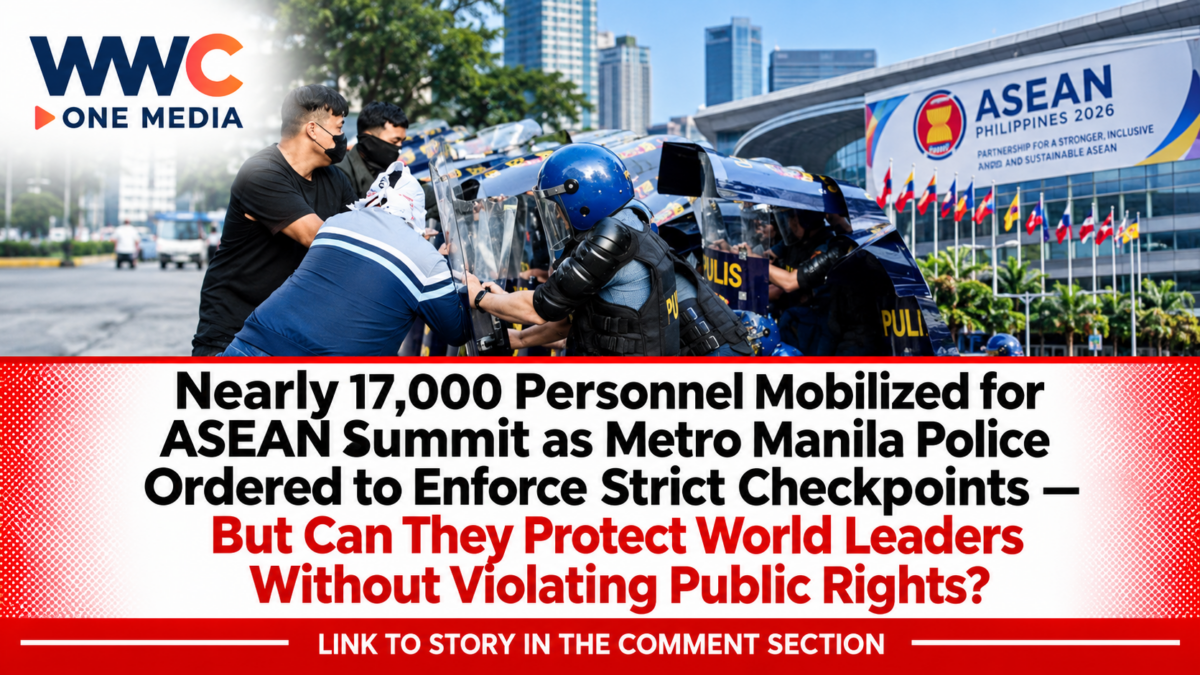
MANILA, PHILIPPINES — November 8, 2026 — Metro Manila police have been ordered to strictly enforce security checkpoints, identification screening and restricted-access zones ahead of the 49th ASEAN Summit, as the Philippines prepares to welcome foreign leaders for one of the region’s most important diplomatic gatherings.
But authorities are being given another equally important instruction: protect the public’s rights and treat ordinary Filipinos professionally.
National Capital Region Police Office (NCRPO) Officer-in-Charge Police Brigadier General Christopher Abrahano issued the directive as security preparations intensified around the Philippine International Convention Center (PICC) in Pasay City, where major summit activities will take place from November 16 to 18.
According to GMA Integrated News, Abrahano ordered police personnel to verify identification documents, official credentials and vehicle authorizations while enforcing restrictions around designated summit venues.
The announcement comes as the Philippine National Police (PNP) prepares a previously reported deployment involving 16,823 police officers and security support personnel across Metro Manila.
Authorities are also preparing for possible demonstrations, traffic disruptions and the arrival of international delegations through Manila and alternative gateways in Clark and Subic.
The PNP has described its current security assessment as involving a low-level threat, but it has not publicly confirmed a specific imminent attack on the summit.
The government now faces a challenge extending beyond securing the visiting dignitaries.
Can police enforce strict security measures without unnecessarily disrupting residents, commuters, businesses and the constitutional right to peaceful assembly?
NCRPO Orders Police to Enforce Security Checks With Professionalism
Abrahano directed police units to maintain a strong security presence around the summit’s official venues, delegate accommodations and designated transportation routes.
His November 8 statement emphasized that security restrictions are intended to prevent unauthorized access and protect both visiting officials and the public.
Police officers were instructed to implement every applicable security protocol consistently.
However, the NCRPO chief also required personnel to show courtesy and respect for individual rights.
The directive covers the verification of identification documents, credentials and vehicle authorizations.
Security personnel must also coordinate with venue administrators and local government officials to ensure that restrictions are applied properly.
The instruction is significant because thousands of residents, employees and motorists may encounter security checkpoints in the days surrounding the summit.
A valid security objective does not automatically justify discourteous treatment or arbitrary restrictions.
Officers are expected to enforce established procedures while keeping interactions with the public professional.
The NCRPO also reminded police units that their responsibilities extend beyond protecting foreign delegates.
They must maintain public safety in surrounding communities and respond to ordinary emergencies throughout Metro Manila.
PICC Exclusion Zones Will Restrict Unauthorized Entry
The Philippine International Convention Center will be one of the most heavily protected locations during the summit.
Security officials confirmed that designated exclusion zones will operate around the venue.
Individuals entering restricted areas will be subject to screening.
Vehicles will also require the appropriate authorization.
These measures are designed to prevent unauthorized entry into locations used by foreign leaders, government officials and summit personnel.
However, the announcement does not mean that all of Pasay City will become inaccessible.
Restrictions apply to designated security areas and affected road segments.
Employees, residents and businesses near the venue should follow the access arrangements announced by local authorities.
The latest police directive also requires officers to check reports of suspicious individuals, unusual activity and unattended objects near sensitive locations.
Such reports must be assessed using established procedures rather than treated automatically as proof of criminal activity.
The goal is to address potential security concerns without creating unnecessary panic or confusion.
Nearly 17,000 Personnel Included in ASEAN Security Operations
The scale of preparations reflects the importance of the international event.
According to an October 31 report by The Philippine Star, authorities planned to mobilize approximately 16,823 personnel for security operations.
The reported contingent includes 13,868 police personnel assigned to functions involving venues, official routes and delegate accommodations.
Another 2,955 personnel from the Metropolitan Manila Development Authority (MMDA) and participating local governments are expected to provide support.
The participating local governments include Manila, Pasay, Parañaque, Makati and Taguig.
Police preparations also include medical personnel who can assist during emergencies.
The personnel are not all assigned to the PICC.
They will support different security functions across the capital, including transportation routes, accommodations, public areas and contingency operations.
As previously reported by WWC ONE MEDIA, preparations have expanded beyond Metro Manila, with Clark and Subic identified as alternative arrival gateways for visiting delegations.
Related WWC ONE MEDIA coverage: Philippines Deploys Nearly 17,000 Security Personnel for ASEAN Summit as Clark and Subic Become Backup Gateways — But Can Authorities Protect World Leaders Without Paralyzing Metro Manila?
The previously announced deployment figure could be adjusted as security planners finalize operational requirements.
PNP Monitors Low-Level Security Threat
PNP chief Police General Jose Melencio Nartatez Jr. confirmed on November 6 that authorities were monitoring what he described as a low-level threat ahead of the summit.
The assessment forms part of preparations to protect international leaders, delegates and the public.
Nartatez said the police have sufficient personnel, logistical resources and funding to support the security operation.
Police intelligence units will continue evaluating potential concerns as the gathering approaches.
However, a low-level threat assessment should not be mistaken for confirmation that authorities have identified a specific terrorist plot or imminent attack.
The PNP has not publicly established such a threat in the reporting reviewed.
Security preparations for major diplomatic events typically involve preventive measures, contingency planning and coordination among several agencies.
Abrahano’s latest directive is consistent with that approach.
He wants every checkpoint, access point and reported security concern handled carefully.
At the same time, police must continue protecting ordinary communities throughout Metro Manila.
Possible Protests Add Another Test for Police
The ASEAN National Organizing Council has acknowledged receiving information about possible demonstrations during the summit.
Retired Major General Potenciano Camba, the council’s deputy director general for operations, discussed the preparations during a November 8 interview with Super Radyo dzBB.
Camba recognized that protests are part of the country’s democratic environment.
He expressed confidence in the PNP’s ability to manage demonstrations under established guidelines.
The distinction between peaceful protest and violent activity remains important.
Filipinos have constitutional protections for freedom of expression and peaceful assembly.
However, authorities may impose lawful security restrictions around designated high-security locations.
For police, the challenge will be managing both responsibilities.
They must protect delegates and enforce legitimate access controls while avoiding unnecessary interference with lawful public expression.
Reports of possible demonstrations do not establish that protests will occur at every summit venue.
Nor should all protesters be treated as security threats simply because they wish to express political views.
Abrahano’s instruction to respect people’s rights is therefore a significant part of the security operation.
Pasay Road Closures Could Affect Motorists Until November 20
The upcoming summit will also affect road access around the PICC and Cultural Center of the Philippines Complex.
According to GMA News and the Pasay Traffic and Parking Management Office, partial road closures were scheduled from October 24 to November 9.
Full closures of designated road segments are scheduled from November 9 to November 20.
Affected roads include portions of:
- J.W. Diokno Boulevard
- Atang Dela Rama Street
- Pedro Bukaneg Street
- Vicente Sotto Street
Authorities have advised motorists to expect possible congestion around Macapagal Boulevard, the World Trade Center area, Diokno Boulevard and sections of Roxas Boulevard.
Temporary ASEAN lanes are also part of the transportation arrangements for official delegates.
The closures apply to specified road segments rather than every road within Pasay.
Employees who need to enter affected work areas may be allowed access upon presentation of valid company identification, subject to the applicable security procedures.
Commuters should check updated traffic advisories before traveling because road arrangements may change according to operational requirements.
MMDA Suspends Some Public Event Permits in Five Cities
The Metropolitan Manila Development Authority has also imposed temporary restrictions involving public events.
From October 24 to November 20, the issuance of permits for certain activities—including fun runs, motorcades and processions—has been suspended in Manila, Pasay, Parañaque, Makati and Taguig.
The measure is intended to minimize traffic disruptions and competing demands on roads used during ASEAN preparations.
It is separate from the rules governing access to summit venues.
It should also not be interpreted as a blanket prohibition on every form of public gathering.
Specific activities and locations remain subject to the applicable laws, regulations and permit arrangements.
The MMDA has also imposed a road-excavation moratorium intended to minimize traffic disruptions during summit preparations and the approaching holiday season.
As previously reported by WWC ONE MEDIA, these measures are part of a broader effort to control congestion during the high-profile diplomatic event.
Related WWC ONE MEDIA coverage: MMDA Suspends Public Event Permits in 5 Metro Manila Cities Ahead of ASEAN Summit — But the Biggest Traffic Changes May Still Be Coming
The key concern for residents is receiving clear, timely information about which routes and activities are affected.
Makati Bans Drone Flights Throughout November
Security preparations also extend to the use of drones.
Makati City has announced a citywide restriction on drone and unmanned aerial vehicle operations throughout November 2026.
The measure covers recreational, commercial and media drone activities under the city’s published advisory.
It is intended to reduce security and operational risks during the period of international meetings.
The restriction is particularly relevant to photographers, news organizations, event operators and businesses that regularly use drones.
As previously covered by WWC ONE MEDIA, the Makati directive applies across the city and is not limited to the immediate surroundings of summit venues.
Related WWC ONE MEDIA coverage: Makati Bans All Drone Flights for the Whole of November, Media Included, Ahead of the ASEAN Summit
However, the Makati measure should not be described as an automatic nationwide drone prohibition.
Operators should verify the rules applicable to their specific locations.
Clark and Subic Prepare as Alternative Arrival Points
The government’s security arrangements also cover areas outside Metro Manila.
The ASEAN National Organizing Council has confirmed that Clark in Pampanga and Subic in Zambales are included in contingency preparations.
Manila remains the primary entry point for visiting delegations.
However, some guests could arrive through alternative facilities depending on logistical requirements.
This arrangement gives organizers more flexibility in handling international arrivals.
It also requires coordination with security authorities and transport officials in Central Luzon.
The designation of alternative arrival points does not mean that all commercial flights will be diverted from Manila.
Airline schedule changes are separate operational matters that passengers should verify with their carriers.
The broader arrangement demonstrates how international diplomatic gatherings require security planning across airports, roads, hotels and multiple government jurisdictions.
Airlines and Passengers May Also Experience Adjustments
Security arrangements may affect some commercial air travel.
The Civil Aeronautics Board previously warned that the arrival of ASEAN delegates could require temporary flight and airport operational changes.
Cebu Pacific confirmed that it had already adjusted several domestic and international flight schedules ahead of the summit.
The airline said affected passengers had been notified and reaccommodated.
However, the existence of flight adjustments does not mean all flights will be cancelled or that airports will close for the entire summit.
Passengers should rely on official notices from their airlines and airport authorities.
Travelers should also allow additional time when using roads affected by security restrictions.
The most practical approach is to verify flight status and transport arrangements before departure.
November 16–18 Declared Special Non-Working Days in NCR
President Ferdinand Marcos Jr. has declared November 16, 17 and 18, 2026, special non-working days in the National Capital Region.
The measure is intended to reduce traffic and support security operations during the summit.
The declaration applies to Metro Manila, not automatically to the entire Philippines.
It also does not mean that every business or essential service must close.
Employees and employers should consult applicable labor rules and official workplace announcements regarding operations and compensation.
For residents, the special non-working-day declaration may help reduce regular commuter volume.
However, roads near official venues and designated delegate routes may still experience restrictions.
Police Must Continue Regular Anti-Crime Patrols
Abrahano has emphasized that ASEAN security must not come at the expense of normal policing.
The NCRPO is maintaining anti-crime patrols and emergency-response capabilities throughout the capital.
Police units have been ordered to monitor residential communities, commercial establishments, public transport facilities and other areas outside the summit venues.
The objective is to avoid leaving communities vulnerable while officers are assigned to diplomatic security duties.
The Philippine News Agency reported on November 5 that the NCRPO was continuing to refine deployment plans and identify possible security gaps.
This includes preparations for changes in traffic conditions, crowd movements and other unexpected developments.
The Philippine Air Force has also indicated its readiness to provide assistance if requested under the approved security arrangements.
Military support, however, depends on operational requirements rather than an assumption that all available assets will be deployed.
Security and Civil Rights Must Be Balanced
The latest police directive emphasizes a principle relevant beyond the ASEAN Summit.
Public safety measures should be implemented lawfully and professionally.
Checkpoints and access restrictions can serve legitimate security purposes, particularly around venues hosting foreign leaders.
But enforcement must remain consistent with the rights of residents, workers, motorists and peaceful demonstrators.
For the NCRPO, that means ensuring personnel understand their responsibilities and follow the applicable procedures.
For the public, it means cooperating with lawful security instructions while remaining aware of the limitations of police authority.
Clear identification requirements, visible advisories and professional communication can help prevent unnecessary conflict.
The quality of enforcement will matter as much as the presence of security personnel.
An international summit cannot be considered well managed solely because delegates are protected.
The impact on surrounding communities is also an important measure of public-service performance.
ASEAN Summit Highlights the Philippines’ Regional Role
The Philippines is hosting the summit during its 2026 ASEAN chairmanship.
The gathering will bring together Southeast Asian leaders and international partners for discussions covering regional cooperation, economic development and security.
The event presents an opportunity for the country to demonstrate its capacity to host complex diplomatic meetings.
The Philippines has already hosted other ASEAN-related meetings during the year, including defense discussions in Cebu.
As WWC ONE MEDIA previously reported, the Mactan Expo hosted approximately 500 delegates and guests for ASEAN defense meetings in October.
Related WWC ONE MEDIA coverage: Megaworld’s ₱1.5-Billion Mactan Expo Hosts 500 ASEAN Defense Delegates in Cebu — But Could It Become Southeast Asia’s Next Major Summit Hub?
Those events highlight the logistical and security requirements of international diplomacy.
But the November gathering is especially demanding because of the number and prominence of participating leaders.
The government’s preparations will therefore be watched closely by both domestic and international audiences.
What Commuters, Workers and Businesses Should Do
Residents and travelers in affected areas should monitor announcements from the PNP, MMDA and local government units.
People who need access to restricted workplaces should prepare appropriate company credentials and follow the announced screening procedures.
Motorists should check whether their planned routes pass through affected portions of Pasay.
Air passengers should confirm flight schedules directly with their airlines.
Businesses handling deliveries near summit venues may need to coordinate access arrangements in advance.
Members of the public should also avoid sharing unverified claims about security threats or road closures.
A suspicious object or activity should be reported through appropriate police channels rather than investigated personally.
Public cooperation can support security operations, but authorities remain responsible for communicating restrictions clearly and implementing them fairly.
The Bigger Picture: Can Metro Manila Secure World Leaders Without Disrupting Daily Life?
The Philippine government is preparing an extensive security operation for the 49th ASEAN Summit.
Nearly 17,000 police and supporting personnel are included in the previously announced deployment plan.
Restricted-access zones will operate around the PICC.
Road closures and transport measures are being implemented in parts of Pasay.
Additional security preparations extend to Clark and Subic.
And police are monitoring possible demonstrations and a low-level security threat.
Yet the latest directive from Brigadier General Christopher Abrahano makes clear that security is not the government’s only responsibility.
Police must also demonstrate professionalism, courtesy and respect for the rights of ordinary Filipinos.
The coming summit will test how effectively different agencies coordinate their operations.
It will also show whether authorities can manage tight security requirements without unnecessarily burdening commuters, workers, residents and businesses.
The challenge is not simply keeping unauthorized individuals away from summit venues. It is ensuring that security arrangements remain lawful, coordinated and respectful of the public.
And as Metro Manila prepares for tighter checkpoints, restricted roads and the arrival of foreign leaders, one question now stands at the center of the ASEAN security operation: Can the Philippines deliver a safe and successful summit without compromising public rights or turning daily life in the capital into a logistical ordeal?