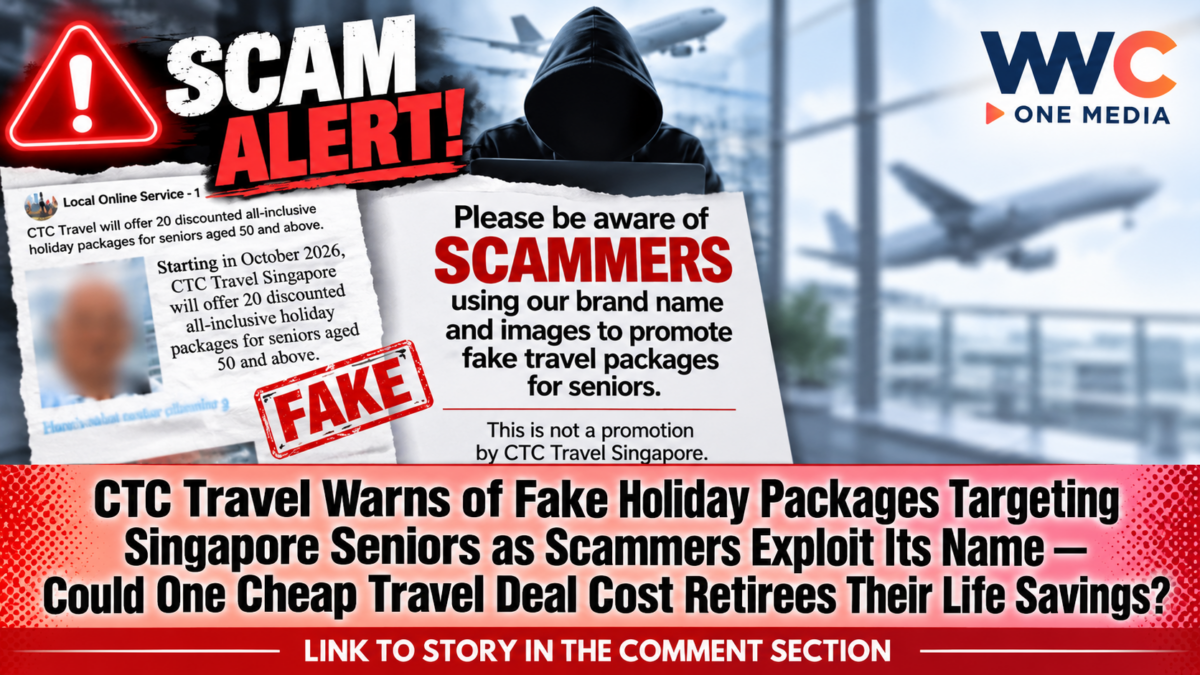
SINGAPORE / MANILA — Singapore’s travel industry is facing another warning over online fraud after scammers allegedly impersonated established travel agency CTC Travel to promote 20 fake holiday packages specifically targeting senior citizens.
The fraudulent advertisements reportedly offered discounted travel deals designed to attract older travellers, raising concerns that criminals are exploiting the reputation of legitimate businesses to deceive consumers into sharing personal information or making payments.
CTC Travel issued a public warning after discovering social media posts falsely using its company identity to advertise the supposed senior travel packages.
The agency stressed that the promotions were not authorised and reminded consumers that its promotional campaigns and special offers are announced through its official Facebook account.
The warning comes as Singapore continues to battle increasingly sophisticated online scams involving fake businesses, fraudulent advertisements and impersonation tactics.
For older Singaporeans hoping to enjoy affordable holidays, the latest incident highlights a growing problem: scammers are no longer simply inventing fake travel companies. They are also borrowing the identities of established businesses to make fraudulent offers appear legitimate.
And with previous travel-related scams costing Singaporeans millions of dollars, authorities are increasingly concerned about how convincing these schemes have become.
CTC Travel Discovers 20 Fake Holiday Packages Targeting Older Travellers
The latest warning centres on fraudulent advertisements promoting 20 supposed travel packages designed specifically for senior citizens.
According to Singapore’s Chinese-language broadcaster 8world, scammers impersonated CTC Travel and circulated social media posts advertising the discounted holiday packages.
The promotions allegedly used attractive prices to encourage older consumers to enquire about the offers.
CTC Travel subsequently reminded the public that the advertisements were fraudulent and that its official promotions should only be trusted when published through its verified Facebook account.
The agency also advised consumers to contact the company directly if they receive suspicious messages or encounter promotions they cannot verify.
Members of the public were specifically warned against clicking questionable links, responding to suspicious messages or providing personal and payment information.
The incident demonstrates how easily consumers can be misled when criminals use the name of a familiar company.
A legitimate business name, professional-looking advertisement or attractive holiday itinerary does not automatically establish that an offer is genuine.
For CTC Travel, the immediate concern is protecting its customers from fraudulent accounts attempting to exploit its reputation.
For consumers, the warning is a reminder that verifying the identity of the seller is just as important as checking the holiday destination and package price.
Why Scammers Are Increasingly Targeting Singapore’s Senior Citizens
The CTC Travel incident comes amid growing concern over the financial vulnerability of older people in Singapore.
According to Singapore’s Ministry of Home Affairs, seniors aged 65 and above accounted for approximately 15% of all scam victims in 2025.
More concerning, they were the only age group to record an increase in the number of scam victims compared with 2024.
The financial consequences were particularly severe.
Each senior victim lost approximately S$37,000 on average, the highest average loss among all age groups.
The government also disclosed that approximately two in five senior scam victims had fallen for investment or government-official impersonation scams.
These figures were presented in a parliamentary response published on May 7, 2026.
Although the latest CTC Travel incident involves travel-agency impersonation, the broader statistics highlight the scale of the problem facing older Singaporeans.
Fraudsters increasingly rely on psychological manipulation, familiar company names and convincing online advertisements to establish trust before attempting to obtain money or sensitive information.
The danger is that victims may not recognise the deception until after they have transferred money or disclosed information.
WWC ONE MEDIA previously examined Singapore’s growing digital fraud problem in Fraud Risks Push Singapore to Tighten Identity Checks Across Digital Services as Scams Grow More Sophisticated.
That report explored how criminals exploit compromised identities, stolen information and social-engineering tactics to gain access to financial and digital services.
The latest travel-package warning highlights another dimension of the same problem: impersonating trusted organisations to persuade consumers to act without properly verifying the source.
Singaporeans Have Already Lost Millions to Fake Travel Package Scams
The CTC Travel warning is not Singapore’s first major incident involving fraudulent holiday promotions.
In June 2023, the Singapore Police Force announced that at least 48 people had lost a combined S$1.7 million in a series of holiday travel-package scams.
The victims had reportedly paid an online travel agency for holiday packages that were never delivered.
After receiving payments through money transfers, the company failed to provide the agreed services and eventually became uncontactable.
Police identified seven suspects, comprising five men and two women aged between 24 and 59, in connection with the investigation.
The case demonstrated how fraudulent travel businesses could attract customers through seemingly legitimate online operations before disappearing with their money.
The Channel NewsAsia report on the incident highlighted the importance of checking travel agencies with the Singapore Tourism Board and purchasing holiday products only through authorised sellers.
The police also warned that scammers may use local bank accounts or copies of identification documents to make fraudulent sellers appear genuine.
For consumers, the lesson was clear: seemingly convincing documentation and professional communication do not guarantee that a travel business is legitimate.
The CTC Travel warning now raises similar concerns, although there is currently no confirmed loss figure specifically associated with this latest impersonation incident.
Travel Scammers Are Also Exploiting Facebook, WhatsApp and Fake Booking Websites
Singapore’s travel-scam problem has continued evolving beyond traditional fraudulent tour advertisements.
In October 2023, the Singapore Police Force reported that 43 people had lost more than S$1.2 million to travel-related scams in September alone.
Victims were attracted by advertisements offering cruises, tour packages, concert tours and other travel-related services on social media platforms such as Facebook and Instagram.
After responding to the advertisements, some victims were instructed to continue their conversations through WhatsApp.
Scammers subsequently sent Android Package Kit files, or APKs, disguised as payment applications.
Installing these malicious applications could allow criminals to access sensitive information on victims’ mobile devices, including banking credentials.
Other victims were instructed to provide online banking information through third-party applications or make PayNow transfers.
The police warned consumers against installing unfamiliar applications or clicking suspicious links.
More recently, Singapore’s travel-scam problem has expanded into cruise bookings.
In a May 15, 2026 advisory, the Singapore Police Force reported at least 40 e-commerce scams involving cruise packages since April 1, with reported losses reaching at least S$53,000.
Fraudulent sellers advertised cruise packages on Facebook before moving conversations to WhatsApp.
Victims were then asked to make payments through PayNow QR codes to secure their bookings.
In some cases, scammers demanded additional payments for supposed taxes and fuel charges after receiving the initial deposit.
Some victims even received fake booking itineraries before discovering that their reservations did not exist.
The police advised consumers to purchase cruise packages directly from official cruise-operator websites or licensed travel agencies.
These cases show that fraudulent travel promotions can take several forms, from fake tour packages and impersonated travel agencies to malicious applications and counterfeit cruise bookings.
Singapore Tourism Board Warns Consumers to Deal Only With Licensed Travel Agents
The Singapore Tourism Board has repeatedly reminded consumers to verify travel agencies before purchasing holiday products.
In an October 16, 2025 public advisory, the STB warned the public to transact only with licensed travel agents.
The advisory followed concerns involving an individual and two companies allegedly offering travel products without the necessary travel-agent licences.
The STB reminded consumers that operating a travel agency without a licence is an offence under Singapore’s Travel Agents Act 1975.
Under Section 6(2), a person convicted of operating without a licence can face a fine of up to S$25,000, imprisonment for up to two years, or both.
The tourism authority also directed consumers to verify travel agencies through its Travel Agents and Tourist Guides Licensing System, known as TRUST.
The system allows members of the public to check whether a travel agency holds an active licence.
For consumers considering CTC Travel promotions, checking the company’s official contact details and independently confirming the advertised package are important precautions.
CTC Travel’s official website identifies its business as Commonwealth Travel Service Corporation Pte Ltd, operating under travel-agent licence TA704.
Its official contact information includes:
- Worldwide tours: +65 6535 0001
- General enquiries: +65 9777 0960
- Email: enquiry@ctc.com.sg
- Official website: https://ctc.com.sg/
Consumers should independently access these official channels rather than relying on telephone numbers or links provided by suspicious advertisements.
Why Fake Holiday Deals Are Particularly Effective Against Older Travellers
Travel promotions often combine several psychological factors that scammers can exploit.
Discounted group tours, senior-exclusive packages and limited-time holiday offers can create a sense of urgency.
Older consumers may also be more comfortable dealing with familiar travel brands than unfamiliar online sellers.
Fraudsters can take advantage of that trust by copying company names, logos, promotional images and other branding elements.
Once a potential customer responds, the scammers may attempt to move the conversation away from public social media platforms to private messaging applications.
This can make it harder for victims to recognise warning signs or verify whether they are communicating with a genuine representative.
Another concern is that scammers may request personal information under the guise of preparing travel documents or confirming reservations.
Such information could potentially be exploited in subsequent identity theft or financial fraud.
The US Federal Trade Commission has also warned about fraudulent travel websites offering unusually cheap holidays and impersonating recognised airlines, hotels and travel companies.
Its consumer guidance recommends checking website addresses carefully, researching unfamiliar sellers and avoiding suspicious payment arrangements.
The broader lesson is that travel fraud is not limited to Singapore. It is an international problem affecting consumers who increasingly rely on online platforms to plan and purchase holidays.
Another Warning About Scams Targeting Older People Across Asia
The CTC Travel case also reflects a wider regional problem involving criminal networks that exploit older consumers.
In October 2026, Malaysian police arrested five people after raiding a luxury property in Iskandar Puteri, Johor, suspected of being used as a call centre for an investment scam targeting Singaporeans.
According to reports, senior citizens were among the main groups targeted by the alleged operation.
The case highlighted how cross-border criminal networks can operate from neighbouring countries while targeting victims in Singapore.
WWC ONE MEDIA covered the development in Five Arrested After Luxury Johor Home Allegedly Used to Scam Singaporean Investors.
Another WWC ONE MEDIA report, Singapore Scam Alert: Millions Lost as Fraudsters Pose as ICA Officers and Promise PR Help, examined how criminals impersonate government authorities and exploit the credibility of official institutions.
The common element across these incidents is the manipulation of trust.
Whether fraudsters impersonate a government agency, a financial institution or a recognised travel company, their objective is to convince victims that they are dealing with someone legitimate.
The financial consequences can be devastating, particularly for people who have spent decades building their savings.
A similar problem has emerged elsewhere in Southeast Asia.
WWC ONE MEDIA previously examined the financial damage caused by criminal networks targeting older people in Thailand’s Retirees Lose Billions to Call-Centre Scams as Criminal Gangs Target Life Savings.
The regional pattern suggests that protecting older consumers requires more than warning them about suspicious advertisements. It also requires stronger verification systems, faster reporting and greater public awareness.
How Singapore Travellers Can Protect Themselves From Fake Travel Packages
Authorities continue urging consumers to verify travel arrangements before making payments.
The Singapore Police Force and Singapore Tourism Board recommend several precautions.
1. Check the travel agency’s licence.
Use the official TRUST directory to confirm whether a company is licensed to sell travel products.
2. Verify promotions directly with the company.
Do not rely on social media advertisements, private messages or unfamiliar telephone numbers. Contact the company through its independently verified official channels.
3. Be suspicious of unusually cheap holiday packages.
A heavily discounted offer should be checked carefully, particularly when the seller pressures customers to make immediate payments.
4. Avoid suspicious payment requests.
Do not transfer money to unfamiliar individuals or unverified accounts simply because someone claims to represent a recognised travel agency.
5. Never install unfamiliar applications.
A seller should not require customers to download an unknown APK file to process a normal travel booking.
6. Protect personal and banking information.
Never disclose online banking passwords, one-time passwords or other security credentials to an unverified contact.
7. Report suspicious activity immediately.
Consumers who believe they have encountered a scam should contact their bank immediately if financial information or payment credentials have been compromised.
Singapore’s 24-hour ScamShield Helpline can be reached at 1799.
The public can also use the official ScamShield website at https://www.scamshield.gov.sg/.
What Happens If Someone Has Already Paid for a Fake Travel Package?
Consumers who suspect they have fallen victim to a fraudulent travel advertisement should act immediately.
The first step is to contact their bank and request assistance in securing their accounts and stopping any potentially fraudulent transactions.
Victims should also preserve evidence, including:
- Screenshots of advertisements and social media accounts.
- WhatsApp conversations and telephone numbers.
- Payment receipts and bank transaction records.
- Booking confirmations and travel itineraries.
- Website addresses and suspicious links.
These records can help authorities investigate the incident.
A police report should also be filed.
Families should encourage older relatives to report suspicious activity without embarrassment or fear of being blamed.
Scammers often deliberately create pressure and emotional manipulation to prevent victims from seeking help.
The earlier a suspicious transaction is reported, the greater the opportunity for banks and authorities to investigate and potentially limit further losses.
The Bigger Question: Are Singapore’s Seniors Becoming Easier Targets for Sophisticated Online Scams?
The CTC Travel warning highlights a growing challenge for Singapore’s consumer-protection and anti-scam efforts.
Criminals are increasingly using familiar business identities, attractive promotional material and private messaging platforms to make fraudulent offers appear legitimate.
The danger is particularly concerning when older people are targeted through advertisements that exploit their interest in affordable holidays and group travel.
Singapore’s previous travel-related scams demonstrate how quickly financial losses can accumulate.
The 2023 holiday-package case alone involved at least S$1.7 million in losses, while the September 2023 travel-scam wave cost victims another S$1.2 million.
The 2026 cruise-package warning shows that criminals continue adapting their methods.
However, the latest CTC Travel incident must be viewed separately: the company has warned about impersonation and 20 fake senior travel packages, but there is no confirmed public figure establishing the number of victims or financial losses connected to this particular scheme.
The challenge for authorities is to ensure that consumers can distinguish genuine travel promotions from fraudulent advertisements before money changes hands.
For families, the warning is equally important. Older relatives should be encouraged to verify unfamiliar offers, discuss suspicious messages and seek assistance before making payments.
For travel companies, protecting their identities and responding quickly to fraudulent advertisements will remain essential as online impersonation becomes more sophisticated.
Singapore’s seniors are being promised affordable holidays, but the wrong click could expose them to far more than a cancelled trip. As scammers increasingly exploit trusted travel brands, could the next fake holiday advertisement become another multimillion-dollar scam?