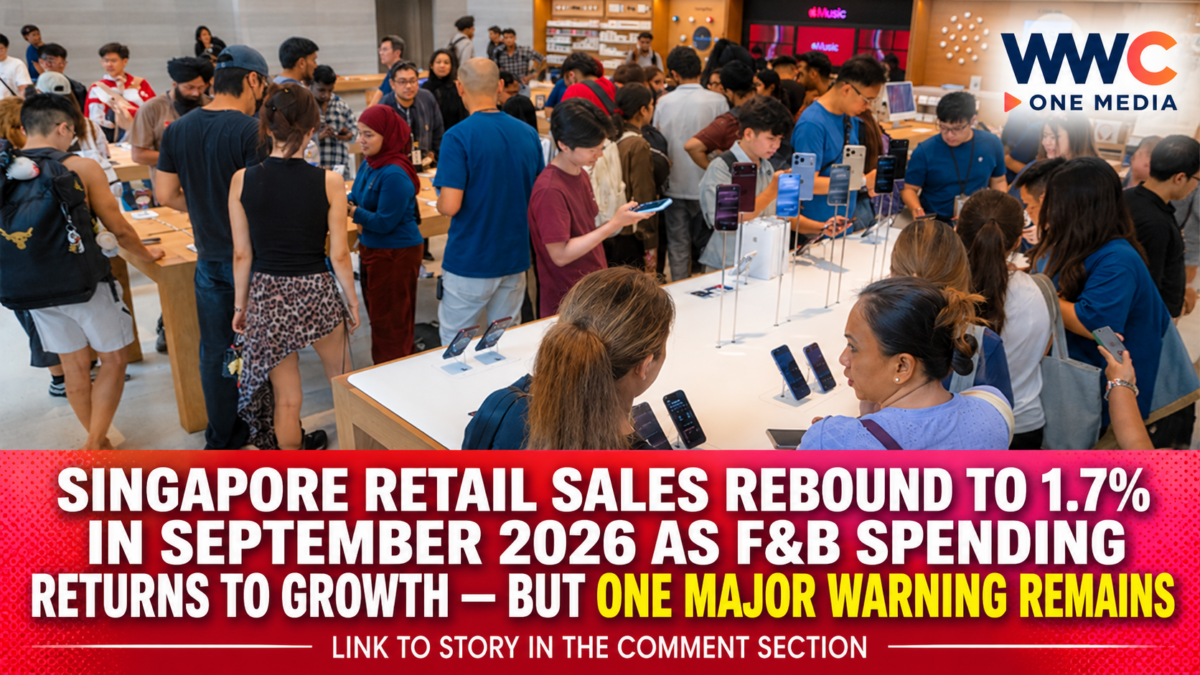
SINGAPORE — Singapore’s retail and food-and-beverage sectors showed signs of recovery in September 2026, with both industries returning to year-on-year growth. However, a closer look at the latest figures reveals that consumer spending remains uneven, online shopping is gaining ground, and the overall retail market is still facing month-to-month pressure.
Retail sales increased by 1.7 per cent year on year in September, reaching an estimated S$4.3 billion, according to data from the Singapore Department of Statistics (SingStat), reported by AsiaOne on November 5.
The improvement came after retail sales growth slowed to 0.8 per cent in August, marking its weakest annual expansion since February.
The latest figures suggest that retail activity has regained some momentum. But the recovery is not uniform across all business categories — and the decline in seasonally adjusted monthly sales indicates that the market has not fully shaken off its softer performance.
Retail growth improves, but monthly sales continue to fall
Excluding motor vehicles, parts and accessories, retail sales grew by 2.5 per cent year on year in September, compared with 1.7 per cent in August.
The value of retail sales excluding those vehicle-related categories reached approximately S$3.6 billion.
However, the month-to-month picture was less encouraging.
On a seasonally adjusted basis, total retail sales declined by 1 per cent in September, extending the 0.9 per cent drop recorded in August.
This difference matters. Year-on-year figures compare sales with the same month a year earlier, while month-on-month figures provide a more immediate picture of recent business momentum. Singapore’s retail sector may be performing better than it did a year ago, but the latest monthly figures show that sales have not yet established a consistent upward trend.
The distinction is particularly important for retailers preparing for the final stretch of 2026, when businesses typically look to year-end shopping and holiday demand to support revenue.
Online shopping takes a bigger share of Singapore retail spending
One of the most noticeable developments in September was the increase in online retail transactions.
Online purchases accounted for 17.7 per cent of total retail sales, up from 15.6 per cent in August.
When motor vehicles, parts and accessories are excluded, the online share rose to 20.8 per cent.
The figures highlight the growing importance of e-commerce in Singapore’s retail market. Consumers are increasingly able to compare prices, browse products and complete purchases without visiting physical stores.
For retailers, this creates opportunities to reach customers through digital platforms, but it also increases the importance of managing delivery costs, online promotions, inventory and competition.
The latest figures also reinforce the need for businesses to understand how consumers divide their spending between physical shops and online channels.
Electronics lead September’s retail growth
Computer and telecommunications equipment recorded the strongest year-on-year growth among the retail categories tracked by SingStat, increasing by 16.5 per cent.
Other sectors that posted growth included:
- Petrol service stations: up 6.5 per cent
- Cosmetics, toiletries and medical goods: up 6 per cent
- Furniture and household equipment: up 5.3 per cent
- Supermarkets and hypermarkets: up 2.2 per cent
- Other retail categories: up 3.3 per cent
The performance suggests that demand was concentrated in selected product categories rather than spread evenly across the retail industry.
Computer and telecommunications equipment stood out, while several traditional shopping categories continued to record annual declines.
Among the weaker performers, minimarts and convenience stores experienced the largest drop, with sales falling 5.6 per cent.
Department stores declined by 3.4 per cent, followed by optical goods and books at 2.5 per cent.
Motor vehicles, parts and accessories recorded a 2.4 per cent decrease, while wearing apparel and footwear and watches and jewellery both fell by 1.5 per cent.
Food and alcohol sales slipped 0.2 per cent, while recreational goods recorded a marginal 0.1 per cent decline.
The contrast shows why the headline retail growth figure should not be interpreted as a broad-based recovery. Some businesses are benefiting from stronger demand, while others are still struggling to regain sales momentum.
F&B sales return to growth after August decline
Singapore’s food-and-beverage services industry also posted a recovery in September.
F&B services sales increased by 1 per cent year on year, reversing the reported 1.8 per cent decline in August.
The estimated total value of F&B sales reached approximately S$1.6 billion, with online transactions accounting for 21.1 per cent.
The improvement was particularly visible among fast-food outlets and restaurants.
Fast-food sales rose by 7.6 per cent, making the segment the strongest performer in the F&B industry.
Restaurants recorded 2.6 per cent growth, while cafes edged up by 0.1 per cent.
However, not every food business benefited from the recovery.
Food courts and other eating places experienced a 4.2 per cent decline in sales, while food caterers recorded a smaller decrease of 0.2 per cent.
The figures indicate that the recovery remains uneven even within Singapore’s dining industry. Fast-food operators and restaurants recorded growth, but food courts and other eating establishments continued to face weaker annual sales.
For smaller food businesses, the latest figures provide little reason to assume that operating conditions have become easier across the board.
What the previous months reveal about consumer spending
The September results follow a period of slower retail growth and declining F&B sales.
SingStat’s August release showed retail sales growth slowing to 0.7 per cent year on year, while F&B services sales declined by 1.6 per cent. The Straits Times also reported that August’s retail performance was affected by weaker month-on-month sales, although some categories — particularly cosmetics and telecommunications equipment — continued to grow.
In July, retail sales expanded by 1.5 per cent, down from 4 per cent in June. F&B services sales declined by 1.9 per cent during the same period.
The September rebound therefore marks an improvement from the preceding months, particularly for the F&B sector.
However, the continued monthly decline in overall retail sales suggests that businesses should be cautious about treating one stronger annual reading as proof of a sustained recovery.
Cost pressures and changing shopping habits remain important concerns
The latest figures arrive amid continuing attention on household expenses and the cost of everyday purchases.
For consumers, the decision to spend may depend not only on income but also on the prices of food, groceries, transport, utilities and other essential expenses.
WWC One Media previously reported that cost-of-living concerns remain a major issue for Singaporean households, while the expansion of the country’s unit-pricing pilot is intended to help shoppers compare the cost of everyday grocery products more easily.
These developments provide useful context for understanding why retail performance can differ significantly between categories. Even when consumers continue buying essential products, they may become more selective about discretionary purchases or where they shop.
For businesses, the challenge is to attract customers while balancing prices, operating expenses and competition from online sellers.
Singapore’s retail recovery is real, but the next figures will matter
September’s numbers offer encouraging signs for Singapore’s retail and F&B industries. Retail sales returned to stronger annual growth, F&B services moved back into positive territory, and online transactions accounted for a larger share of retail spending.
Yet the 1 per cent month-on-month decline in retail sales remains an important warning.
The market is showing signs of improvement, but the gains are concentrated in selected categories. Electronics, fast-food outlets and restaurants performed better, while convenience stores, department stores and food courts continued to record declines.
As businesses move toward the year-end shopping season, the next monthly releases will help determine whether September marked the beginning of a more sustained recovery or simply a temporary improvement in an uneven consumer market.
Singapore’s shoppers are still spending — but the bigger question is whether that spending will be strong enough to support a broader recovery across the country’s retail and F&B businesses.