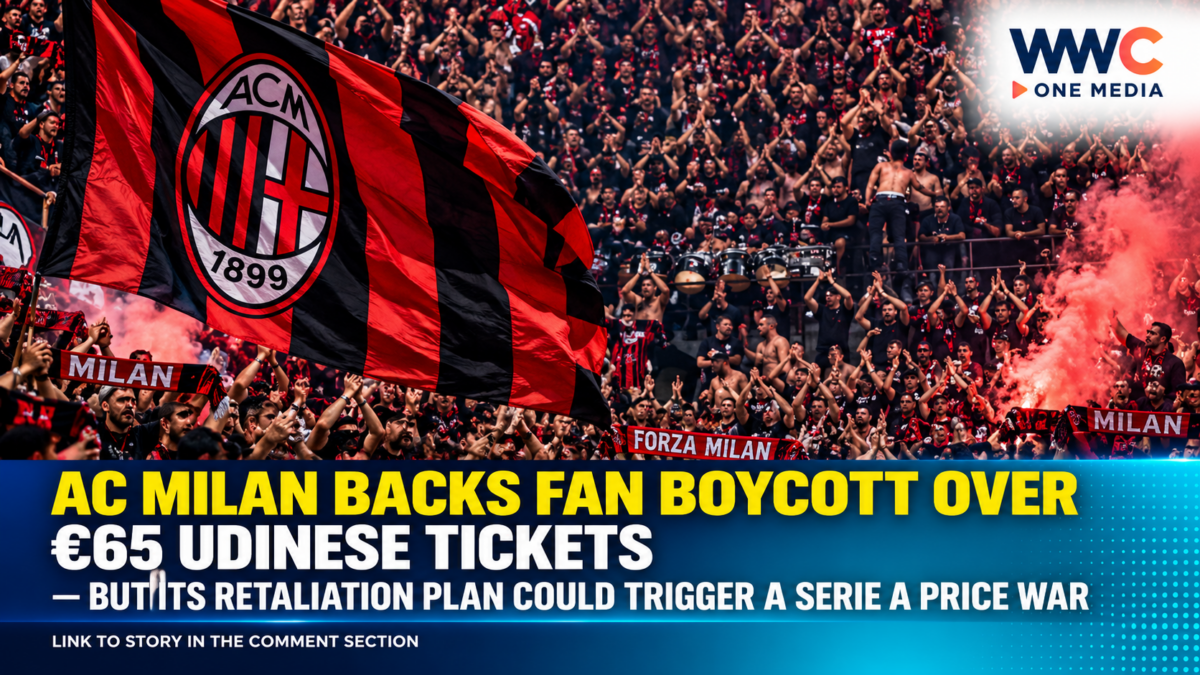
MILAN, ITALY — October 22, 2026 — Italian football giants AC Milan have taken a dramatic stand against soaring away-ticket prices, publicly supporting their supporters’ decision to boycott Sunday’s Serie A clash against Udinese.
The dispute erupted after Udinese priced tickets for visiting Milan supporters at €65, approximately US$73, a figure more than twice the typical €30 away-ticket price at the club’s Bluenergy Stadium, according to Associated Press reporting.
Rather than criticizing their supporters for refusing to attend, Milan’s management has thrown its full weight behind the protest.
The Rossoneri are now demanding a league-wide cap on away-ticket prices and have warned that clubs charging excessive amounts could face reciprocal pricing measures when their supporters visit Milan’s San Siro stadium.
The controversy is turning a dispute over one football match into a wider debate about whether loyal fans are being priced out of Italian football.
Why AC Milan Supporters Are Boycotting Udinese
The organized Milan supporters’ group Curva Sud announced that it would not travel to Udine for the October 25 match because of the price of tickets allocated to away fans.
At €65, the charge is considerably higher than the prices visiting supporters usually pay at the Bluenergy Stadium.
Italian sports newspaper La Gazzetta dello Sport reported that the fans had already raised objections about Udinese’s away-ticket pricing the previous year and believed their concerns had gone unanswered.
For traveling supporters, the match ticket represents only part of the overall cost.
Fans often have to pay for transport, motorway tolls, fuel, food and sometimes accommodation to follow their teams across Italy.
The cumulative expense can make even one away match a significant financial commitment.
Milan’s supporters argue that these costs should not be made worse by ticket prices they consider unfairly inflated because of their club’s popularity.
AC Milan Publicly Backs Curva Sud
In a statement issued on October 21, AC Milan confirmed its support for supporters protesting excessive away-ticket prices.
The club said fans should be treated fairly regardless of the team they support.
Milan also argued that charging high prices to visiting fans could damage Italian football’s international reputation at a time when Serie A is trying to strengthen its appeal against England’s Premier League and other European competitions.
Its intervention is especially notable because football clubs do not always publicly support organized supporter boycotts.
By backing Curva Sud, Milan has turned the protest into an official club position.
The club’s leadership, under owner Gerry Cardinale, also announced plans to pursue broader changes in ticket-pricing practices.
Milan Wants Serie A to Introduce an Away-Ticket Price Cap
One of Milan’s main proposals is a competition-wide cap on prices charged to away supporters.
The club has pointed to England’s Premier League as an example.
Premier League clubs have maintained a £30 ceiling for adult away tickets, a policy designed to protect traveling supporters from excessive charges.
A similar system in Italy would establish a maximum amount that clubs could charge away fans, reducing pricing differences across stadiums.
Such a measure would require agreement or action at the league level.
Milan’s proposal has not yet been adopted as a binding Serie A regulation.
However, the club believes a consistent pricing policy would make the league fairer and more attractive to supporters.
AC Milan Warns of Reciprocal Ticket Pricing
Milan has also raised the possibility of introducing a retaliatory pricing system.
Under the proposed approach, clubs that charge Milan supporters above-average prices could see their own fans face higher ticket prices when visiting San Siro.
Any such policy would have to comply with applicable league regulations.
Milan says additional revenue generated through the proposed arrangement would be donated to Fondazione Milan, the club’s charitable foundation, to support local community initiatives.
The proposal is intended to put pressure on clubs that impose unusually high prices on visiting supporters.
However, it also introduces a difficult question.
Would charging another team’s supporters more ultimately solve the fairness problem, or would it risk spreading higher prices throughout Serie A?
That tension makes the club’s proposed countermeasure one of the most controversial aspects of the dispute.
Udinese Match Is Not the First Ticket Boycott
Milan’s Curva Sud has previously protested the cost of away tickets.
In 2023, organized supporters boycotted the club’s away fixture against Juventus because of ticket-pricing concerns.
The issue resurfaced during the previous season, when supporters again complained about prices for Juventus matches and criticized Torino over charges for visiting fans.
These earlier disputes demonstrate that the disagreement is not limited to Sunday’s match against Udinese.
Instead, it reflects an ongoing conflict over the cost of following major Italian clubs away from home.
The latest dispute may increase pressure on league officials to examine whether current pricing practices are fair across clubs.
Why the Controversy Matters Beyond AC Milan
Ticket revenue is an important part of professional football’s business model, but stadium attendance also contributes to the atmosphere and identity of the sport.
Traveling supporters provide vocal backing for their teams, create rivalries and help generate the intensity that makes major football matches attractive to television audiences around the world.
If away-ticket prices continue rising, some supporters may be forced to reduce the number of matches they attend.
That could weaken the traveling fan culture that has long been central to European football.
There is also a commercial argument for keeping football accessible.
A lively and competitive stadium atmosphere is part of the experience clubs and leagues sell to broadcasters, sponsors and international audiences.
The challenge is finding a balance between stadium revenues and protecting the affordability of attending matches.
Could Serie A Face a Wider Fan Boycott?
The dispute has raised the possibility of further demonstrations by organized supporter groups.
If other fan associations adopt similar protests, pressure on Serie A and its member clubs could intensify.
However, no coordinated league-wide boycott has been confirmed in the reporting reviewed.
Nor has Serie A announced a new universal ticket-pricing cap in response to Milan’s statement.
For now, the confirmed development is Milan’s public support for its supporters and its stated intention to push for pricing reform.
Whether the controversy expands into a broader movement will depend on the response of other clubs, their supporters and league authorities.
What Happens Next?
AC Milan and Udinese are scheduled to meet on Sunday, October 25, with the Rossoneri’s organized supporters planning to stay away in protest.
The game itself has not been canceled or postponed because of the boycott.
Attention will now turn to whether Udinese revisits its ticketing policy, whether Serie A considers Milan’s proposal for a league-wide cap, and whether Milan follows through with reciprocal pricing measures.
For supporters, the dispute goes beyond the cost of one ticket.
It raises a fundamental question about who football clubs and competitions are ultimately serving.
AC Milan has chosen to stand with its fans against €65 away tickets. But if Serie A fails to agree on a fairer system, the club’s proposed countermeasures could turn one boycott into a much larger battle over the price of supporting football.