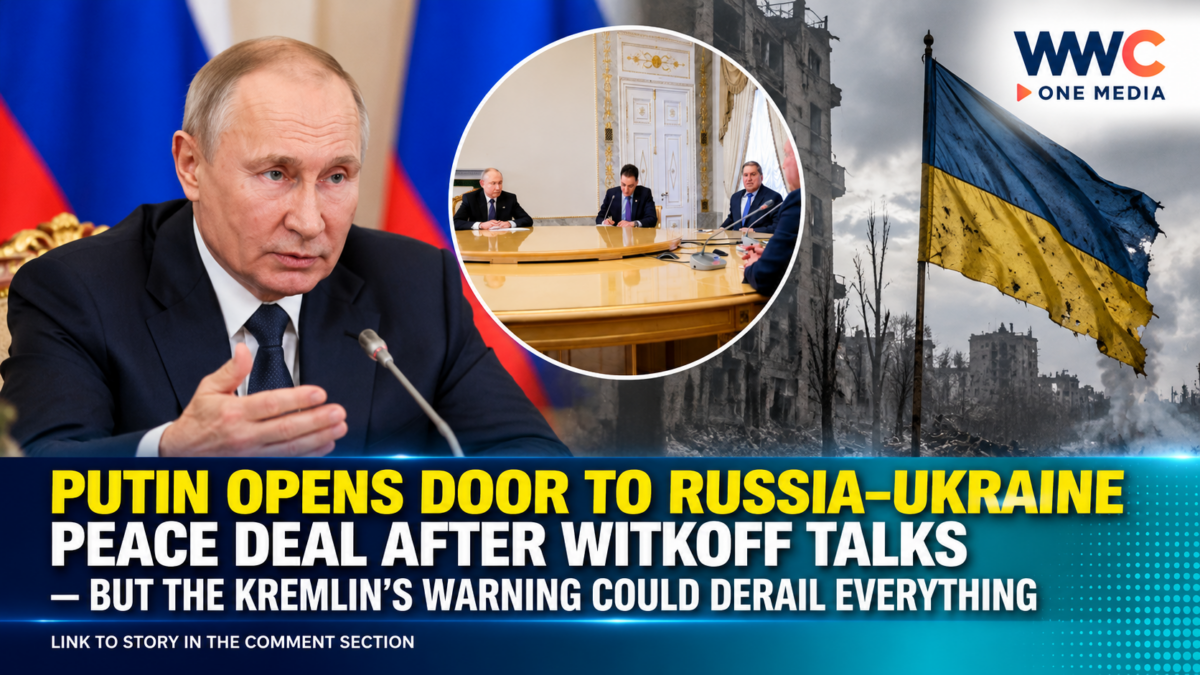
SAINT PETERSBURG, RUSSIA — October 22, 2026 — A renewed diplomatic effort to end the Russia–Ukraine war has gained momentum after Russian President Vladimir Putin signaled Moscow’s willingness to resume negotiations with Ukraine and the United States as early as November.
But behind the apparently encouraging announcement lies a major obstacle: the Kremlin says recent peace proposals presented by Ukraine and European governments still lack meaningful substance.
The conflicting messages followed nearly three hours of discussions between Putin and US special envoy Steve Witkoff in Saint Petersburg on Wednesday, October 21.
While US President Donald Trump expressed optimism about the chances of ending the conflict, Russian officials remained cautious about whether the negotiations could produce a lasting agreement.
The latest diplomatic developments come more than four years after Russia launched its full-scale invasion of Ukraine in February 2022.
Putin Signals Willingness to Resume Trilateral Negotiations
Kremlin foreign policy adviser Yuri Ushakov said Russia was prepared, in principle, to participate in another round of trilateral negotiations involving Moscow, Kyiv and Washington.
The proposed meetings could take place in November and would be the first such talks since February.
According to Ushakov, the discussions should focus on establishing security arrangements for Russia and Ukraine after the conflict ends.
That issue remains one of the most difficult components of any potential settlement.
Ukraine has consistently emphasized the need for credible protections against future Russian attacks, while Moscow has demanded security arrangements that address its own stated concerns.
The two sides have sharply different positions on what an acceptable postwar security framework would look like.
Witkoff’s latest mission was intended to identify potential areas of agreement after months of stalled diplomatic efforts.
However, agreement to hold negotiations should not be confused with agreement on the terms of peace.
Kremlin Dismisses New Ukrainian and European Ideas
Despite Putin’s stated willingness to resume talks, Russia expressed skepticism about the proposals brought to Saint Petersburg by the American delegation.
Witkoff had traveled to Russia after meeting Ukrainian President Volodymyr Zelenskyy and European leaders in Oslo on Tuesday, October 20.
The Oslo discussions included the Norwegian prime minister and the Finnish president.
Ushakov acknowledged that Kyiv and European governments had introduced some new approaches.
However, he argued that the proposals offered little practical value toward resolving the conflict.
The Kremlin’s assessment highlights the substantial gap between diplomatic engagement and actual progress toward a peace agreement.
Moscow has not publicly demonstrated that it is prepared to accept the core conditions sought by Ukraine and its supporters.
Similarly, no mutually accepted settlement framework emerged from Wednesday’s meeting.
Trump Claims Peace Is Closer Than Ever
President Donald Trump offered a more optimistic interpretation of the diplomatic efforts.
Speaking about the possibility of ending the war, Trump characterized the current negotiations as the closest the parties had come to achieving peace.
His administration has made ending the Russia–Ukraine conflict a major foreign-policy objective.
Witkoff, a leading figure in Washington’s diplomatic outreach to Moscow, said the latest discussions had been constructive.
He also indicated that the United States, Russia and Ukraine would continue talks at the technical level.
These negotiations could provide an opportunity to examine the detailed provisions of a possible settlement.
Nevertheless, Witkoff acknowledged that significant work remains before a comprehensive agreement can be reached.
The difference in tone between Washington and Moscow reveals one of the central challenges facing the peace initiative.
The Trump administration is emphasizing diplomatic momentum, while the Kremlin continues to question the substance of the proposals.
Russia Releases American Citizen Stephen Hubbard
The diplomatic meeting was accompanied by a significant humanitarian development.
Russia released Stephen Hubbard, an American citizen who had been detained in the country.
Witkoff thanked Putin for the decision, describing the release as a positive gesture during the negotiations.
The development provided a tangible outcome from the latest diplomatic engagement, even though no breakthrough was announced on ending the war itself.
Prisoner releases can help create opportunities for further dialogue, but they do not necessarily indicate agreement on broader military or political disputes.
The release of Hubbard therefore represents a separate diplomatic success rather than evidence that a Ukraine peace settlement has already been secured.
Russian Diesel Deal Adds Another Dimension to Talks
The discussions between Putin and Witkoff also extended beyond the battlefield.
According to Reuters, the two sides discussed implementation of an October 9 agreement between Putin and Trump involving supplies of Russian diesel to American and international markets.
The energy issue underscores how the Ukraine conflict intersects with broader economic and geopolitical concerns.
Russia remains an important participant in global energy markets, while international sanctions and wartime disruptions have affected trading relationships and supply routes.
Any significant change in Russian energy shipments could have implications for global fuel markets.
However, the reported discussions do not establish that all shipments have commenced or that broader energy sanctions have been removed.
The economic arrangements and Ukraine peace negotiations remain separate matters, even if both were discussed during the same diplomatic meeting.
Putin and Witkoff Also Discuss Iran Crisis
Another unexpected element of the meeting involved the continuing crisis surrounding Iran.
Ushakov said Putin emphasized the importance of maintaining diplomatic channels with Tehran and pursuing a negotiated resolution.
Russia has maintained close strategic relations with Iran, making developments in the Middle East particularly important to Moscow.
The inclusion of Iran in the discussions illustrates the increasingly interconnected nature of international security negotiations.
Washington and Moscow are attempting to manage disagreements over Ukraine while also addressing other major international crises.
Still, there is no confirmed agreement arising from the Saint Petersburg meeting that resolves either conflict.
Why the Ukraine Peace Deal Remains Difficult
Despite renewed diplomatic activity, several fundamental disagreements continue to complicate the path toward a negotiated settlement.
Territorial control: Russia and Ukraine remain divided over the future of Ukrainian territory occupied or claimed by Moscow.
Security guarantees: Ukraine seeks protections against renewed aggression, while Russia insists that any settlement must address its own security demands.
Enforcement and verification: A durable agreement would require mechanisms capable of monitoring compliance and responding to violations.
Political acceptance: Any negotiated settlement would need to survive significant political scrutiny in Kyiv, Moscow and among Ukraine’s international partners.
These issues have repeatedly complicated previous attempts to end the fighting.
Without progress on the underlying disputes, another round of negotiations could produce additional meetings without delivering a ceasefire or peace treaty.
What Could This Mean for Asia and the Philippines?
A credible agreement ending the war could have implications well beyond Europe.
The conflict has affected international energy markets, agricultural trade, shipping costs and investor confidence.
For Asian economies, a sustained reduction in geopolitical tensions could potentially improve trade conditions and reduce certain supply-chain risks.
For the Philippines, global oil prices and food import costs are particularly relevant because international market movements can influence domestic inflation.
However, these are potential economic effects rather than guaranteed consequences of the latest talks.
Until the negotiating parties reach a concrete agreement and military conditions change, uncertainty is likely to remain.
What Happens Next?
Attention now turns to whether the proposed November negotiations will formally proceed and whether negotiators can develop a framework acceptable to Russia and Ukraine.
The central test will be whether both countries can move beyond general declarations of diplomatic willingness and begin narrowing their disagreements over territory, security and the terms of an eventual settlement.
For Washington, the challenge is to transform diplomatic momentum into enforceable commitments.
For Moscow and Kyiv, the question is whether either side sees a negotiated outcome as preferable to continuing the conflict.
The United States says peace may be closer, and Russia says it is prepared to talk. But until the opposing sides agree on the terms of a settlement, the most difficult decisions remain unresolved.
The question confronting world leaders is whether the proposed November talks will finally produce a meaningful breakthrough — or become another round of negotiations that leaves Europe’s deadliest ongoing conflict unresolved.