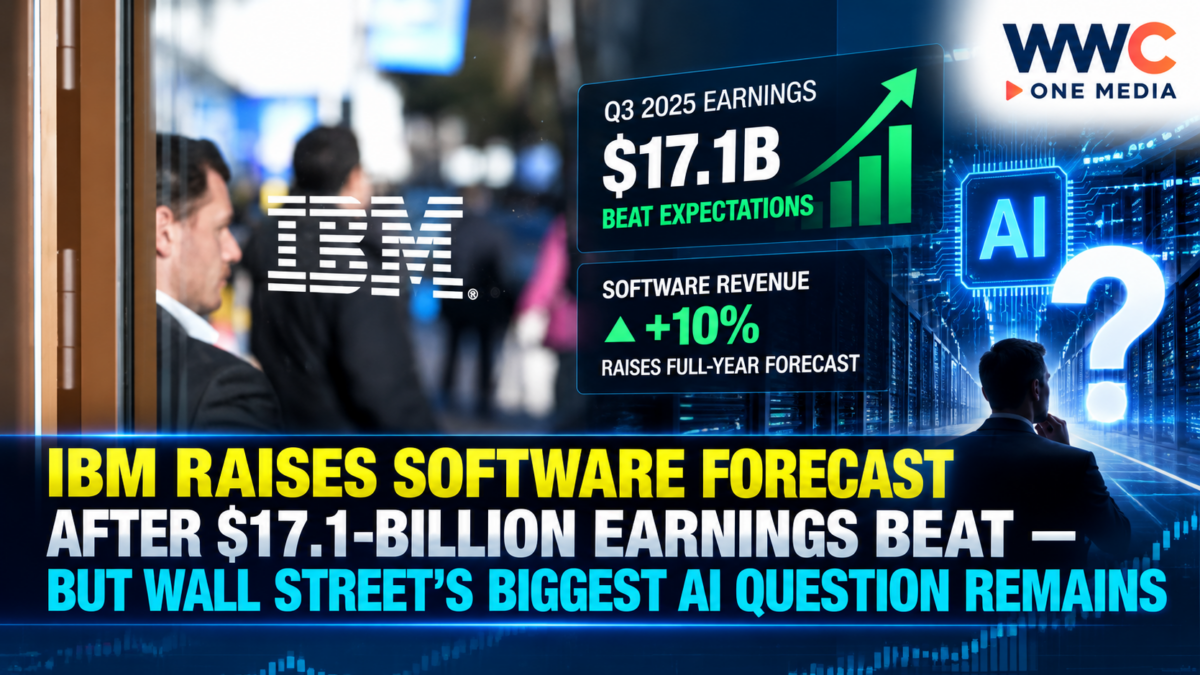
ARMONK, NEW YORK — IBM has raised its full-year software revenue growth forecast after reporting stronger-than-expected third-quarter earnings, offering a sign that some enterprise technology purchases delayed earlier this year are finally moving forward.
In its October 21 earnings announcement, IBM reported US$17.10 billion in quarterly revenue, an increase of 4.7% from a year earlier and above Wall Street’s expectation of US$16.82 billion.
Adjusted earnings reached US$2.95 per share, beating analysts’ estimate of US$2.86.
The company’s software business was a major contributor, generating US$7.80 billion in revenue, up 8.3%.
Following the results, Chief Financial Officer James Kavanaugh told Reuters that IBM now expects annual software revenue growth of approximately 7% to 8%, compared with its previous projection of 6% to 8%.
The upward revision narrows the forecast by raising the lower end, rather than increasing its maximum expected growth rate.
IBM shares rose approximately 4% in extended trading in the initial Reuters report, reflecting a positive investor reaction.
But the recovery comes after a difficult second quarter that raised concerns about IBM’s ability to keep pace with changing corporate technology spending.
IBM’s Third-Quarter 2026 Earnings: The Key Numbers
IBM Q3 2026 | REPORTED OCTOBER 21
Total revenue
$17.10B
Up 4.7% year over year
Software revenue
$7.80B
Up 8.3%
Adjusted earnings per share
$2.95
Analyst estimate: $2.86
GAAP net income
$2.19B
Up from $1.74B a year earlier
Figures from IBM’s earnings release, Reuters and The Wall Street Journal. Adjusted earnings are not the same as GAAP earnings.
IBM’s Software Growth Outlook Improves
Full-year 2026 software revenue growth guidance. The lower end increased; the upper end stayed unchanged.
Lower bound
Upper bound
0%2.5%5%7.5%10%Previous outlookUpdated outlook
The results exceeded market forecasts on both revenue and adjusted earnings.
That matters because IBM’s previous quarterly performance had raised questions over whether customers were postponing software purchases while investing in AI-focused data centers and infrastructure.
What Happened to the Delayed Software Deals?
The central explanation for IBM’s improvement is that business which had slipped out of the previous quarter began closing during the third quarter.
Kavanaugh said roughly one-quarter of transaction-processing software revenue came from deals deferred from the second quarter.
The remaining three-quarters represented new business.
This distinction is important.
If all the revenue growth had come from delayed transactions, investors might interpret the quarter mainly as a temporary catch-up.
The additional new business suggests IBM also continued attracting current customer spending.
Separately, The Wall Street Journal reported that approximately two-thirds of previously delayed mainframe-related deals had closed during the third quarter.
Kavanaugh described the earlier shortfall as largely a question of timing rather than customers permanently abandoning IBM’s systems.
However, not all outstanding deals were completed, and future sales execution remains an important measure of the company’s performance.
IBM’s Software Business Leads the Recovery
IBM’s software division benefited from growth in enterprise software, hybrid cloud services and transaction processing.
SELECTED BUSINESS SEGMENT PERFORMANCE
| Software | $7.80B | +8.3% |
| Infrastructure | $3.71B | +4.2% |
| Consulting | $5.34B | Broadly flat |
Third-quarter 2026 revenue; percentage changes are year over year. Figures are rounded.
Within software, hybrid cloud sales grew approximately 11%, while transaction-processing software revenue increased 9%.
Hybrid cloud allows organizations to operate workloads across their own computing environments and external cloud services.
IBM’s Red Hat business and related products are important parts of its enterprise technology strategy.
Transaction-processing systems, meanwhile, support critical business activities, including large-scale operations in sectors such as banking and retail.
The recovery in these products offers reassurance that demand for established enterprise systems continues even as customers adopt new AI technologies.
AI Spending Created a Challenge for IBM Earlier This Year
IBM’s improved third-quarter performance follows a particularly difficult period.
During its second-quarter reporting in July, CEO Arvind Krishna acknowledged that the company had struggled to adapt quickly enough to changing customer priorities.
Some corporate buyers were shifting spending from software toward data-center infrastructure needed for artificial intelligence.
The earnings disappointment contributed to a severe decline in IBM’s share price.
Reuters described that earlier selloff as its sharpest one-day drop in more than a century.
The October results therefore carry significance beyond a routine earnings beat.
They are an opportunity for IBM to show that it can participate in the AI investment cycle while maintaining growth in its established software and computing businesses.
IBM’s Infrastructure Business Also Rebounds
Software was not the only division showing improvement.
IBM’s infrastructure revenue increased 4.2% to US$3.71 billion, supported by strong demand for distributed infrastructure, including servers and storage systems.
Sales in that category rose 31%, offsetting weakness in IBM’s Z mainframe business.
That mixed performance is significant. Corporate customers are continuing to invest in computing infrastructure, but growth is uneven across different product categories.
IBM’s consulting division generated approximately US$5.34 billion in revenue, with little overall growth.
The figures show that IBM’s recovery is being driven principally by software and selected infrastructure products rather than a simultaneous acceleration across every business unit.
IBM Raises Its Free Cash Flow Outlook
Beyond its software guidance, IBM also increased its full-year free cash flow expectations.
The company now expects free cash flow to grow by more than US$1 billion year over year, compared with its earlier estimate of approximately US$1 billion.
Meanwhile, IBM maintained its forecast for full-year revenue growth of 4% to 5% on a constant-currency basis.
UPDATED IBM 2026 OUTLOOK
| Software revenue growth | 7%–8% |
| Total revenue growth | 4%–5% |
| Free cash flow growth | More than $1B year over year |
Total revenue growth guidance is on a constant-currency basis. These are management forecasts, not completed full-year results.
Free cash flow matters because it reflects cash available after spending required to maintain and expand the business. It can support dividends, debt management, acquisitions and further investment.
IBM’s improved outlook may strengthen investor confidence, although actual full-year performance will depend on its remaining quarter and execution.
Wall Street Welcomes the Earnings Beat — But Questions Remain
IBM shares initially rose about 4% in extended trading after the announcement, according to Reuters.
Other reports captured different market snapshots, including smaller after-hours gains. Such differences can arise because prices change throughout the trading session.
The positive reaction contrasts with July’s sharp selloff, but investors have not necessarily dismissed all concerns.
Barron’s noted that IBM still faced questions about its underlying growth and the contribution of acquisitions to performance.
The Wall Street Journal also emphasized that previously delayed deals contributed to the stronger quarter.
This leaves investors watching whether IBM can maintain its performance once the catch-up from earlier transactions has passed.
Reuters
+2
What This Means for the Philippines and ASEAN
IBM’s performance is relevant to businesses across Southeast Asia because multinational companies, financial institutions and government organizations depend on enterprise software, cloud services and large-scale computing infrastructure.
Its results suggest that corporate spending on established business systems continues even as AI investment becomes an increasingly important budget priority.
For Philippine IT companies and enterprises, the broader development highlights the importance of integrating AI capabilities with existing systems rather than treating modernization as a complete replacement of current infrastructure.
However, IBM’s global results do not establish a specific increase in Philippine technology spending or announce new investments in the country.
The Bigger Question: Is IBM’s Recovery Sustainable?
IBM’s third-quarter performance offers encouraging evidence that its software business has regained momentum.
The company exceeded revenue and earnings forecasts, completed significant previously delayed business and raised its annual software growth outlook.
But the next challenge is demonstrating that this improvement can continue without depending heavily on transactions postponed from earlier quarters.
The bottom line: IBM’s US$17.1-billion quarterly revenue and stronger software performance helped restore investor confidence. The company now expects 7%–8% annual software growth, but its longer-term outlook will depend on maintaining demand while corporate technology budgets increasingly prioritize AI and infrastructure.