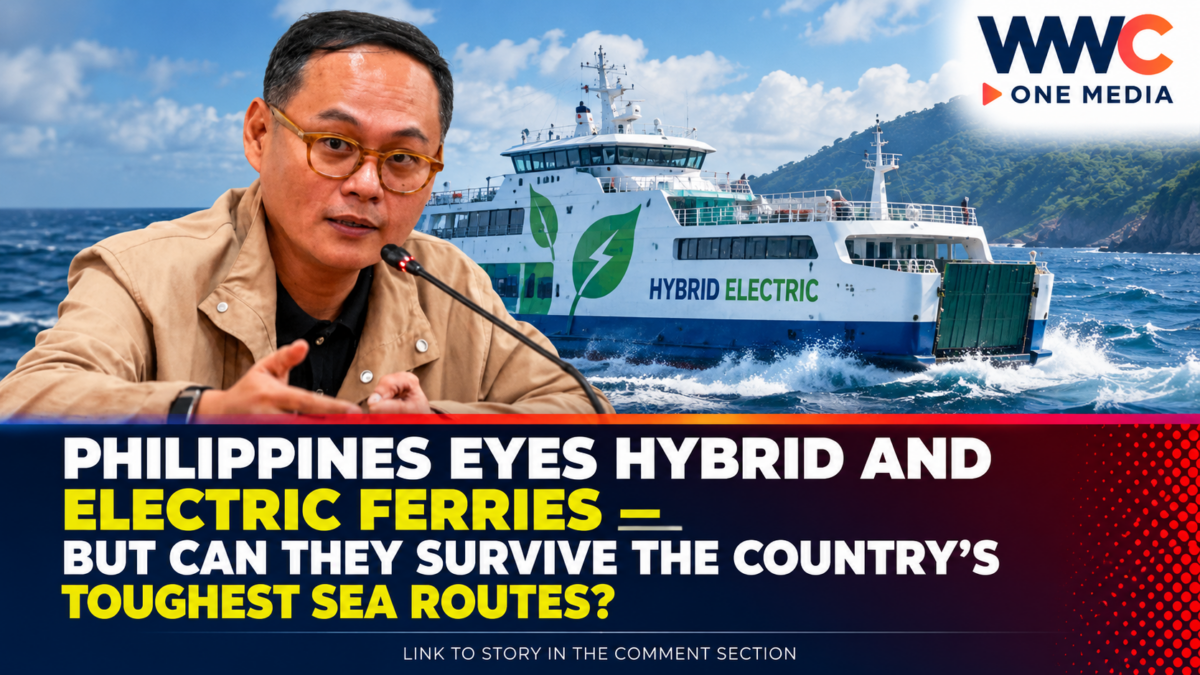
MANILA, Philippines — The Philippines is exploring a cleaner future for maritime transportation as the Department of Transportation (DOTr) and the Maritime Industry Authority (MARINA) consider pilot testing hybrid and fully electric ferries.
The initiative could help reduce fuel consumption, greenhouse gas emissions and operating costs while modernizing domestic passenger services across the country’s extensive network of islands.
But turning that vision into reality will require more than introducing new vessels. Charging infrastructure, battery performance, passenger safety, maintenance costs and the suitability of different routes will determine whether electric ferries can become a practical alternative to conventional diesel-powered ships.
The latest push builds on existing government and international efforts to decarbonize Philippine shipping, including a pilot study examining how cleaner ferry technologies could be introduced on selected inter-island routes.
Why the Philippines Is Looking at Electric Ferries
The Philippines relies heavily on maritime transportation to connect its islands, move goods and support tourism. Yet many domestic vessels continue to depend on conventional engines that consume fuel and produce emissions.
Hybrid ferries combine conventional propulsion with electric power, potentially reducing fuel consumption depending on the vessel design and operating conditions. Fully electric ferries rely on battery-powered propulsion and produce no exhaust emissions from their onboard propulsion system during operation.
For short-distance routes, particularly urban waterways and frequent commuter services, electric vessels may offer a practical starting point.
The government has already supported research into electric passenger boats, while international partners have been studying ways to modernize domestic ferry operations and reduce the sector’s environmental footprint.
However, the financial and technical feasibility of electrification will vary by route. Longer inter-island journeys may require larger battery systems, more charging capacity or hybrid propulsion rather than fully electric operation.
M/B Dalaray Shows What Electric Ferry Technology Can Do
One of the Philippines’ most significant developments in electric maritime transport is M/B Dalaray, a locally developed electric passenger ferry created through a collaboration involving the Department of Science and Technology (DOST), the University of the Philippines Diliman and other partners.
The vessel was launched in October 2025 as a demonstration of electric passenger transport on the Pasig River.
According to project information published by UP’s electric mobility initiative, M/B Dalaray has an aluminum catamaran hull, a 160-kilowatt-hour battery system and two 50-kilowatt electric motors. It is designed to carry 40 passengers and three crew members, with a stated range of approximately 45 kilometers at eight knots.
The project also includes a charging system designed to support its operations.
These specifications illustrate why electric ferries may be particularly suitable for short, predictable journeys where charging can be scheduled between trips.
The project is not proof that every Philippine ferry route can be electrified immediately. Instead, it offers a basis for assessing vessel performance, energy requirements, charging needs and maintenance under local conditions.
World Bank-Backed Study Examines Inter-Island Ferry Routes
The proposed shift toward greener shipping is also supported by work involving the World Bank, DOTr and MARINA.
Engineering and consulting firm Arup has described a national ferry decarbonization initiative aimed at developing a practical roadmap for reducing emissions and modernizing the country’s domestic fleet.
The study considers the technical, financial and regulatory challenges involved in introducing low- and zero-emission vessels, including the condition of existing ships and the infrastructure needed to support cleaner technologies.
MARINA’s March 2026 newsletter outlined three potential pilot pathways:
- Electric ferries: Short-distance routes such as Iloilo–Bacolod.
- Hybrid ferries: Routes such as Batangas–Calapan, where a combination of propulsion technologies may be more suitable.
- Fuel-efficiency upgrades: Improvements for longer-distance services where full electrification may be more difficult.
These are proposed pathways from the study, not confirmation that every route has already begun operating electric or hybrid ferries.
The approach reflects a practical reality: a technology that works well for a short commuter crossing may not be suitable for a longer voyage with greater energy requirements.
Could Electric Ferries Lower Travel and Operating Costs?
Fuel is a significant operating expense for shipping companies. Electric propulsion could help reduce exposure to fluctuating diesel prices, particularly on routes with frequent departures and predictable distances.
Electric motors can also reduce onboard noise and eliminate exhaust emissions from propulsion during operation. Depending on electricity prices, vessel design and maintenance requirements, these characteristics may improve operating economics over time.
For commuters, however, lower operating costs do not automatically translate into cheaper fares.
The final impact on ticket prices will depend on the cost of acquiring vessels, financing, electricity, charging facilities, maintenance and the commercial arrangements used to operate each service.
Government support and partnerships with local authorities or private operators may therefore play an important role in making cleaner ferry services financially sustainable.
Safety Remains a Major Issue
The transition to electric maritime transport also requires robust safety measures.
Lithium-ion batteries can present fire risks if damaged or improperly managed, and battery fires can be difficult to control in confined spaces. Electric and hybrid vessels therefore require appropriate battery monitoring, emergency procedures, crew training and firefighting systems.
The issue has received renewed attention following the September 2026 fire involving the passenger vessel MV June Aster off Coron, Palawan.
Authorities have been investigating the incident. As of the Maritime Industry Authority’s September 18 statement, investigators had not established a final finding that an electric vehicle aboard the vessel caused the fire.
MARINA, the Department of Energy and the Bureau of Fire Protection have been working on safety protocols for the carriage of electric and hybrid vehicles aboard domestic passenger vessels.
That issue is distinct from the use of electric propulsion in a purpose-designed ferry. Nevertheless, both developments highlight the need for clear safety standards, appropriate equipment and well-trained crews as maritime electrification expands.
Infrastructure Could Determine How Quickly the Shift Happens
Even a well-designed electric ferry cannot operate efficiently without dependable charging facilities and adequate electricity supply.
Ports and terminals may need new electrical connections, charging equipment, maintenance capabilities and systems for managing battery safety. Routes with limited time between departures could require faster charging or additional vessels to maintain service frequency.
Island communities may also face different challenges depending on the reliability of their electricity supply and the availability of technical support.
Hybrid vessels may provide a more flexible option for certain routes because they can combine electric power with conventional propulsion. Fully electric vessels may be more practical where distances are short, charging is accessible and operating schedules are predictable.
A successful pilot program would need to assess these factors before the government considers wider deployment.
What Happens Next?
The DOTr and MARINA’s push toward hybrid and fully electric ferries reflects a broader effort to modernize Philippine maritime transportation while reducing its environmental impact.
The next major test is whether pilot projects can demonstrate that cleaner vessels are safe, reliable and economically viable under actual operating conditions.
If successful, the approach could offer a model for selected urban ferry services and inter-island routes. If infrastructure costs, technical limitations or safety requirements prove too difficult to overcome, the transition may proceed more gradually, with hybrid systems and efficiency improvements serving as intermediate steps.
The question is no longer simply whether the Philippines can build an electric ferry. It is whether the country can develop the vessels, charging infrastructure, safety standards and financing needed to make cleaner sea travel practical for ordinary Filipinos.