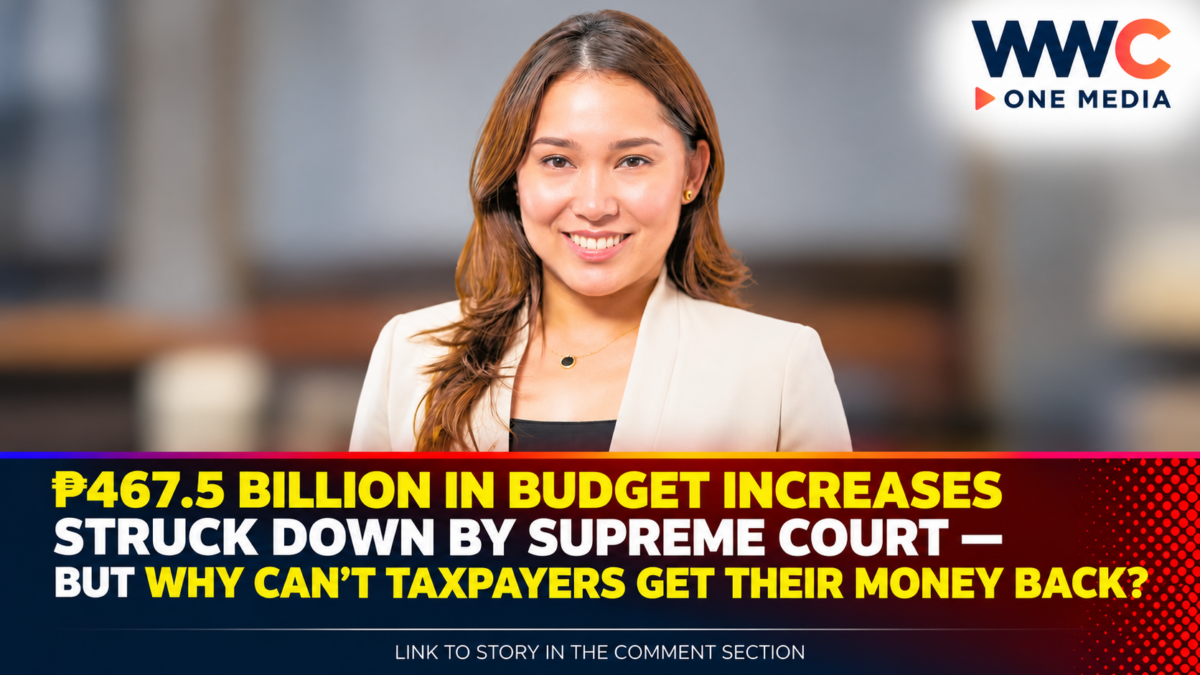
MANILA, Philippines — Nearly half a trillion pesos in disputed budget increases has become the focus of a major constitutional battle after the Supreme Court ruled that key provisions of the Philippines’ 2024 and 2025 national budgets violated legal limits on government spending.
The ruling invalidated a ₱449.5-billion increase in unprogrammed appropriations under the 2024 General Appropriations Act and a separate ₱17.99-billion increase in the Department of Public Works and Highways’ Special Road Fund under the 2025 budget. Combined, the two increases amount to approximately ₱467.49 billion.
But despite the staggering figure, Filipino taxpayers should not expect individual refunds simply because the Supreme Court declared the disputed budget increases unconstitutional.
The reason is that the case concerns the legality of government appropriations and the constitutional limits on public spending—not a finding that every peso involved was collected improperly from individual taxpayers or that the entire amount was actually spent.
The ruling also raises questions about how the government should handle funds already released, projects already completed and officials who participated in approving or implementing the challenged provisions.
Why the Supreme Court Struck Down the Budget Increases
In a decision written by Senior Associate Justice Marvic Leonen, the Supreme Court ruled that Congress exceeded its constitutional authority when it increased appropriations beyond the total amount recommended by the President.
Under the 1987 Constitution, Congress cannot increase the appropriations recommended by the President for the operation of the government as specified in the national budget.
The Court found that the 2024 budget’s unprogrammed appropriations had been increased by ₱449.5 billion, from the ₱281.9 billion proposed in the National Expenditure Program to ₱731.4 billion in the enacted budget.
Unprogrammed appropriations are standby allocations that may be released only when specified funding conditions are met. They are intended to provide flexibility for certain government expenditures, but they are not automatically available for spending without satisfying the applicable requirements.
The Court ruled that Congress could not circumvent constitutional spending limits by substantially increasing these standby allocations while leaving the programmed budget unchanged.
It also invalidated the ₱17.99-billion increase in the DPWH Special Road Fund under the 2025 budget.
Separately, the Court found that a ₱12.75-billion increase in certain agencies’ Special Accounts in the General Fund violated restrictions under the Administrative Code of 1987.
These findings underscore the constitutional limits governing how lawmakers revise the executive branch’s proposed spending plan.
Why Taxpayers Cannot Simply Demand a Refund
The headline figure may be enormous, but it does not mean the government has ₱467.49 billion sitting in an account ready to be returned to citizens.
An appropriation is legal authority to spend public money. It is not, by itself, proof that the full amount has been released, disbursed or lost.
The Supreme Court’s ruling also applied the doctrine of operative fact to protect certain completed government programs and projects whose effects could no longer be reversed, particularly where beneficiaries had acted in good faith.
In practical terms, invalidating a budget provision does not automatically erase every transaction or undo every public service that took place under it.
For example, a completed public infrastructure project or assistance already received by an eligible beneficiary cannot necessarily be reversed simply because the legal authorization associated with the spending was later declared unconstitutional.
That does not mean all disputed expenditures are automatically beyond scrutiny. The legal consequences depend on the specific expenditure, the applicable rules and the circumstances surrounding its implementation.
Nor does the decision establish that every official involved committed a crime.
The Court clarified that the protection afforded by the doctrine of operative fact does not automatically extend to the authors, proponents and implementers of the unconstitutional provisions. Those officials may still face civil, criminal or administrative liability unless the proper tribunals determine that they acted in good faith.
The distinction is crucial: protecting completed programs and good-faith beneficiaries is not the same as granting blanket immunity to officials.
The 2026 Budget Is Also Affected
The Supreme Court’s decision extends beyond the disputed increases in the 2024 and 2025 budgets.
The justices also invalidated two provisions governing the release of unprogrammed appropriations under the 2026 General Appropriations Act.
The Court found that the provisions allowed funds to be triggered by collections from individual revenue sources or new revenue streams without sufficiently accounting for the government’s overall revenue position.
According to the Court’s reasoning, this approach could create an artificial surplus even when aggregate government revenues had not exceeded the targets assumed in the national budget.
The ruling reinforces the requirement that standby appropriations operate within the overall fiscal program and be governed by clear conditions and safeguards.
Importantly, the Court did not declare all unprogrammed appropriations unconstitutional. It recognized that such funds can be a legitimate instrument of fiscal management when used within constitutional limits.
The decision instead targets the challenged increases and provisions that failed to comply with those limits.
Malacañang Seeks Reconsideration
The Marcos administration has expressed disagreement with portions of the ruling and directed the Office of the Solicitor General to file a motion for reconsideration.
According to the Philippine News Agency, Palace Press Officer Claire Castro said the administration believes the Court’s conditions go beyond those established by Congress and could severely restrict the use of unprogrammed appropriations.
The Palace has also emphasized that public officials remain obligated to account for government expenditures and that spending records should be made available for public scrutiny.
The government’s move means the legal dispute is not necessarily over. A motion for reconsideration asks the Supreme Court to review its decision, but it does not itself reverse the ruling.
The outcome could influence how the administration and Congress structure future budgets, including the proposed 2027 national spending plan.
What the Ruling Means for Government Accountability
The decision highlights a central question in Philippine public finance: how can the government retain flexibility to respond to unexpected needs while ensuring that public money is spent within constitutional limits?
Unprogrammed appropriations can help finance eligible expenditures when the required funding conditions are satisfied. However, the Court’s ruling makes clear that they cannot be used to bypass constitutional restrictions on total appropriations or undermine fiscal safeguards.
The ruling also carries implications for congressional budget deliberations. Lawmakers must reconcile their spending priorities with the constitutional limits governing the President’s proposed budget.
Senator Panfilo Lacson welcomed the timing of the decision as the Senate scrutinizes the proposed 2027 national budget, saying it reinforces the need to examine changes made to the executive branch’s spending proposal.
For taxpayers, the most immediate concern is transparency: knowing which amounts were authorized, which were actually released, what projects or programs received funding, and whether expenditures complied with the law.
Those questions require examination of government budget documents, disbursement records and relevant audit findings—not simply treating the headline figure as money that has disappeared.
The Bigger Question: Who Will Be Held Accountable?
The Supreme Court’s ruling establishes that the challenged budget increases exceeded constitutional limits. It does not automatically establish criminal wrongdoing by every person involved, nor does it guarantee that all affected amounts can be recovered.
The next steps will depend on the government’s motion for reconsideration, the implementation of the Court’s directives and any appropriate proceedings concerning particular expenditures or officials.
For the public, the challenge is to distinguish between three separate issues: whether the budget provisions were constitutional, whether public funds were actually spent in accordance with the law, and whether particular officials should be held liable.
The central question now is not simply whether ₱467.5 billion can be returned to taxpayers. It is how the government will account for the disputed spending, enforce the Supreme Court’s ruling and ensure that future national budgets comply with constitutional limits.