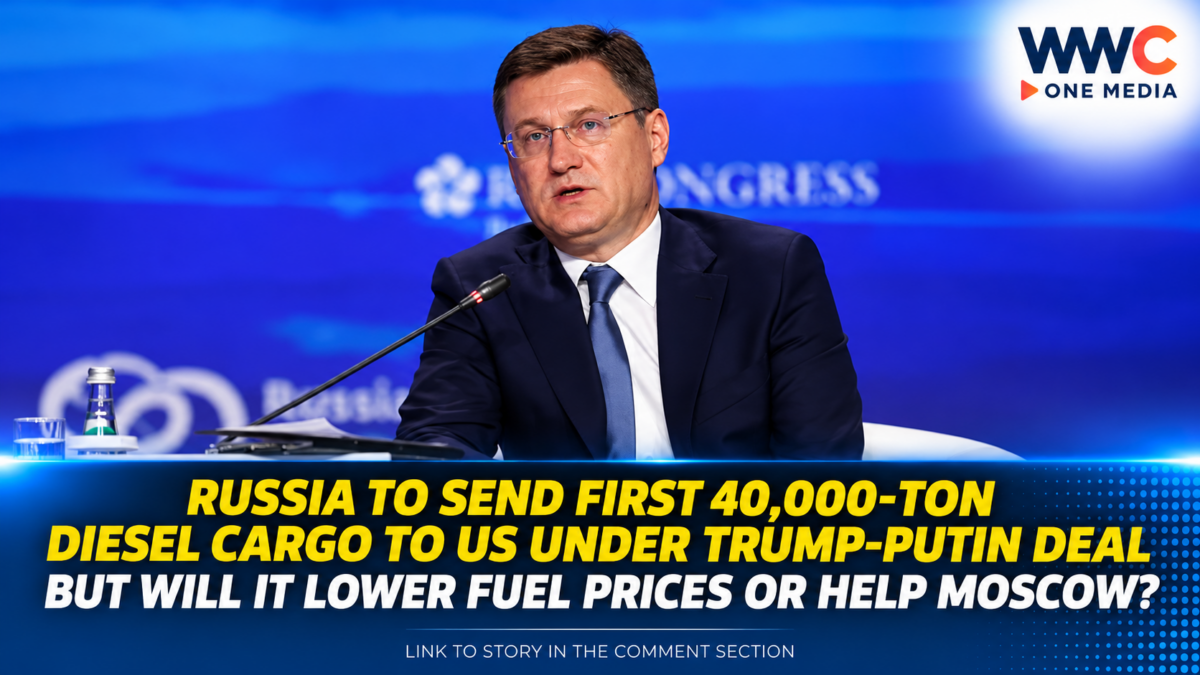
MOSCOW, RUSSIA — Russia is preparing to send its first diesel shipment to the United States under a new energy arrangement between President Vladimir Putin and U.S. President Donald Trump, marking a significant shift in trade relations between the two countries amid rising fuel prices and continuing tensions over the war in Ukraine.
Russian Deputy Prime Minister Alexander Novak announced on Wednesday, October 21, that the first tanker is scheduled to depart on Thursday, October 22, carrying approximately 40,000 metric tons of diesel fuel.
The shipment follows an agreement between Moscow and Washington that allowed Russia to resume diesel exports after a temporary domestic ban.
But the energy deal has also triggered controversy over whether renewed purchases of Russian fuel could weaken economic pressure on Moscow while the war in Ukraine continues.
The arrangement comes as global energy markets face severe supply disruptions, with high diesel prices affecting transportation, manufacturing, agriculture and consumers.
The central question is whether Russian diesel can meaningfully ease the fuel shortage — or whether the agreement will have greater geopolitical consequences than economic benefits.
Russia Confirms First 40,000-Ton Diesel Cargo
According to Novak, preparations for the initial shipment are nearing completion.
The first vessel is expected to carry 40,000 metric tons of diesel, while additional tankers are being prepared for dispatch.
The Russian government has not publicly identified the port of departure or the specific American delivery destination.
Novak said the additional shipments would depend on Russia’s production capacity.
His remarks are significant because Moscow had previously restricted diesel exports to protect domestic supplies following disruptions to its oil-refining operations.
However, as of October 21, the first vessel was still scheduled for departure.
The announcement confirms the planned shipment, not that the diesel has already arrived in the United States.
How Much Russian Diesel Could Reach the United States?
Further planned supply: An additional 1 million metric tons, according to figures announced by Trump, with no precise delivery schedule established in the original report.These are announced shipment plans, not confirmed completed deliveries.
The first shipment represents only a fraction of the volumes discussed by the two governments.
President Trump previously said Russia would supply approximately 300,000 metric tons initially, followed by 500,000 tons in November and another 1 million tons afterward.
If all three announced volumes are delivered, they would total approximately 1.8 million metric tons.
However, the actual supply schedule will depend on Russian refinery output, shipping arrangements, regulatory conditions and commercial contracts.
Why Russia Banned Diesel Exports in the First Place
Russia imposed restrictions on diesel exports on October 9 after disruptions to domestic fuel production.
Ukrainian drone attacks on Russian oil refineries had reduced available refining capacity, contributing to concerns over domestic shortages.
Restricting exports was intended to preserve fuel for Russia’s internal market.
The restriction was subsequently lifted as Moscow and Washington reached an agreement to reopen diesel trade.
Russia’s decision illustrates the competing pressures facing its energy industry: maintaining sufficient domestic fuel supplies while earning revenue from international sales.
Ukraine’s attacks on Russian energy facilities form part of its broader strategy to weaken Moscow’s war-supporting infrastructure and economic resources.
The export restrictions and their removal must therefore be understood within the wider conflict, not simply as routine energy-market decisions.
Trump-Putin Energy Agreement Changes the Sanctions Landscape
The diesel agreement also required a significant change in the U.S. sanctions environment.
On October 9, the U.S. Treasury Department’s Office of Foreign Assets Control issued General License 135, authorizing specified transactions involving the sale, delivery, unloading and importation of Russian-origin diesel.
The authorization created a legal pathway for qualifying diesel trade that would otherwise face sanctions restrictions.
However, this does not mean the United States has removed every sanction imposed on Russia over its invasion of Ukraine.
The authorization is specific to the transactions and conditions covered by the license.
Broader sanctions affecting other Russian companies, industries and financial activities may continue to apply.
Putin and Witkoff Discuss Diesel During Ukraine Peace Talks
The announcement coincided with another important diplomatic development.
President Putin met U.S. special envoy Steve Witkoff in St. Petersburg on Wednesday for talks concerning the war in Ukraine.
During the meeting, Witkoff thanked Putin for lifting restrictions on diesel exports.
Putin said the agreement had already helped reduce international diesel prices by approximately 5% to 6%.
That figure represents Putin’s account of the market response, rather than independently verified proof that the agreement alone caused the entire price movement.
The Russian leader also suggested that Moscow could supply significant quantities of fertilizer to the United States.
Those comments indicate that the two countries may be exploring broader commercial cooperation alongside diplomatic negotiations.
However, no comprehensive Ukraine peace agreement was announced as part of the diesel discussions.
Why Ukraine Is Concerned About Russian Fuel Sales
The renewed energy trade has become a source of friction between Washington and Kyiv.
Ukrainian President Volodymyr Zelenskyy has criticized the arrangement, arguing that additional revenue from Russian fuel exports could support Moscow’s ability to continue the war.
From Ukraine’s perspective, lifting restrictions on Russian energy revenue risks weakening the economic pressure intended to encourage Moscow to negotiate.
The Trump administration, meanwhile, has presented the arrangement as a way to improve fuel availability and reduce economic pressure on American households and businesses.
The competing priorities create a difficult diplomatic challenge.
Washington wants lower fuel prices, while Kyiv seeks to maintain financial pressure on Russia.
The agreement does not automatically establish that diesel-sale revenues will fund particular military operations. It does, however, create potential additional export earnings for Russia.
Will Russian Diesel Actually Lower Global Fuel Prices?
Energy analysts remain skeptical that Russian exports alone can resolve the worldwide diesel shortage.
A separate Reuters report published October 21 found that the planned supply is relatively small compared with the scale of the disruption affecting international markets.
Analysts estimate that substantially more diesel production — potentially hundreds of thousands of additional barrels per day — would be required to make a lasting difference to prices.
The shortage has been intensified by Middle East supply disruptions and the effects of the U.S.-Israeli conflict with Iran.
High freight costs, limited refining capacity and logistical obstacles also complicate efforts to move additional fuel into the market.
Consequently, even if Russia delivers its planned shipments, the impact on retail diesel prices may be limited.
Global Oil Prices Remain Under Pressure
Reported crude oil price benchmarks, October 21, 2026
Approximate reported prices per barrel, not a real-time market quote.
$0$30$60$90$120Brent crudeWTI crudePrices reported by Reuters on October 21, 2026; market quotations may have changed since publication.
Global oil prices have remained elevated amid concerns about Middle East shipping routes and supply disruptions.
Reuters reported Brent crude around US$110 per barrel on Wednesday, while West Texas Intermediate approached US$99.
Diesel markets face additional pressures because diesel supply depends on refinery capacity, the type of crude oil available and demand from transportation and industry.
This means an increase in Russian diesel exports may provide some relief without eliminating the underlying shortage.
Why the United States Needs Russian Diesel Despite Being a Major Exporter
The United States is itself a major producer and exporter of petroleum products.
According to Reuters, the country exports approximately 1.5 million barrels of diesel per day.
That may seem contradictory: why import Russian diesel when the U.S. already exports large quantities?
The answer lies in how regional energy markets operate.
A country can export fuel from some refining centers while importing petroleum products into other regions when transportation economics, refinery configurations, regional shortages or pricing make such transactions commercially attractive.
The present arrangement also reflects extraordinary international supply pressures.
However, the original report does not establish the receiving refinery, final destination or commercial buyer for the first Russian shipment.
What This Means for the Philippines and Asian Fuel Markets
The Philippines relies heavily on imported petroleum products, making domestic fuel prices sensitive to international supply conditions, shipping costs and currency movements.
If additional Russian diesel contributes to improved global supply, Asian importers could potentially benefit from reduced market pressure.
However, the expected impact is uncertain.
Diesel prices in the Philippines depend on several factors, including international product benchmarks, exchange rates, freight charges, taxes and local distribution costs.
The planned Russian shipment does not guarantee an immediate pump-price rollback in the Philippines.
For transportation companies, logistics operators, farmers and households, sustained reductions in global fuel prices would matter more than a temporary change following a diplomatic announcement.
The Bigger Question: Energy Relief or Geopolitical Gamble?
The Russia-U.S. diesel arrangement brings together two issues that are often treated separately: energy affordability and international sanctions.
The Trump administration is seeking additional diesel supply as fuel costs put pressure on businesses and consumers.
Russia, meanwhile, stands to regain access to a major market for some of its petroleum products while continuing negotiations with Washington over Ukraine.
The resulting tension is clear.
The agreement could provide an additional source of diesel to a strained global market, but it also complicates efforts to maintain economic pressure on Russia.
The bottom line: Russia expects to dispatch its first 40,000-ton diesel shipment to the United States on October 22, with further supplies planned. The arrangement is confirmed, but actual delivery, sustained price reductions and any diplomatic benefits remain uncertain.