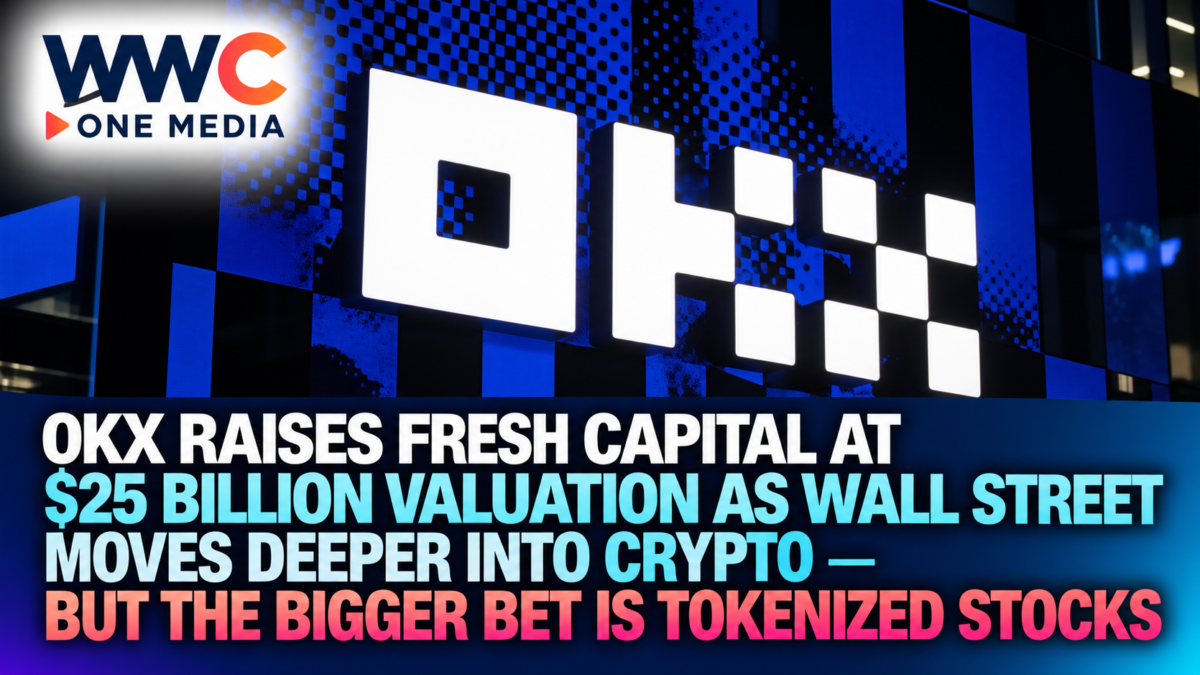
NEW YORK — Crypto exchange OKX has secured fresh backing from some of the biggest names in traditional finance and digital assets, holding its valuation at $25 billion as it tries to transform itself from a crypto trading platform into something much closer to a global financial-market infrastructure company.
The latest investment round includes Circle Internet Group, Ripple, Qube Research & Technologies and SC Ventures, the venture arm of Standard Chartered.
OKX did not disclose how much new money it raised.
But the company confirmed that the investment was completed at a $25 billion pre-money valuation, matching the valuation used earlier this year when Intercontinental Exchange, the parent company of the New York Stock Exchange, made a strategic investment in the exchange.
Bloomberg reported that ICE invested roughly $200 million in March.
The fact that the valuation has remained at $25 billion seven months later is important.
It means OKX is attracting powerful new strategic investors without yet claiming a higher headline valuation.
That may be less dramatic than a valuation jump.
But it could be more important strategically.
The new investors bring expertise in:
stablecoins,
cross-border payments,
institutional banking,
quantitative trading,
and blockchain-based financial infrastructure.
And that gives OKX much more than cash.
Circle, Ripple and Standard Chartered Are Not Random Investors
The investor list tells the real story.
Circle is the company behind USDC, one of the world’s largest dollar-backed stablecoins.
Ripple operates blockchain-based payments and settlement infrastructure.
Standard Chartered is one of the world’s major international banks, with deep exposure to Asia, the Middle East and cross-border finance.
And Qube Research & Technologies is a London-based quantitative investment firm active across sophisticated global markets.
Those relationships could help OKX build products that move beyond speculative crypto trading.
The company says it wants to create a broader global financial-technology platform combining crypto infrastructure with the standards customers expect from major financial institutions.
That ambition increasingly places OKX in competition not only with Binance and Coinbase.
It puts the company closer to exchanges, brokerages, payments networks and capital-markets infrastructure providers.
The Biggest Opportunity May Be Tokenized Stocks
The timing of the fundraising is especially important.
Just one day before the financing announcement, OKXICE, a 50-50 joint venture between OKX and Intercontinental Exchange, filed with U.S. regulators to launch a platform for trading tokenized U.S. stocks.
The proposed service would allow investors to trade blockchain-based versions of U.S.-listed shares around the clock.
The initial plan covers more than 60 companies.
Industry reporting says the list includes major names such as:
Nvidia,
Apple,
Microsoft,
Tesla,
and other heavily traded U.S. equities.
That would move tokenization well beyond experimental crypto products and into mainstream public equities.
Why Tokenized Stocks Matter
A tokenized share is a blockchain-based representation of a traditional stock.
In the strongest structures, the digital token gives the holder economic and legal rights equivalent to ownership of the underlying security.
That could eventually allow investors to:
trade outside normal exchange hours,
settle transactions faster,
use fractional ownership,
transfer assets directly between approved digital wallets,
and connect stock trading with stablecoin-based settlement.
The SEC took a major step toward that future in September when it created a temporary Innovation Exemption allowing certain regulated venues to experiment with tokenized U.S. stocks using permissioned blockchain networks.
Under the framework, tokenized shares must preserve the rights attached to the underlying stock, including dividends and voting rights where applicable.
Issuers also have the ability to object to having their shares traded through these venues.
That means the U.S. regulatory environment has shifted significantly from only a few years ago.
The NYSE Connection Changes the Narrative
OKX’s partnership with ICE may be the most surprising element in its transformation.
ICE owns the New York Stock Exchange, one of the most established institutions in global finance.
OKX emerged from the much more volatile crypto industry.
Only a few years ago, those two worlds looked almost completely separate.
Now they are jointly exploring blockchain-based stock trading.
That partnership signals a broader change.
Traditional financial institutions are no longer asking whether blockchain technology will disappear.
They are increasingly asking how they can use it without surrendering control of markets to crypto-native competitors.
Wall Street Is Moving Toward Tokenization
OKX is not alone.
Traditional exchanges, banks and brokers around the world are experimenting with tokenized assets.
The New York Stock Exchange has also explored tokenized equities with Blockchain.com, while Nasdaq, Deutsche Börse and the London Stock Exchange have been developing various forms of digital-market infrastructure.
The basic attraction is straightforward.
Traditional stock markets still rely on multiple layers of:
clearing,
custody,
settlement,
transfer agents,
and reconciliation.
Blockchain-based systems could potentially automate parts of that process.
If they work at scale, settlement could become faster and cheaper.
But the biggest promise may be trading availability.
Traditional U.S. markets operate during limited weekday hours.
Blockchain networks never close.
Stablecoins Could Become the Cash Layer
Circle’s investment provides another clue about where the market may be heading.
Tokenized stocks need a digital form of cash if investors want to trade and settle them efficiently onchain.
That is where stablecoins such as USDC could become critical.
Instead of selling a stock, waiting for conventional settlement and moving cash through multiple banking systems, a blockchain venue could theoretically exchange tokenized shares directly against regulated dollar-backed stablecoins.
That could reduce settlement time dramatically.
It could also create a much closer relationship between:
digital dollars,
tokenized stocks,
and global trading platforms.
Circle therefore has an obvious strategic reason to deepen its relationship with OKX.
Ripple Adds Another Piece of the Infrastructure
Ripple’s involvement also fits the strategy.
The company has spent years developing blockchain infrastructure designed for payments and institutional settlement.
Its investment suggests OKX is building relationships with multiple digital-asset ecosystems rather than relying on one stablecoin or one blockchain partner.
That may become increasingly important if tokenized financial markets evolve into a network of interoperable systems rather than one dominant platform.
Standard Chartered Gives OKX Traditional-Banking Credibility
Standard Chartered’s SC Ventures brings something different.
It brings the banking system.
The London-listed bank has a major presence in Asia, Africa and the Middle East and has spent years experimenting with digital assets, custody and tokenized finance.
A deeper partnership with Standard Chartered could help OKX bridge one of crypto’s biggest remaining gaps:
moving smoothly between traditional bank money and blockchain-based assets.
Institutional investors may be willing to trade tokenized securities.
But they still need regulated banking relationships, custody, compliance and payment rails.
That is where established banks remain extremely powerful.
The $25 Billion Valuation Has Not Increased
This is one of the most important details for investors.
OKX’s valuation stayed at $25 billion, the same level as the March financing led by ICE.
That does not necessarily signal weakness.
Strategic fundraising rounds are often structured around partnerships rather than maximizing valuation.
OKX itself described the latest investment as an extension of the earlier financing rather than an entirely separate new round.
But the flat valuation does show that investors are currently emphasizing strategic positioning over headline valuation inflation.
In other words:
The story is not that OKX suddenly became worth much more.
The story is that some of the most important companies in finance now want a seat at the table.
OKX Says It Is Building Market Infrastructure, Not Just Raising Cash
OKX Global Managing Partner Haider Rafique said the capital is intended to strengthen the company’s long-term market infrastructure.
Founder and CEO Star Xu has similarly framed the company’s future as a combination of crypto technology and institutional-grade financial services.
That framing is deliberate.
Crypto exchanges have historically depended heavily on trading fees from volatile digital assets.
That revenue can rise explosively during bull markets and collapse during downturns.
Building broader financial infrastructure could make OKX less dependent on speculative crypto cycles.
That Could Mean a Very Different Business Model
A mature OKX could eventually make money from:
crypto trading,
stablecoin payments,
tokenized equities,
institutional execution,
custody,
settlement,
wallet infrastructure,
real-world assets,
and financial-market technology.
That is a much broader opportunity than simply charging retail traders to buy Bitcoin.
It also puts OKX closer to companies such as:
Coinbase,
Robinhood,
Nasdaq,
ICE,
and major international banks.
The boundaries between a crypto exchange and a conventional securities platform are becoming increasingly difficult to define.
But OKX Has a Serious Regulatory History
The company’s push toward institutional finance also comes with baggage.
In February 2025, an OKX operating entity pleaded guilty in the United States to operating an unlicensed money-transmitting business.
The company agreed to pay more than $504 million in penalties and forfeiture.
U.S. prosecutors said OKX had officially prohibited U.S. customers but nevertheless served American users who conducted more than $1 trillion in transactions on the exchange between 2018 and early 2024.
The Justice Department also said OKX historically allowed some customers to trade without completing full know-your-customer checks and acknowledged that U.S. users could circumvent IP restrictions using VPNs.
As part of the resolution, OKX agreed to retain an external compliance consultant through February 2027 and cooperate with U.S. authorities.
That history matters.
A company that wants to become trusted market infrastructure for tokenized U.S. securities will face a dramatically higher compliance bar than one operating primarily as an offshore crypto exchange.
The New SEC Environment Gives Crypto Firms a Bigger Opening
The regulatory environment has also changed.
On September 17, the SEC approved temporary exemptions allowing qualified venues to experiment with tokenized versions of U.S.-listed shares.
SEC Chairman Paul Atkins described the initiative as a step toward bringing U.S. capital markets “onchain.”
Commissioners supporting the framework argue tokenization could modernize:
issuance,
trading,
settlement,
ownership records,
and liquidity.
That is a dramatic departure from the far more hostile U.S. regulatory climate that defined much of the crypto industry’s earlier expansion.
Companies that survived the previous enforcement cycle are now racing to position themselves for a potentially more permissive era.
OKX is clearly one of them.
Tokenized Stocks Are Still Tiny Compared With Traditional Markets
The opportunity is large.
The existing market is not.
Reuters Breakingviews estimates tokenized equities are worth only around $3 billion, with monthly trading volume below $30 billion.
Traditional U.S. equity markets trade trillions of dollars every month.
So despite the excitement, tokenized stocks remain a tiny niche.
This is why OKX’s partnership with ICE matters.
Crypto-native platforms have already shown that blockchain-based securities can technically trade.
The harder challenge is attracting:
institutional liquidity,
regulated market makers,
issuers,
custodians,
and mainstream investors.
ICE can potentially help solve those problems.
Issuers Could Push Back
Tokenization also has critics.
Some public companies are uncomfortable with third parties creating blockchain versions of their shares.
They worry about:
fragmented liquidity,
investor confusion,
governance,
corporate actions,
and trading outside established exchanges.
The SEC’s new framework specifically allows companies to object to tokenized trading of their stock.
That safeguard could slow adoption.
A venue may technically be able to tokenize hundreds of companies.
But if major issuers refuse participation, the market could remain fragmented.
24/7 Trading Sounds Simple — But It Changes Market Structure
Around-the-clock stock trading is one of tokenization’s most attractive promises.
It also raises difficult questions.
If tokenized Apple shares trade on Sunday night while Nasdaq is closed, what determines the price?
How do market makers hedge risk?
What happens when major corporate news breaks during traditional off-hours?
How are price differences reconciled when the conventional market reopens?
Crypto markets are accustomed to continuous trading.
Traditional equity markets are not.
Bringing the two systems together will require much more than putting shares on a blockchain.
The Strategic Investors Could Help Solve Those Problems
This is why the composition of the funding round may matter more than its size.
Circle can help with digital dollars.
Ripple can help with blockchain payments and institutional infrastructure.
Standard Chartered can help bridge regulated banking.
QRT brings quantitative trading expertise.
ICE brings exchange infrastructure and institutional market access.
Taken together, those companies represent many of the building blocks necessary for a tokenized financial market.
OKX sits in the middle.
The Crypto Exchange Is Trying to Become Something Bigger
That may ultimately be the real significance of the $25 billion valuation.
OKX does not appear satisfied with being another platform where people buy and sell crypto tokens.
Its partnerships suggest it wants to become infrastructure connecting:
traditional stocks,
digital assets,
stablecoins,
payments,
banks,
and institutional markets.
That is a much larger ambition.
It is also much more heavily regulated.
The company’s earlier U.S. compliance problems show how costly mistakes can become.
A $25 Billion Valuation Is Only the Starting Point
The latest round does not tell investors how much money OKX raised.
It does not increase the company’s headline valuation.
And it does not guarantee that tokenized U.S. stock trading will become a massive market.
What it does show is that major financial institutions are becoming increasingly willing to back infrastructure built by crypto-native companies.
That would have been difficult to imagine only a few years ago.
The NYSE’s parent company invested first.
Now Circle, Ripple, Standard Chartered’s venture arm and one of London’s sophisticated quantitative investment firms have followed.
OKX is still valued at $25 billion.
But the bigger story is that its investors are betting the next phase of crypto may not be about new coins at all—it may be about putting the traditional financial markets people already use onto blockchain rails.