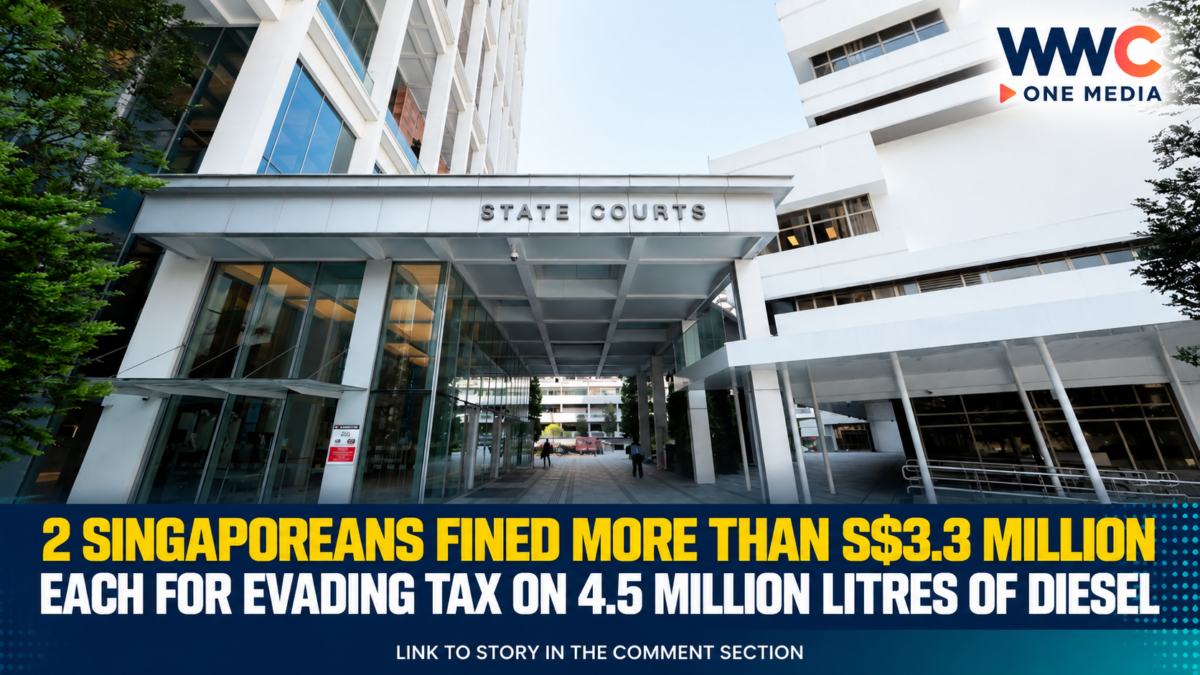
Two Singaporean men have each been fined more than S$3.3 million after admitting to a scheme to import millions of litres of cheaper diesel from Malaysia into Singapore without declaring the shipments or obtaining the required permits.
Chua E Hong, 51, and Ng Leok Kwee, 48, each pleaded guilty on Tuesday (Oct. 6) to three charges of fraudulently evading duty on the importation of more than 4.5 million litres of automotive diesel oil between April and December 2024.
Singapore Customs said the men had arranged for the diesel to be brought into Singapore without paying the required taxes, allowing it to be sold to customers locally at a profit.
More Than S$900,000 in Duty Evaded
The three charges against each man involved 4,527,099 litres of automotive diesel oil.
The amount of duty evaded under those charges was about S$905,419.
The court also took another 16 charges into consideration when sentencing the pair. These comprised six additional charges involving fraudulent evasion of duty and 10 charges involving fraudulent evasion of Goods and Services Tax (GST).
The total amount of uncollected duty and GST covered by those additional charges was about S$2.5 million, Singapore Customs said.
Each man was ultimately fined S$3,340,000.
The size of the fines reflects the serious nature of the offences under Singapore’s Customs Act, which allows those convicted of fraudulently evading duty or GST to be fined up to 20 times the amount evaded and jailed for up to 12 months.
Executives of CNC Petroleum and PS Energy
At the time of the offences, Chua was the managing director, while Ng was the executive director, of both CNC Petroleum Pte Ltd and PS Energy Pte Ltd.
The two companies are sister companies under the PS Energy Group and were involved in last-mile fuel distribution in Singapore.
According to Singapore Customs, Chua was responsible for the companies’ finance and sales functions, while Ng handled operational matters.
The pair devised the scheme in early 2024 to obtain cheaper diesel from Malaysia and bring it into Singapore without declaring the imports or securing the necessary customs permits.
The duty-unpaid diesel was then resold to customers in Singapore, increasing CNC Petroleum’s profits.
Diesel Bought From Malaysia
The diesel was purchased by CNC Petroleum from suppliers’ terminals in Pengerang, Johor.
From there, a vessel collected the fuel and transported it into Singapore’s territorial waters.
The diesel was then transferred on multiple occasions at Selat Pauh Petroleum Anchorage to two smaller vessels before being transported to Penjuru Terminal.
At Penjuru, the fuel was transferred to tanker trucks for distribution to customers around Singapore.
Singapore Customs said Ng coordinated the logistics, including the scheduling of the vessels and tanker trucks, as well as the collection and transfer of the diesel.
The arrangement allowed the diesel to enter the Singapore market without the required duty and tax payments being made.
Customs Investigation Began After Tip-Off
Singapore Customs began investigating the companies after receiving information about the suspected scheme.
The investigation eventually uncovered the undeclared diesel imports and the arrangements used to transport the fuel from Malaysia into Singapore.
Authorities have not indicated that the customers who purchased the diesel were involved in the tax-evasion scheme.
The case centred on the importation and movement of the duty-unpaid diesel and the failure to make the required declarations.
Diesel Is a Dutiable Import
Petroleum products, including diesel, are subject to Singapore’s customs requirements.
Singapore Customs states that motor fuel such as petrol, diesel and compressed natural gas is dutiable, while imported goods are generally also subject to GST unless an exemption applies. Importers must obtain the relevant customs permit before bringing goods into Singapore.
For petroleum products specifically, Singapore Customs requires companies handling such goods to comply with licensing, permit and accounting requirements.
The rules are intended to ensure that imported fuel is properly declared and that the appropriate duty and GST are collected.
Millions of Litres Moved Through Singapore Waters
The scale of the case is significant.
More than 4.5 million litres of diesel were covered by the three charges to which Chua and Ng pleaded guilty.
The fuel was not simply transported directly from Malaysia to a Singapore facility. Instead, the investigation found that it was moved through several stages, including transfers between vessels in Singapore waters before eventually reaching Penjuru Terminal.
From there, tanker trucks transported the diesel to customers.
The logistics required coordination between marine vessels, the terminal and road transport, with Ng responsible for arranging much of the movement.
Authorities Warn Against Duty and GST Evasion
Singapore Customs said it remains committed to enforcing customs regulations and protecting government revenue.
The agency takes a serious view of attempts to avoid paying duty and GST, including smuggling, under-declaration of imported goods and falsification of customs declarations.
The penalties can be substantial.
Under the Customs Act, a person convicted of fraudulently evading duty or GST can face a fine of up to 20 times the amount of duty and GST evaded, as well as imprisonment of up to 12 months.
In this case, the court imposed fines of more than S$3.3 million on each of the two men.
A Growing Focus on Import Compliance
The case comes as Singapore authorities continue to step up enforcement against customs and tax offences involving imported goods.
Petroleum products are particularly closely regulated because of their value and the duties and taxes imposed on them.
Singapore Customs’ import procedures require businesses to obtain the appropriate permits and account for imported goods before they are brought into Singapore.
The agency has also urged members of the public to report suspected smuggling, duty evasion and other illicit trade activities.
For Chua and Ng, the court proceedings mark the conclusion of the prosecution over the diesel scheme, with both men now facing multimillion-dollar financial penalties for their roles in importing and distributing duty-unpaid fuel.
The case serves as a reminder that importing commercial quantities of fuel without the required declarations and permits can result in severe financial consequences, particularly when authorities establish that the tax was deliberately evaded.