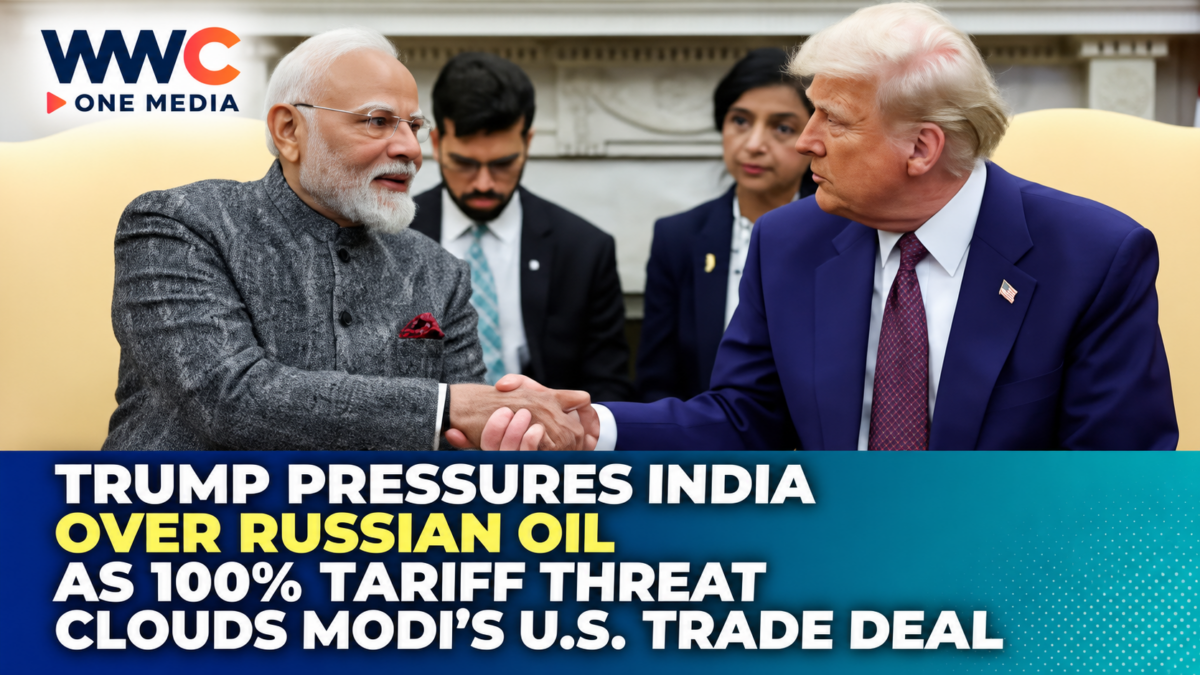
NEW DELHI/WASHINGTON — U.S. President Donald Trump is turning India’s purchases of Russian oil into one of the biggest obstacles in Washington’s trade relationship with New Delhi, confronting Prime Minister Narendra Modi with an increasingly difficult choice between cheaper energy for 1.4 billion people and access to India’s most important export market.
The pressure intensified after Trump signed legislation giving the U.S. president broad authority to impose tariffs of up to 100% on goods from major countries that continue buying Russian oil and gas. India is among the countries potentially exposed because Russia remains its biggest supplier of crude.
The legislation does not automatically impose a 100% tariff on every Indian product.
But it gives Washington significantly more leverage at a time when the United States and India are already negotiating an unfinished trade agreement.
U.S. Trade Representative Jamieson Greer said October 1 that an India-U.S. deal was not imminent, despite continued discussions with Indian Commerce Minister Piyush Goyal.
That means Russian oil, tariffs and market access are becoming increasingly intertwined.
TRUMP WANTS INDIA TO BUY LESS RUSSIAN OIL
Trump has spent much of 2026 pressing India to reduce purchases of Russian crude as part of Washington’s broader effort to shrink Moscow’s energy revenues.
The logic is straightforward.
Oil exports remain one of Russia’s largest sources of foreign currency, helping fund government spending during the war in Ukraine.
India became one of Russia’s most important buyers after Western sanctions and restrictions redirected large quantities of Russian crude away from Europe.
Since 2022, Indian refiners have been able to buy Russian barrels—particularly Urals crude—at discounts relative to alternative supplies.
That helped India control refinery costs while maintaining fuel supplies for one of the world’s fastest-growing major economies.
But Washington increasingly views those purchases through a geopolitical rather than purely commercial lens.
INDIA SAYS ENERGY SECURITY COMES FIRST
New Delhi’s position is equally direct.
India argues that its purchasing decisions are driven by the need to secure affordable energy for a country of more than 1.4 billion people.
Indian officials have warned that restrictions on major Russian buyers could disrupt global energy markets and push prices higher.
India imports roughly 90% of the crude oil it consumes, making the country particularly vulnerable when international oil prices rise.
That dependence has become even more important in 2026 as instability in the Middle East has pushed oil prices above $100 per barrel at various points.
Replacing millions of barrels of relatively competitive Russian crude with more expensive alternatives could increase:
India’s import bill
Domestic fuel costs
Inflation
Pressure on the rupee
and
Government subsidy burdens.
That is why Modi’s government has resisted framing Russian oil purchases simply as a diplomatic choice.
For New Delhi, they are also an economic calculation.
RUSSIAN OIL STILL ACCOUNTS FOR A HUGE SHARE OF INDIA’S SUPPLY
Russia remains India’s largest crude-oil supplier.
Reuters reported that Russian crude accounted for more than 40% of Indian supplies during parts of 2026.
That represents an extraordinary change.
Before Russia’s full-scale invasion of Ukraine in 2022, Russian crude played only a relatively small role in India’s import mix.
Western sanctions changed the economics.
With many European buyers pulling away, Moscow offered discounted barrels to Asian customers.
Indian refiners became some of the biggest beneficiaries.
BUT INDIA’S RUSSIAN IMPORTS ARE ALREADY FALLING
There is an important twist.
Indian purchases of Russian crude have recently declined.
Russian oil imports fell around 16.5% in August to approximately 2.1 million barrels per day, according to trade data reviewed by Reuters.
By September, imports were expected to drop to roughly 1.75 million barrels per day, the lowest level since April.
But that decline does not necessarily mean India is bowing completely to U.S. pressure.
Several market forces are contributing.
Russia has less crude available for India.
China is competing more aggressively for Russian barrels.
Ukrainian attacks have disrupted Russian export infrastructure.
And Middle Eastern producers have been offering alternative supplies.
That means market economics—not only diplomacy—are reducing Russian flows.
CHINA IS COMPETING FOR THE SAME RUSSIAN BARRELS
One reason India is receiving less Russian crude is stronger Chinese demand.
Chinese refiners increased purchases as Middle East supply disruptions tightened the broader Asian market.
That has pushed up prices for Russian grades that were previously attractive because of steep discounts.
Reuters reported that Russian ESPO crude traded above $120 per barrel in September, while Urals reached around $110 as Asian competition intensified.
For Indian refiners, that changes the calculation.
Russian oil becomes much less attractive when the discount disappears.
As a result, Indian buyers have increasingly looked toward alternatives including:
UAE Murban
Iraqi Basrah
and
Angolan crude.
TRUMP ALREADY ANNOUNCED ONE INDIA TRADE DEAL THIS YEAR
The current dispute is especially striking because Washington and New Delhi appeared to reach a major breakthrough earlier in 2026.
On February 2, Trump announced a trade deal reducing U.S. tariffs on Indian goods from 50% to 18%.
Trump said India had agreed to stop buying Russian oil and increase purchases from the United States and potentially Venezuela.
But almost immediately, uncertainty emerged over what India had actually committed to.
Indian refiners told Reuters they had received no government order to stop buying Russian crude and would need time to unwind existing contracts even if such an instruction were eventually issued.
A formal U.S.–India joint statement released February 7 confirmed the broader framework for an interim trade agreement and the planned 18% U.S. reciprocal tariff rate, but its publicly released text focused primarily on tariff reductions and market access rather than spelling out a complete Russian-oil ban.
That gap between political announcements and commercial reality has followed the negotiations ever since.
TRADE TALKS ARE STILL NOT FINISHED
Eight months later, the broader U.S.–India trade agreement remains incomplete.
Trump and Modi spoke again on September 30, reaffirming cooperation on trade, defense, energy and technology.
At the same time, Indian Commerce Minister Piyush Goyal traveled to the United States from September 29 to October 5 for further trade negotiations.
But USTR chief Greer said October 1 that a deal was “not imminent.”
Officials say both sides are still working through unresolved issues.
Russian oil now hangs over those negotiations.
THE NEW U.S. LAW RAISES THE STAKES DRAMATICALLY
The biggest change came in September.
Trump signed a new Russia sanctions law granting the president authority to impose tariffs of up to 100% on goods from the five largest importers of Russian oil and gas or from countries deemed to be helping Russia evade sanctions.
The legislation does not explicitly name India.
It also gives Trump substantial discretion over how the measures are applied, including waiver authority.
But India is an obvious potential target because of the sheer scale of its Russian crude purchases.
Other countries potentially exposed include China and other major Russian energy customers.
The result is powerful leverage.
Washington can now link Russian energy purchases directly to access to the U.S. consumer market.
WHY 100% TARIFFS WOULD BE A MAJOR THREAT TO INDIA
The United States is one of India’s most important trading partners and its largest export destination.
Indian industries dependent on American customers include:
Textiles and clothing
Gems and jewelry
Pharmaceuticals
Engineering products
Electronics
Chemicals
and
Machinery.
A 100% tariff would effectively double the border cost of affected goods before transportation, distribution and retail expenses.
That could make many Indian exports commercially uncompetitive.
This is why the Russian-oil question has implications far beyond energy.
It could affect Indian factories, exporters and employment.
INDIA ALREADY FACES OTHER U.S. TARIFFS
The Russia dispute is not India’s only tariff challenge.
In July, the United States imposed an additional 10% duty on Indian imports under a Section 301 investigation involving enforcement against goods produced with forced labor.
India had initially faced a proposed rate of 12.5%, but Washington placed it in a lower 10% tier after negotiations.
That measure sits alongside the broader 18% reciprocal tariff framework.
The expanding number of overlapping tariff regimes illustrates how trade policy has become a central instrument of Trump’s foreign policy.
INDIA’S CHOICE IS HARDER BECAUSE OIL IS ABOVE $100
New Delhi might have found it easier to reduce Russian purchases if global energy supplies were abundant.
They are not.
Oil markets have been disrupted by conflict involving Iran, refinery outages, shipping risks and attacks on Russian energy infrastructure.
Brent crude traded above $100 per barrel during late September and early October.
For India, high oil prices are particularly painful.
Every increase in crude prices raises the cost of importing energy into an economy where domestic production covers only a small share of demand.
It can also weaken the rupee.
Reuters reported that rising oil costs recently pushed the Indian currency toward 96 rupees per dollar, with the Reserve Bank of India intervening to limit depreciation.
RUSSIA AND INDIA ARE STILL DEEPENING THEIR RELATIONSHIP
Despite U.S. pressure, Modi has not abandoned Moscow.
He met Russian President Vladimir Putin in New Delhi on September 11, with both leaders pledging deeper trade, technology and defense cooperation.
India and Russia are targeting bilateral trade of $100 billion by 2030, up from nearly $70 billion.
Their relationship stretches back decades and covers:
Defense
Nuclear power
Energy
Space cooperation
and
Diplomatic coordination.
For India, Russia is therefore not simply another oil supplier.
It is a long-standing strategic partner.
INDIA ALSO DOES NOT WANT TO BECOME OVERDEPENDENT ON WASHINGTON
New Delhi has historically pursued what it calls strategic autonomy.
That means maintaining relationships with competing powers rather than formally aligning entirely with one bloc.
India cooperates closely with the United States through the Quad alongside Japan and Australia.
At the same time, it belongs to BRICS with Russia and China.
It buys American weapons and technology while continuing major defense and energy relationships with Russia.
That balancing strategy has become much harder as Washington increasingly links economic access with geopolitical alignment.
THE U.S. ARGUMENT: OIL MONEY HELPS MOSCOW
Washington’s position is that large-scale Russian oil purchases help Moscow maintain revenue despite Western sanctions.
Russia has been able to redirect significant volumes away from Europe toward Asia.
India became one of the largest buyers of those displaced barrels.
If India and China dramatically reduced purchases, Russia could be forced to offer deeper discounts or cut production.
Reuters analysts estimated earlier this year that losing India as a major buyer could substantially reduce Moscow’s oil income.
That is precisely what Trump is trying to achieve.
INDIA’S COUNTERARGUMENT: CUTTING RUSSIAN OIL COULD RAISE GLOBAL PRICES
Indian policymakers see another danger.
Russia is one of the world’s largest oil producers.
If sanctions remove large quantities of Russian crude from international markets faster than other producers can replace them, oil prices could rise sharply.
That could hurt countries far beyond Russia.
India argues that continued Russian exports help maintain overall global supply—even if the destination of those barrels has changed.
The current market provides some support for that concern: geopolitical disruptions have already pushed oil prices above $100 without a complete shutdown of Russian exports.
INDIA COULD BUY MORE U.S. OIL — BUT IT CANNOT SWITCH OVERNIGHT
Trump has urged India to replace Russian crude with American energy.
India already buys oil and LNG from the United States.
But replacing around 2 million barrels per day of Russian supply is not as simple as changing suppliers.
Refiners must consider:
Price
Shipping distance
Crude quality
Refinery configuration
Freight costs
and
Long-term contracts.
U.S. crude also travels much farther to India than many Middle Eastern alternatives.
That can make Gulf producers such as Saudi Arabia, Iraq and the UAE commercially more attractive replacement sources.
MODI ALSO FACES DOMESTIC POLITICAL PRESSURE
Energy prices are politically sensitive in India.
Higher crude costs can eventually affect:
Petrol
Diesel
Cooking fuel
Transportation
Food prices
and
Inflation.
That matters ahead of important state elections.
Reuters reported that Indian policymakers are concerned a sharp shift away from Russian crude could create a domestic fuel-price shock.
Modi therefore faces pressure from two directions.
Washington wants India to stop helping Russia financially.
Indian consumers want affordable fuel.
THE BIGGER STORY: TRUMP IS TURNING MARKET ACCESS INTO ENERGY LEVERAGE
The U.S.–India disagreement shows how international trade and energy security are increasingly becoming the same geopolitical issue.
Trump has a powerful bargaining tool:
access to the American market.
Modi has an equally important domestic obligation:
keeping energy available and affordable for 1.4 billion people.
India has already reduced its Russian oil purchases.
But Russia still supplies more crude to India than any other country.
Washington now has legal authority to threaten tariffs of up to 100% against major Russian energy buyers.
Meanwhile, the long-discussed U.S.–India trade agreement is still not finished.
That means the next decision could carry consequences far beyond oil.
If India keeps buying large quantities of Russian crude, it risks another escalation with Washington.
If it cuts those purchases sharply, it may have to replace discounted barrels at a time when global oil prices are already elevated.
For Modi, the choice is no longer simply between Russia and the United States.
It is between foreign-policy pressure, trade access and the cost of keeping one of the world’s largest economies fueled.