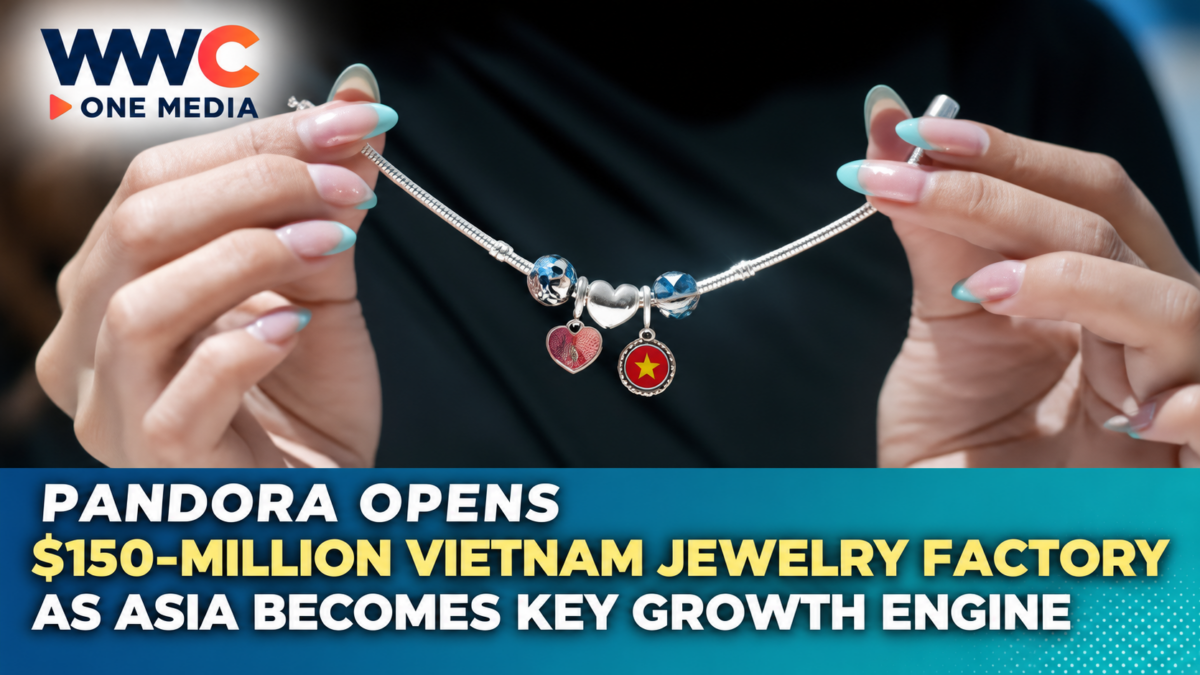
HO CHI MINH CITY — Pandora has opened a massive $150-million jewelry factory in Vietnam capable of producing up to 60 million pieces a year, giving the world’s largest jewelry brand its first manufacturing base outside Thailand as it bets heavily on Asia for its next phase of growth.
The Danish company inaugurated the new facility on October 1 at the Vietnam-Singapore Industrial Park III in the northern part of Ho Chi Minh City.
When fully operational, the factory is expected to employ around 7,000 craftspeople and increase Pandora’s global jewelry-production capacity by approximately 50%.
It is also the largest fine-jewelry crafting facility in the world, according to Pandora.
But the investment is about much more than producing more bracelets, charms and rings.
Pandora is simultaneously trying to reduce its dependence on Thailand, build capacity for future global demand and capture stronger growth across Asian markets including Japan, South Korea, India and Southeast Asia.
VIETNAM FACTORY CAN MAKE 60 MILLION PIECES A YEAR
The scale of the new operation is enormous.
Pandora’s Vietnam facility occupies around 7.5 hectares and will eventually produce up to:
60 million pieces of jewelry annually.
For comparison, Pandora sold approximately 112 million pieces worldwide in 2025.
That means the Vietnam plant alone will ultimately have theoretical production capacity equivalent to more than half of Pandora’s 2025 global sales volume.
The facility will initially represent around 15% of Pandora’s production capacity, Reuters reported.
By 2030, Vietnam could account for approximately one-third of the company’s total output as operations scale up.
That represents one of the biggest geographical shifts in Pandora’s manufacturing history.
FOR DECADES, PANDORA MADE ITS JEWELRY ALMOST ENTIRELY IN THAILAND
Pandora’s production story has historically been closely tied to Thailand.
The company began jewelry production in Bangkok in 1989, initially through a small goldsmith workshop.
It later expanded heavily in Thailand through major facilities at:
Gemopolis near Bangkok
and
Lamphun in northern Thailand.
Pandora now employs thousands of craftspeople at those sites.
Until the Vietnam opening, all of the company’s manufacturing had effectively remained concentrated in Thailand.
That concentration created efficiency—but also risk.
A major disruption involving labor, infrastructure, natural disasters or geopolitics in one country could potentially affect a large share of global Pandora production.
Vietnam changes that.
WHY PANDORA CHOSE VIETNAM
Pandora CEO Berta de Pablos-Barbier said Vietnam offered a combination of skilled labor, jewelry-making tradition, infrastructure and a stable business environment.
The company reportedly evaluated 27 potential locations before choosing Vietnam.
The country’s advantages included:
A large manufacturing workforce
Existing jewelry-making skills
Industrial infrastructure
Proximity to other Asian markets
and
A growing role in global manufacturing supply chains.
Vietnam has become an increasingly important manufacturing destination for multinational companies looking to diversify production beyond China or avoid relying too heavily on a single country.
For Pandora, however, the shift is not primarily away from China.
It is diversification away from Thailand.
ASIA IS NOW ONE OF PANDORA’S FASTEST-GROWING REGIONS
The timing is significant.
Pandora reported 10% like-for-like growth in Asia-Pacific during the second quarter of 2026.
That compared with:
North America: -1% like-for-like
Europe, Middle East and Africa: -2%
Asia-Pacific: +10%
Latin America: +18%.
Overall company organic growth reached 3% in the second quarter, including 1% like-for-like growth and 2% from network expansion and other factors.
The contrast is important.
Pandora’s largest and most established Western markets are growing much more slowly, while several Asian markets continue expanding faster.
That makes Asia increasingly important not just as a manufacturing center but also as a source of customers.
JAPAN IS A PARTICULARLY IMPORTANT MARKET
Pandora sees Japan as one of the strongest opportunities in its Asian portfolio.
The Business Times reported that Japan remains a major regional growth driver as Pandora expands its presence across Asia.
Japan is already one of the world’s largest luxury and jewelry markets, with consumers accustomed to both international and domestic premium brands.
Pandora’s challenge is positioning its relatively accessible jewelry alongside a highly developed luxury sector dominated by companies ranging from Cartier and Tiffany & Co. to major Japanese jewelers.
The company is also targeting growth in:
South Korea
India
Indonesia
and other Asian markets.
PANDORA OPENED ITS ASIA HEADQUARTERS IN SINGAPORE
The Vietnam manufacturing investment follows another important regional move.
Pandora established a new Asia headquarters in Singapore in November 2025.
The office oversees the company’s Asia Cluster and is intended to coordinate expansion across both company-operated and distributor markets.
At the time, Pandora identified:
Japan
South Korea
India
and
Indonesia
as markets with significant long-term growth potential.
That gives Pandora a developing three-country Asian structure:
Singapore — regional corporate headquarters
Thailand — established production base
Vietnam — major new manufacturing hub.
The setup places more of Pandora’s management and production infrastructure physically inside the region it increasingly sees as a major growth opportunity.
THE FACTORY IS NOT JUST FOR ASIAN CUSTOMERS
One important distinction is that the Vietnam plant will not simply produce jewelry for Asian markets.
Pandora says the facility will serve global demand.
Jewelry produced in Vietnam can therefore be shipped to Pandora stores and distributors in:
North America
Europe
Asia
Latin America
and other regions.
The Asia growth story is therefore only one part of the rationale.
The factory is also designed to give Pandora enough global capacity to continue expanding its store network and product range.
PANDORA IS PREPARING FOR THE GROWTH IT EXPECTS YEARS FROM NOW
Pandora CEO Berta de Pablos-Barbier told CNBC that the company is effectively building manufacturing capacity today for the demand it expects tomorrow.
That is a critical distinction.
The company does not currently need 60 million additional pieces immediately.
Rather, the Vietnam facility gives it room to increase output over several years as sales and store numbers expand.
Pandora currently sells jewelry through roughly 7,000 points of sale in more than 100 countries, including around 2,800 concept stores.
It generated 32.5 billion Danish kroner in revenue in 2025.
THE FACTORY WILL ALSO HELP PANDORA MOVE BEYOND SILVER
Pandora is best known for silver jewelry and charm bracelets.
But the Vietnam facility is also being designed to support a broader materials strategy.
Reuters reported that Pandora plans to increase production of platinum-plated jewelry, reducing the brand’s dependence on silver.
That diversification matters because precious-metal prices can be volatile.
Silver costs have risen sharply at various points, putting pressure on jewelry manufacturers whose products depend heavily on the metal.
Expanding into platinum-plated designs gives Pandora another material option and potentially another way to differentiate its products.
LAB-GROWN DIAMONDS ARE ANOTHER BIG BET
Pandora is also investing heavily in lab-grown diamonds.
The company has expanded its Pandora Lab-Grown Diamonds collections into more markets, including Spain and Italy in 2026.
Lab-grown stones allow Pandora to enter categories traditionally associated with higher-priced jewelry while maintaining its positioning as an “accessible luxury” company.
They are chemically and physically similar to mined diamonds but can generally be produced and sold at lower prices.
That could make diamond jewelry accessible to a broader customer base.
For Pandora, it also provides another growth category beyond the charms and bracelets on which the brand built much of its global business.
THE U.S. MARKET HAS BECOME MORE DIFFICULT
The Asian expansion comes as Pandora faces softer consumer spending in its biggest market.
North America produced negative 1% like-for-like growth in Q2 2026, after declining 2% in the first quarter.
Pandora has had to navigate:
Weak consumer sentiment
Tariffs
Higher commodity costs
and
Foreign-exchange pressures.
In the first quarter alone, the company said external pressures from tariffs, currencies and commodities created a 440-basis-point headwind to profitability.
That makes faster-growing markets increasingly important.
If North American and European customers spend more cautiously, Pandora needs growth elsewhere to maintain momentum.
VIETNAM ALSO HELPS REDUCE SUPPLY-CHAIN RISK
The pandemic showed multinational companies how dangerous concentrated supply chains can become.
Factories can close.
Shipping routes can be disrupted.
Borders can tighten.
Natural disasters can halt production.
By adding another major manufacturing base, Pandora can spread those risks across different locations.
Reuters described supply-chain resilience as one of the central reasons for the Vietnam investment.
Thailand will remain critical to Pandora.
Vietnam simply gives the company another large production engine.
7,000 JOBS COULD BE CREATED
At full scale, Pandora expects the Vietnam site to employ around 7,000 people.
Workers will receive specialized training through a dedicated Pandora crafting academy.
The company says the academy will help transfer skills between its long-established Thai manufacturing operations and the new Vietnamese workforce.
That training component is important because Pandora jewelry remains heavily dependent on human craftsmanship even though production takes place at industrial scale.
Individual pieces still require tasks such as:
Stone setting
Polishing
Finishing
Assembly
and
Quality inspection.
Pandora’s ability to hire and train thousands of workers was therefore a key part of the location decision.
THE FACTORY RUNS ON 100% RENEWABLE ELECTRICITY
Pandora is also using the Vietnam facility to support its sustainability strategy.
The factory has achieved LEED Gold certification and operates using 100% renewable electricity.
Pandora says all silver and gold used at the facility will also be 100% recycled.
The company shifted its jewelry production globally to recycled silver and gold beginning in 2024.
Pandora has said recycled metals significantly reduce greenhouse-gas emissions compared with mining new material.
The company has set a target of halving greenhouse-gas emissions across its value chain by 2030.
RECYCLED GOLD AND SILVER HAVE BECOME CENTRAL TO THE BRAND
Jewelry companies face growing scrutiny over where their precious metals come from.
Mining can create significant environmental impacts, including land disruption, water use and carbon emissions.
Pandora’s response has been to eliminate newly mined gold and silver from its regular production supply.
According to AP, the company sources recycled metals from materials that can include previously used jewelry and other metal-containing products, with independent auditing designed to verify the supply chain.
That sustainability argument is becoming part of Pandora’s appeal to younger consumers who increasingly examine the environmental impact of luxury products.
VIETNAM’S OWN ENERGY MIX CREATES AN INTERESTING CONTRAST
Pandora’s new facility runs entirely on renewable electricity even though Vietnam’s national power system still relies heavily on coal.
Vietnam has nevertheless pledged to reach net-zero emissions by 2050 and is rapidly expanding renewable generation.
Large foreign manufacturers increasingly want access to renewable electricity because their own climate targets depend partly on reducing emissions from factories and suppliers.
That can create additional pressure on industrial economies such as Vietnam to expand cleaner power.
THE FACTORY ITSELF TOOK LONGER THAN ORIGINALLY PLANNED
Pandora first announced its Vietnam project several years ago.
Initial plans envisioned approximately $100 million of investment and production beginning by the end of 2024.
The project later expanded.
By the groundbreaking stage, investment had increased to more than $150 million, while the production timeline moved into 2026.
The final facility officially opened on October 1, 2026.
Despite those schedule changes, the planned production capacity remained around 60 million pieces annually.
VIETNAM IS WINNING ANOTHER MAJOR GLOBAL MANUFACTURING INVESTMENT
Pandora’s decision also adds to Vietnam’s growing role in international manufacturing.
The country has spent years attracting foreign companies seeking:
Competitive labor
Export infrastructure
Industrial parks
Trade agreements
and
Alternative production bases within Asia.
Electronics, garments, footwear and consumer goods are already major sectors.
Jewelry manufacturing adds another high-value, labor-intensive industry.
Pandora’s investment is particularly significant because this is not simply an assembly operation.
The company is transferring specialized jewelry craftsmanship and training thousands of local workers.
THE BIGGER STORY: PANDORA IS BUILDING IN ASIA FOR GROWTH IT EXPECTS WORLDWIDE
The new Vietnam factory represents three bets at the same time.
Pandora is betting that:
global demand for its jewelry will keep rising,
Asia will become a larger source of customers,
and
a more diversified production network will make the business stronger.
The $150-million facility gives Pandora room to produce another 60 million pieces every year, while its Singapore headquarters coordinates a regional push into markets including Japan, South Korea and India.
At the same time, the company is expanding beyond traditional silver charms into platinum-plated jewelry and lab-grown diamonds.
That makes Vietnam much more than another factory.
It is physical infrastructure for what Pandora hopes will be its next stage of global growth.
But there is one major question behind the expansion:
Can faster growth in Asia become big enough to offset slower demand in Pandora’s mature U.S. and European markets?
With a factory capable of boosting global capacity by 50%, Pandora is investing $150 million on the belief that the answer will eventually be yes.