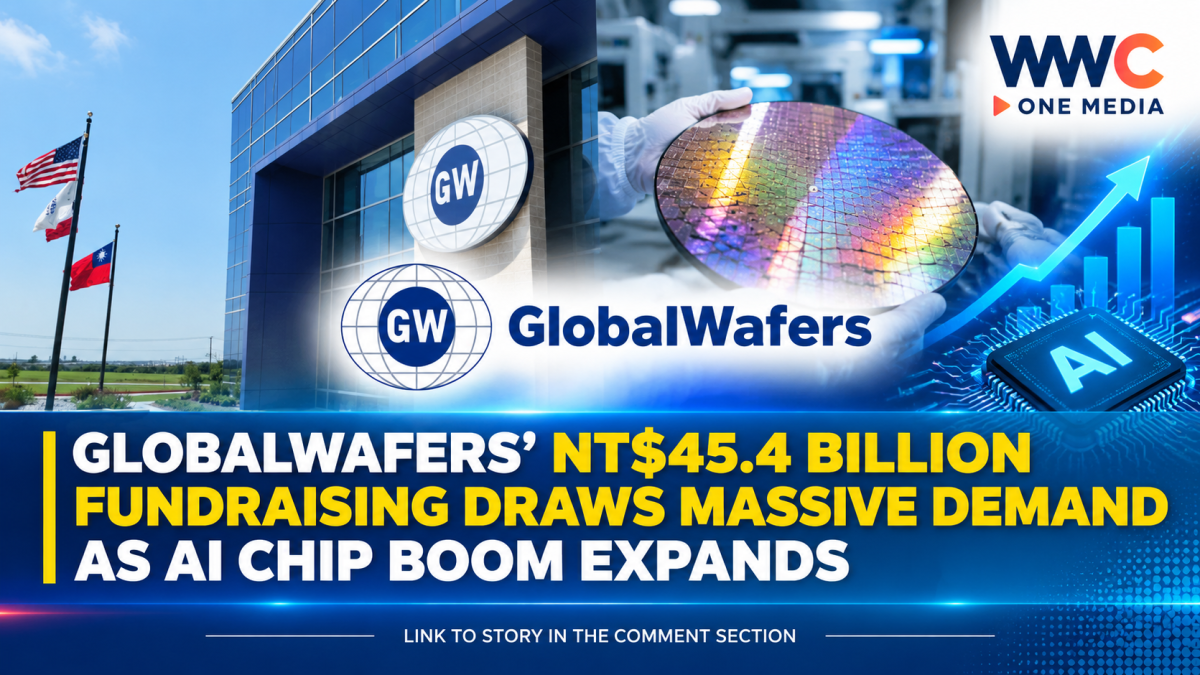
TAIPEI — Taiwan’s semiconductor supply chain is attracting another major wave of investor demand, with silicon-wafer maker GlobalWafers Co. reporting that orders for its latest overseas share offering reached roughly four times the amount available.
The company raised about NT$45.4 billion (US$1.43 billion) through the offering, giving GlobalWafers fresh financial firepower to expand overseas operations and secure materials as semiconductor demand continues to recover.
The strong response comes as the global silicon-wafer industry benefits from renewed demand for advanced chips, artificial intelligence infrastructure, high-performance computing and data centers.
Investors pile into GlobalWafers offering
GlobalWafers priced the offering at NT$908.32 per share, compared with the company’s NT$971 closing price on September 22. That represented a discount of about 6.46%.
The company finalized the pricing on September 23, when its Taiwan-listed shares rose about 4.3%, according to Taiwan News. The transaction involves 50 million global depositary shares, with plans for them to be listed on the Luxembourg Stock Exchange’s Euro MTF market. Each depositary share represents one ordinary GlobalWafers share.
The offering is reportedly the third-largest overseas depositary-share offering by a Taiwanese company, following GlobalWafers’ own earlier transaction in March 2024, which raised approximately NT$21.8 billion.
Where will the NT$45.4 billion go?
GlobalWafers plans to direct most of the proceeds toward investments in overseas subsidiaries, particularly capacity expansion.
Some funds will also be used to purchase materials in foreign currencies, according to Taiwanese business reporting cited by Taiwan News.
The strategy comes as semiconductor manufacturers around the world continue building additional production capacity to meet demand for AI processors, advanced computing systems and other high-performance applications.
GlobalWafers operates facilities in several major semiconductor markets, giving the company a geographically diversified manufacturing footprint.
Texas expansion becomes a major piece of the puzzle
One of the most closely watched parts of GlobalWafers’ international expansion is its Texas operation.
The company said its Texas facility is increasing production and has obtained qualification from several Tier 1 customers. Strategic funding and long-term agreements with major customers are also supporting the outlook for the operation.
The Texas facility is part of GlobalWafers’ broader effort to establish more silicon-wafer manufacturing capacity in the United States.
That expansion is particularly significant as semiconductor companies seek more geographically diversified supply chains.
Japan and Missouri operations are also gaining momentum
GlobalWafers is seeing growth at other overseas facilities as well.
The company’s Niigata plant in Japan is expected to post third-quarter revenue above its previous record from the second quarter, according to Taiwan business reporting cited by Taiwan News.
Meanwhile, production of 12-inch silicon-on-insulator wafers has increased substantially at the company’s expanded Missouri facility.
Together, the developments indicate that GlobalWafers is positioning several overseas operations for stronger demand rather than relying solely on Taiwan-based production.
AI is driving the wafer race — but demand is broadening
Artificial intelligence remains a major force behind semiconductor investment.
SEMI’s Silicon Manufacturers Group reported that worldwide silicon-wafer shipments increased 13.1% year on year in the first quarter of 2026, reaching 3.275 billion square inches. The organization said AI data-center demand was supporting advanced logic and memory, while demand was also extending into power-management devices.
GlobalWafers is also seeing signs of improvement outside AI and high-performance computing.
The company reported recovery in consumer electronics, communications, automotive and industrial markets, suggesting that the semiconductor cycle may be broadening beyond the infrastructure being built for AI.
That could become increasingly important for wafer manufacturers because the industry is highly sensitive to changes in chip-production volumes across multiple end markets.
Why silicon wafers matter
Silicon wafers are the foundational substrates on which most semiconductor devices are manufactured.
As chipmakers move toward increasingly advanced manufacturing processes, demand for sophisticated wafer products is closely tied to investments in new semiconductor fabrication capacity.
That puts companies such as GlobalWafers at an important point in the supply chain: they may not manufacture the finished AI processors themselves, but their products are essential to producing many of the chips powering modern computing.
A huge fundraising round — and a bigger semiconductor bet
GlobalWafers’ latest fundraising effort therefore comes at a significant moment for the semiconductor industry.
The company now has NT$45.4 billion in additional capital to support overseas expansion and materials procurement, while demand indicators from the silicon-wafer industry point to continued growth in AI-related applications.
The four-to-one order demand for the offering also signals substantial investor interest in the company’s international expansion strategy.
The bigger question is what happens next: if AI infrastructure investment continues to expand while automotive, communications and consumer electronics demand recover, GlobalWafers could find itself supplying an even broader semiconductor boom across multiple markets.
WWC ONE MEDIA G,A