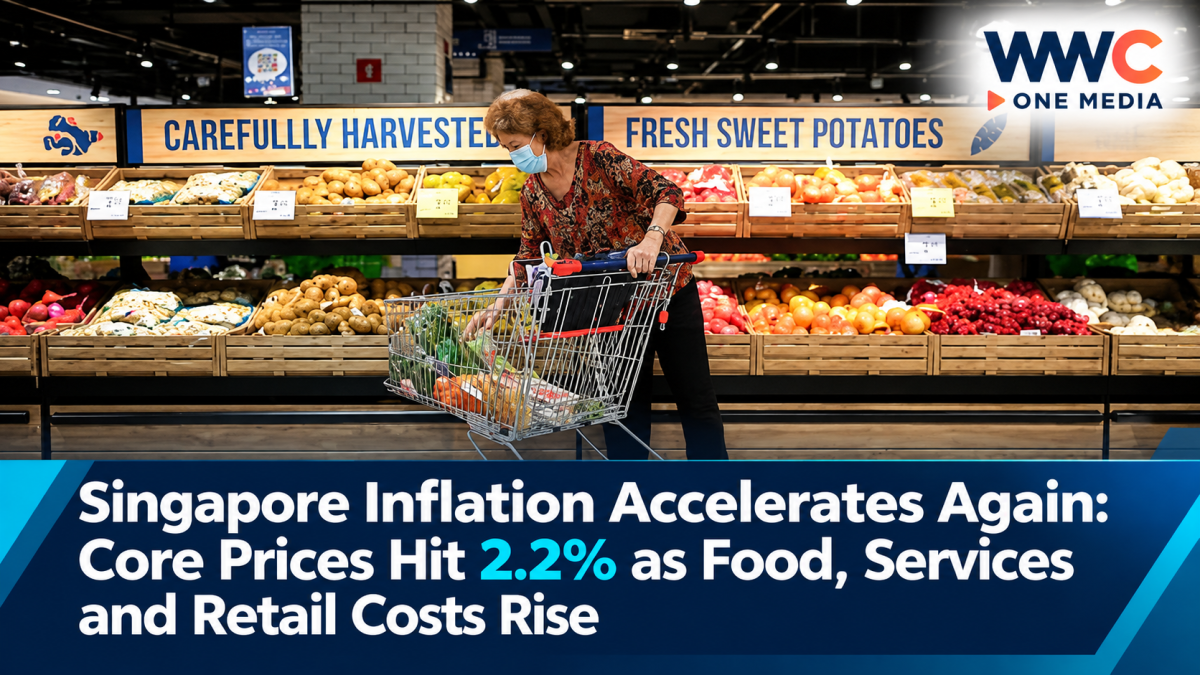
Singapore’s inflation pressures strengthened again in August, with core inflation rising to 2.2% year on year, up from 2.0% in July, as higher costs for services, food, retail goods and other items put renewed pressure on household expenses.
The latest figures were released on Sept. 23 by Singapore’s Department of Statistics, the Monetary Authority of Singapore (MAS) and the Ministry of Trade and Industry (MTI).
Core inflation excludes accommodation and private transport, making it a closely watched measure of underlying price pressures affecting households.
Overall inflation also increased, with Singapore’s CPI-All Items inflation reaching 2.3% in August, compared with 2.2% in July.
Services and Retail Prices Move Higher
Services inflation accelerated to 2.0% in August from 1.7% in July, with faster increases in airfares and point-to-point transport services contributing to the rise.
Retail and other goods inflation also picked up, rising to 1.8% from 1.4%. Authorities attributed the increase partly to higher prices for clothing, footwear and personal-care products.
Food inflation edged higher as well, reaching 2.3% from 2.2% in July, with food-service prices contributing to the increase even as inflation for non-cooked food moderated.
Electricity and Gas Costs Remain Elevated
Electricity and gas inflation remained high at 8.7%, unchanged from July.
MAS and MTI said elevated global energy prices have contributed to higher electricity and gas tariffs as well as transportation fares in Singapore. They also warned that global oil prices remain high and volatile.
The authorities further pointed to adverse weather conditions, which could reduce agricultural yields and raise the cost of imported food. Higher input costs moving through global supply chains could also push up prices for a broader range of imported goods and services in the coming quarters.
Private Transport Inflation Eases
Not every category moved higher.
Private transport inflation slowed to 7.5% in August from 8.0% in July, reflecting a smaller increase in car prices. Accommodation inflation remained unchanged at 0.8%, with housing rents increasing at the same pace as the previous month.
That meant the increase in core inflation was the main factor behind the rise in overall inflation, more than offsetting the moderation in private transport inflation.
Inflation Has Been Building Since Midyear
August’s figures continue a recent upward movement.
Core inflation rose from 1.6% in June to 2.0% in July, before reaching 2.2% in August. Overall inflation followed a similar path, rising from 1.9% in June to 2.2% in July and then 2.3% in August.
The acceleration comes as Singapore faces higher global energy costs and continued price pressures in several domestic services and consumer categories.
Reuters reported that August’s 2.2% core reading was above the median forecast in a Reuters poll, highlighting that the latest increase came in stronger than economists had expected.
MAS and MTI Keep 2026 Inflation Forecast
Despite the August increase, MAS and MTI have maintained their forecast for average core inflation and headline inflation of 1.5% to 2.5% for 2026.
The authorities’ latest assessment indicates that inflation risks remain linked to global energy markets, weather-related food pressures and the possibility that higher input costs will filter through international supply chains.
For consumers, however, the August numbers show that price pressures have not disappeared — and several everyday categories are now contributing more strongly to inflation.
With core inflation reaching 2.2%, Singapore enters the final months of 2026 with households still facing a changing price environment, particularly across services, food, retail goods and energy-related costs.
WWC ONE MEDIA G,A