
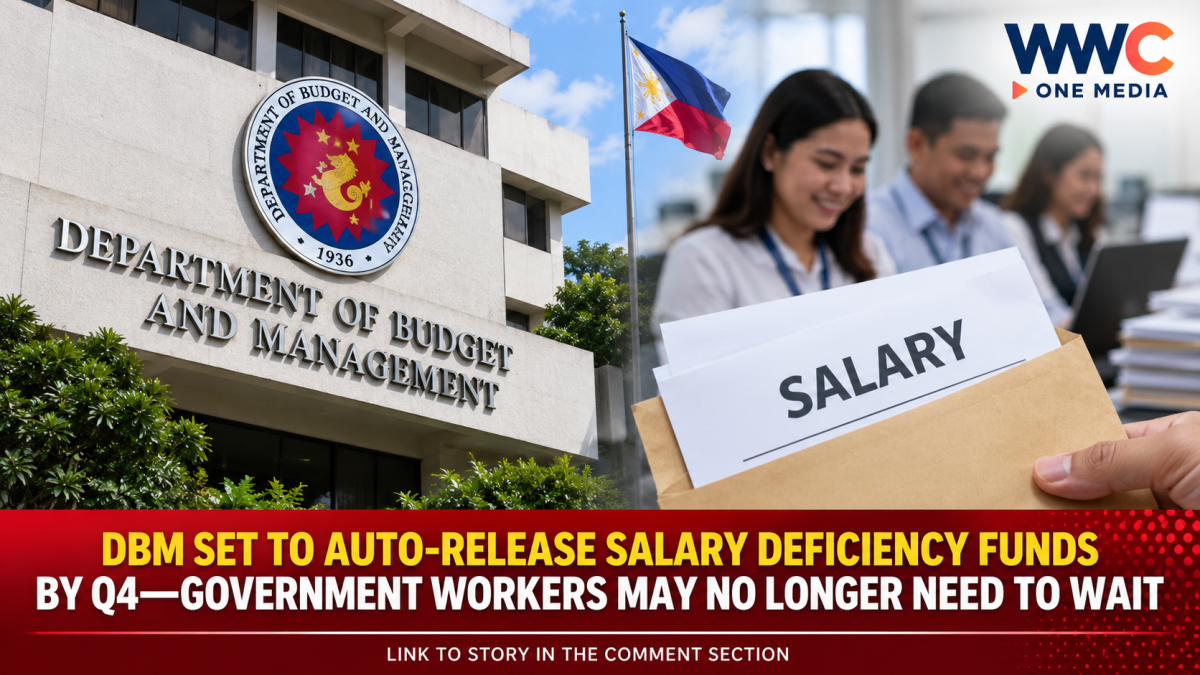
MANILA, Philippines — Government employees who have been waiting for salary adjustments because of promotions, reclassification or other personnel changes could soon face fewer bureaucratic hurdles as the Department of Budget and Management (DBM) prepares to test an automatic system for releasing funds needed to cover salary deficiencies.
Budget Secretary Kim Robert De Leon said the agency is working on a policy that would allow DBM to identify salary funding shortfalls through an agency’s updated plantilla or personnel master list—without requiring government offices to submit a separate request for additional funds.
The reform is targeted for testing in the fourth quarter of 2026, according to reports following De Leon’s interview on DZRH’s Special on Saturday program on September 5.
From request-based to automatic releases
Under the current process, agencies generally have to identify employees whose salaries require additional funding and submit the necessary information to DBM. The agency then evaluates the request and releases the corresponding funds.
De Leon cited the Department of Education as an example, explaining that information on employees who were promoted—including their new positions or salary levels—has to be transmitted to DBM before the additional funding can be downloaded to the agency.
The proposed system would reverse that process.
Instead of waiting for agencies to formally request the money, DBM would use updated plantilla information to determine whether an agency has a personnel-services funding deficiency and release the needed amount automatically.
The goal is to eliminate a major source of delay for employees who have already earned their higher salaries but remain temporarily paid at their previous rate because the corresponding funding has not yet been released.
Circular expected before the end of September
The proposed policy is still being drafted. De Leon said DBM expects to issue a formal circular before the end of September, with the automatic-release mechanism slated for live testing during the fourth quarter.
The pilot is not expected to be limited to DepEd. DBM intends to test the approach across agencies that normally encounter personnel-services, or PS, deficiencies toward the end of the year.
This is significant because salary deficiencies can arise from several personnel actions, including promotions, reclassification, newly filled positions and salary step increments.
A recent DBM-DepEd workshop in Region IX, for example, specifically dealt with computing funding requirements for reclassified positions, filled-but-unfunded positions and salary step increments. DBM said delays in submitting deficiency requests can consequently delay salary processing for affected personnel.
Why the change matters to government workers
The proposed system could be particularly important for government employees who receive promotions or salary adjustments during the year.
Under a request-driven arrangement, an agency must recognize the deficiency, prepare the necessary documentation and coordinate with DBM before additional funding can be released.
An automated approach could potentially shorten that chain by allowing DBM to act based on updated personnel information.
The change also comes as the government continues implementing the latest tranche of the updated salary schedule for civilian government personnel under Executive Order No. 64, series of 2024. DBM issued National Budget Circular No. 601 in January 2026 covering the third tranche of the updated salary schedule.
This is not a new salary increase
Importantly, the planned automatic release system does not itself create a new salary increase.
Rather, it is intended to make sure agencies receive funding for personnel costs that are already authorized and properly supported by the government’s budget and personnel rules.
Existing budget rules already recognize that available Personnel Services appropriations may be used to cover deficiencies in authorized personnel benefits, subject to DBM guidelines.
The distinction matters: the proposed reform is primarily about speeding up access to already authorized funds, not giving government workers an additional across-the-board pay hike.
DBM has already dealt with similar deficiencies
The issue is not theoretical.
DBM’s own year-end fiscal reporting for 2025 showed that billions of pesos were released to agencies for personnel-services deficiencies. These included funding for newly created or filled positions and other personnel requirements.
Among the releases were P1.8 billion to the Department of Social Welfare and Development for personnel-services deficiencies and P4.5 billion to the Department of Health for payment of PS deficiencies.
DBM’s recent work with DepEd also shows why the agency is looking for a more proactive mechanism. The department has been helping schools divisions calculate and validate salary-related funding deficiencies associated with promotions, reclassification and salary increments.
Bigger push to reduce salary delays
The proposed automatic system is part of a broader effort to reduce red tape in government financial administration.
The DBM has previously emphasized that salary increases and benefits included in the national budget should not be delayed or reduced. Malacañang likewise said in January that the 2026 national budget fully provides for approved salary increases and government employee benefits.
For government workers, the crucial question now is whether the planned fourth-quarter test can translate into a permanent system that identifies salary shortfalls before they become months-long backlogs.
If successfully implemented, employees who are promoted or whose positions are reclassified could eventually see the funding for their authorized salary adjustments released without having to wait for their agencies to file a separate deficiency request.
For now, however, the system remains under development, with the formal guidelines and Q4 testing still to come.
The bottom line
The DBM’s planned reform could mark a significant shift in how government salary deficiencies are handled—from a system where agencies have to ask for missing funds to one where DBM can identify and release those funds automatically based on updated personnel records.
If the Q4 2026 test succeeds, the change could reduce paperwork, shorten processing times and help prevent government employees from waiting months for salary adjustments they are already entitled to receive.
For thousands of promoted, reclassified and newly appointed government workers, the bigger question is no longer whether additional salary funding exists—but how quickly it can reach their payroll.
WWC ONE MEDIA J.M.S




Leave a Reply