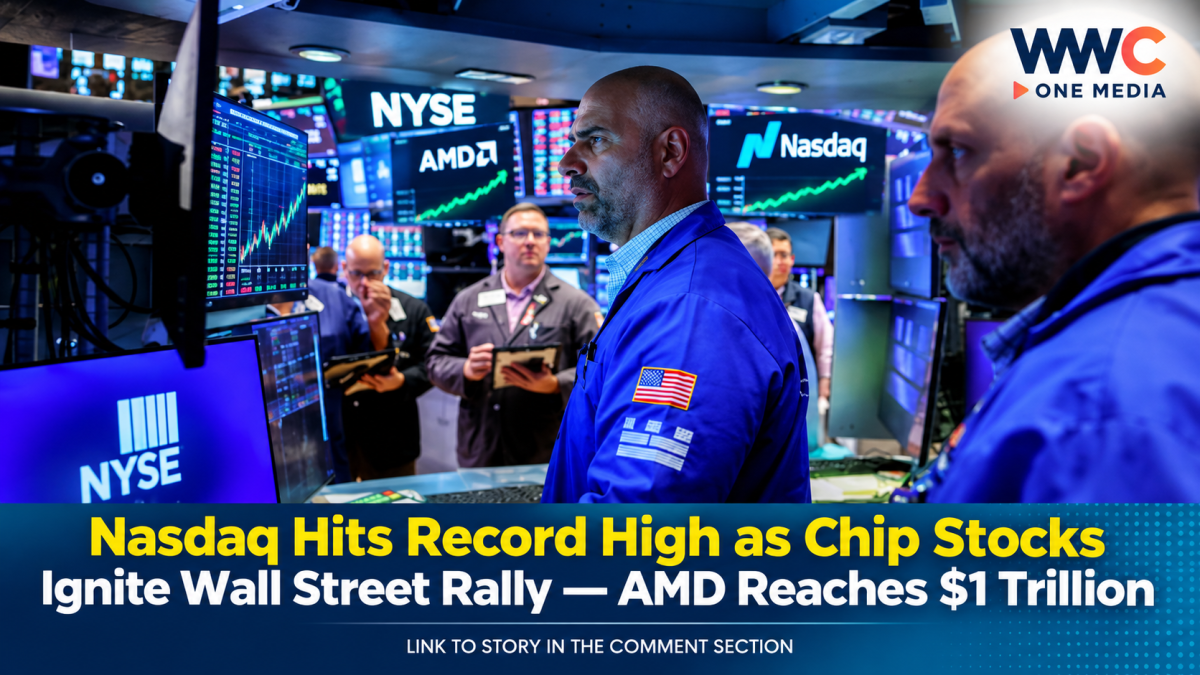
Wall Street surged on Monday as a powerful rally in semiconductor and artificial intelligence stocks pushed the Nasdaq Composite to a record closing high, reviving investor enthusiasm for the AI-driven technology trade.
The Nasdaq jumped 2.26% to 27,122.09, its first record close since June 2. The S&P 500 gained 1.49% to 7,764.70, while the Dow Jones Industrial Average rose 0.71% to 52,048.83.
Chipmakers led the advance. The Philadelphia Semiconductor Index climbed 4.3%, while Intel and Arm Holdings each posted gains of more than 12%. Nvidia also advanced, adding 2.3%.
One of the biggest moves came from Advanced Micro Devices, whose shares surged about 10%. The rally pushed AMD’s market value above $1 trillion for the first time, making it the fourth US chipmaker to reach that milestone after Nvidia, Broadcom and Micron.
The move reflects renewed confidence that spending on artificial intelligence infrastructure remains strong despite recent concerns about the enormous cost of developing and operating advanced AI systems.
Investors have recently questioned whether the massive amounts being spent by technology companies on AI infrastructure can continue to generate sufficient returns. Monday’s rally suggested that, at least for now, enthusiasm surrounding demand for AI computing remains powerful.
AMD has increasingly positioned itself as a major competitor to Nvidia in AI computing. The company has expanded beyond individual processors and is developing complete computing systems that combine chips, networking equipment and other components for data centers.
AMD’s shares have risen dramatically in 2026, with Reuters reporting that the stock had gained about 185% for the year by Monday. The surge has substantially outpaced the Nasdaq’s gain over the same period.
The broader market also received support from falling oil prices and lower long-term US Treasury yields.
US crude fell nearly 4.9% to $95.43 a barrel, while Brent crude declined 3.6% to $100.11. The 10-year US Treasury yield also fell to about 4.95%, easing some of the pressure that higher borrowing costs had placed on riskier assets.
Oil prices have been closely watched as tensions involving Iran, the United States and the Houthis have raised concerns about energy supplies and inflation. A decline in crude prices helped ease some of those concerns during Monday’s trading session.
Markets are also looking ahead to a high-level diplomatic week in New York, with US President Donald Trump attending the United Nations General Assembly and preparing to meet Chinese President Xi Jinping.
That meeting could carry particular significance for technology investors because Washington and Beijing remain deeply involved in disputes over trade, advanced technology and semiconductor restrictions.
The rally comes despite the Federal Reserve’s recent hawkish signals and growing expectations that US interest rates could rise again. Futures markets were pricing in a 55% chance of an October rate increase and a 91% chance of at least one additional hike by the end of the year, according to Reuters.
Asian technology shares were already responding on Tuesday, with South Korea’s Kospi climbing more than 2% as major memory-chip companies Samsung Electronics and SK Hynix followed the strength seen in US semiconductor stocks.
The latest rally puts the AI investment boom back at the center of Wall Street’s attention.
After months of debate over whether AI-related valuations had moved too far ahead of actual business demand, investors are once again pouring money into semiconductor companies that stand to benefit from expanding AI infrastructure.
But with interest rates, energy prices, US-China technology tensions and the enormous cost of AI development still hanging over markets, the question now is whether this renewed chip rally can continue — or whether Wall Street is heading into another period of sharp volatility.