
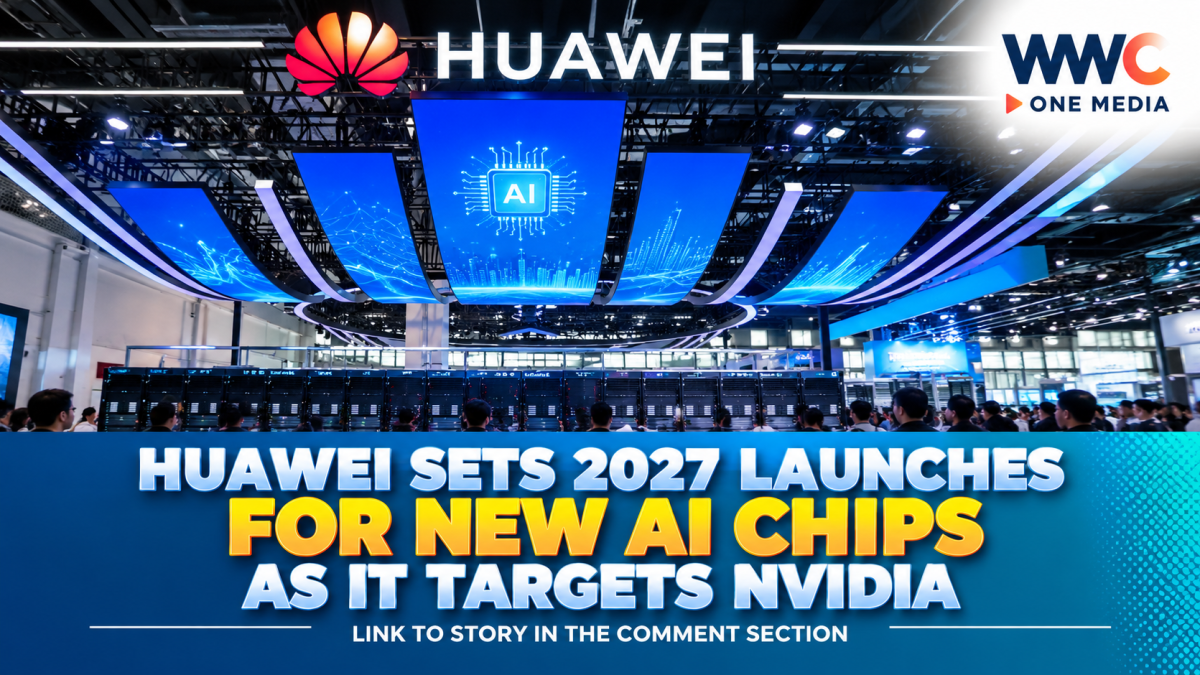
Huawei Technologies plans to launch two new artificial intelligence chips in 2027 as the Chinese technology giant expands its AI computing business and seeks to compete more closely with Nvidia.
Huawei rotating chairman David Wang said on Sept 17 that the company plans to launch the 960DT chip in the first quarter of 2027, followed by the Ascend 960PR in the third quarter.
The accelerated timetable reflects Huawei’s efforts to develop more powerful domestic alternatives to advanced AI chips from US companies. Washington’s export restrictions have limited Chinese companies’ access to some high-end processors and semiconductor manufacturing technology.
Huawei is also developing technology that allows large numbers of AI chips to operate together as a single computing system. The company says its UnifiedBus technology will allow chips to exchange information more efficiently across large AI systems.
Wang said Huawei has developed 11 semiconductors based on UnifiedBus technology for use in its large computing systems. The company’s largest linked systems, known as superclusters, can support up to one million AI processors, he said.
Huawei has also shipped more than 1,000 smaller systems known as supernodes to more than 370 customers. These systems combine multiple AI chips so they can work together on demanding computing tasks.
The approach is increasingly important for Chinese technology companies facing restrictions on access to the world’s most advanced foreign processors. Linking larger numbers of domestic chips can provide additional computing capacity, although the systems require fast and efficient communication between processors.
Huawei has emerged as one of China’s leading domestic AI chip suppliers as Beijing pushes for greater technological self-reliance.
The company nevertheless faces competition from Nvidia, whose chips and software are widely used by AI developers globally. Building a strong software and developer ecosystem will be an important part of Huawei’s efforts to expand adoption of its hardware.
Wang said Huawei’s AI chip ecosystem currently has about 5,270 monthly active developers.
Huawei’s chip plans come as the United States and China continue to compete over AI technology, semiconductor manufacturing and the computing infrastructure needed to develop advanced artificial intelligence systems.
The company is also working to improve the performance of its AI systems through innovations in chip connectivity and large-scale computing. Huawei’s strategy is increasingly focused not only on individual processors but also on combining large numbers of chips into integrated systems.
The new 2027 chips are expected to form part of Huawei’s broader effort to strengthen China’s domestic AI infrastructure and reduce reliance on foreign technology.
As Huawei accelerates its chip development, the company’s progress will be closely watched by the global semiconductor industry, particularly as competition over advanced AI computing continues to intensify.




Leave a Reply