
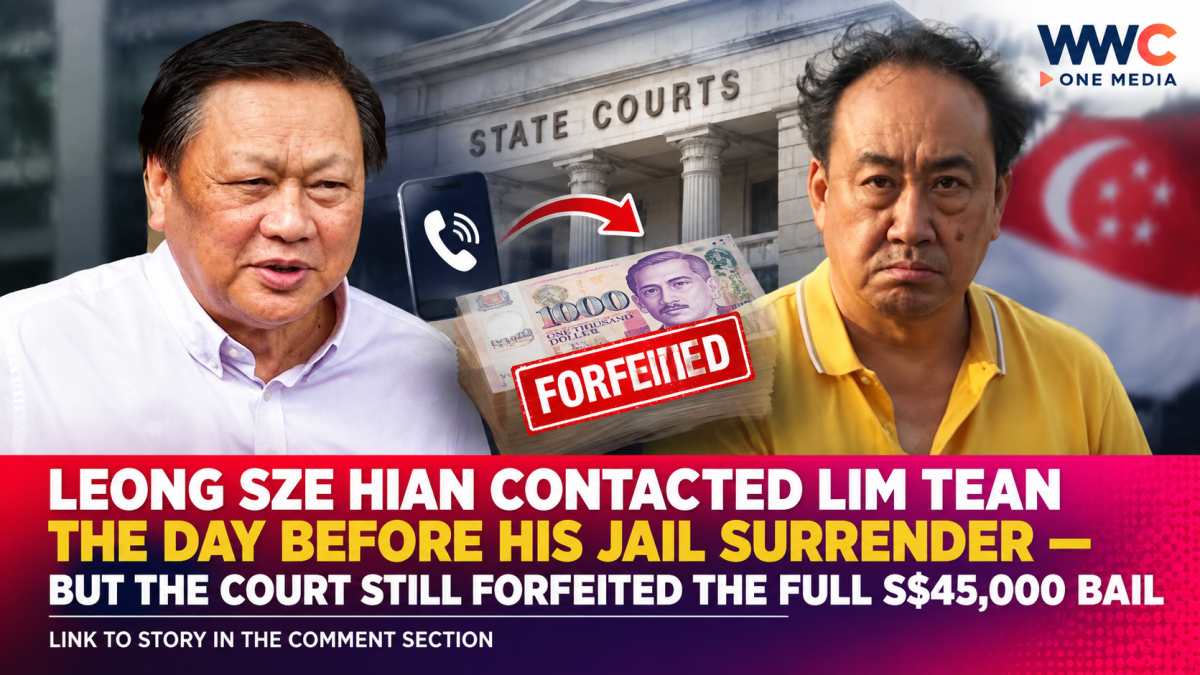
SINGAPORE — The financial consequences of Lim Tean’s failure to surrender for his jail sentence have now reached the man who stood bail for him.
Socio-political blogger Leong Sze Hian, 72, has forfeited the full S$45,000 bail security he provided for Lim, after a Singapore court found on Thursday, September 17, that he had not adequately fulfilled his responsibilities as Lim’s surety.
Leong urged the court not to take the entire amount, saying he had been in contact with Lim shortly before the scheduled surrender and had no reason to believe Lim would leave Singapore. But District Judge Chay Yuen Fatt agreed with prosecutors that the full amount should be forfeited.
The case offers a stark reminder of something often overlooked when bail is granted in Singapore:
A bailor is not merely lending a name or helping someone raise money. The bailor assumes legal duties to help ensure the accused remains contactable, stays in Singapore unless permitted to travel and appears when required by the court.
And when those duties are not carried out, the security can disappear.
The S$45,000 was made up of two different forms of security
According to CNA, Leong’s total exposure consisted of S$30,000 in monetary security in one case and S$15,000 in non-monetary security in another.
Monetary bail can involve cash or equivalent financial assets.
Non-monetary bail allows a bailor to pledge qualifying personal property, such as jewellery, watches, household items or luxury goods, rather than physically depositing the item with the court. Singapore Courts says the pledged property must belong to the bailor and be fully paid for.
The court decided that all S$45,000 should be forfeited.
That makes Thursday’s hearing significant not because Leong himself was accused of helping Lim leave Singapore — CNA did not report such an allegation against him — but because the court found he did not sufficiently discharge the obligations he had accepted as bailor.
Leong said he had contacted Lim the day before
Leong told the court he had done what he reasonably could.
He said he and others had offered to accompany Lim when the lawyer was due to report to court.
According to Leong, Lim told him there was no need because he planned to make a statement about jobs on the morning of August 3 before surrendering for his prison term.
Leong also said that on the day Lim was supposed to surrender, Lim’s lawyer contacted him and told him that Lim had transferred two cases to the lawyer.
Those circumstances, Leong argued, gave him no reason to expect that Lim would fail to appear.
“I had no reason to believe that he was going to run away,” CNA quoted Leong as telling the court.
But prosecutors focused on what Leong was legally required to do rather than what he believed Lim intended.
The prosecution said one obligation was especially clear: daily contact
Deputy Public Prosecutor Bryan Wong told the court that Leong had failed to communicate with Lim every day, despite that being one of his duties as surety.
Prosecutors also said Leong did not contact Lim on August 3 — the actual day he was required to surrender — until after the investigation officer contacted Leong.
That requirement is not unusual or hidden.
Singapore Courts’ public guidance expressly tells bailors that they must keep in daily communication with the accused, make a police report within 24 hours if contact is lost, ensure that the accused does not leave Singapore without court permission and ensure attendance whenever investigators or the court require it.
The Judiciary describes those responsibilities as duties that must be performed “with diligence” for as long as the bail arrangement continues.
That helps explain why Leong’s contact with Lim on the previous day was not enough to prevent forfeiture.
Being a bailor can put the entire pledged amount at risk
Singapore Courts warns explicitly that standing bail is a “very serious responsibility”.
When an accused person fails to appear, the bailor can be summoned to court and required to explain what efforts were made to ensure compliance. If the explanation is not accepted, some or all of the pledged money or property can be forfeited.
That is effectively what happened here.
Leong presented his explanation.
The prosecution argued that he had not met his duties.
The judge ordered the entire S$45,000 forfeited.
The story began with Lim’s conviction for practising law without a valid certificate
The jail term Lim was supposed to begin serving arose from a separate criminal case.
He was convicted after trial on three charges under the Legal Profession Act for acting as an advocate and solicitor without a valid practising certificate between April 1 and June 9, 2021. Court records show he carried out legal work for clients on numerous occasions, including court proceedings.
The District Court initially sentenced him in February 2025 to six weeks’ jail and a S$1,000 fine.
Lim appealed against his conviction and sentence.
The prosecution separately appealed, arguing that the punishment was too low.
In February 2026, the High Court dismissed Lim’s appeal, allowed the prosecution’s sentence appeal and increased his imprisonment to three months and one week.
The conviction itself therefore was not pending when the August events occurred.
It had been upheld.
Lim then went to the Court of Appeal
Lim sought permission to refer four legal questions to Singapore’s Court of Appeal.
On July 6, the apex court rejected the application, concluding that the proposed questions did not meet the requirements for questions of law of public interest that warranted referral.
The Court of Appeal initially ordered Lim to surrender on July 20.
But CNA later reported that on July 17 the court approved a further request to defer commencement of his sentence, pushing the surrender date to 12pm on August 3.
That distinction is important because some earlier reports refer to July 20.
By the time the warrant was issued, August 3 was the operative surrender deadline.
August 3 came — and Lim did not appear
Lim failed to report to the State Courts by noon on August 3.
His lawyer, Revi Shanker, told CNA at the time that Lim was uncontactable and that his inability to reach him was “very unlike him”.
A warrant of arrest was issued that same day.
Under Singapore Courts’ guidance, an accused person on bail who does not turn up when required is regarded as having jumped bail or absconded while on bail. The court can then issue an arrest warrant and call the bailor to explain what happened.
The Singapore Police Force later said Lim had left Singapore illegally while on court bail after failing to surrender.
Police say arrangements were made for Lim to leave Singapore
The investigation subsequently widened.
Singapore police said two men were suspected of conspiring to arrange for Lim to leave Singapore for Malaysia after he had been ordered to begin his prison term.
The two men, Mohammad Adam Abd Karim, 44, and Sulaiman Muhammad Firdaus, 37, were each charged on August 8 with engaging in a conspiracy to do an act tending to defeat the course of justice.
According to the charge information reported by The Straits Times, the alleged arrangements were made on August 4, a day after Lim failed to surrender. The precise method allegedly used was not disclosed in the initial charge information.
Their cases remain allegations before the court; filing a charge is not a conviction.
Lim was arrested in Johor Bahru on August 6
The search did not last long.
The Royal Malaysia Police arrested Lim in Johor Bahru on August 6, three days after his missed surrender deadline.
Singapore and Malaysian authorities then coordinated his return.
On August 11, Malaysia handed Lim over to the Singapore Police Force, and the Commercial Affairs Department arrested him upon his arrival back in Singapore.
He has since begun serving the three-month-and-one-week sentence imposed for practising law without the required certificate.
But Lim has not yet been charged over the alleged absconding itself
This is one of the most important legal distinctions in the current story.
As of CNA’s September 17 report, Lim had not been charged with a new offence arising from the alleged abscondment or illegal departure.
Police said in August that investigations into the circumstances of his departure were ongoing.
So headlines should not say that Lim has been “convicted of escaping Singapore” or convicted of jumping bail.
What is established is that he failed to surrender, an arrest warrant was issued, police say he left Singapore illegally while on court bail, he was arrested in Malaysia and returned to Singapore.
Whether additional criminal liability will be established requires the separate investigative and court process.
Leong’s financial loss is separate from any possible criminal case against Lim
The S$45,000 forfeiture is a consequence of the bail arrangement, not a punishment imposed on Leong for Lim’s underlying Legal Profession Act offences.
Singapore Judiciary guidance makes the principle clear: a bailor provides security to help guarantee the accused’s compliance. If the accused does not attend and the court finds that the bailor did not properly carry out his duties, the security may be forfeited.
That means the legal questions are different.
Lim’s original case concerned practising law without a valid certificate.
The investigation into his departure concerns what happened after he failed to surrender.
The two men charged in August face their own alleged conspiracy offences.
And Leong’s September 17 hearing concerned whether he fulfilled his obligations as surety.
Combining all four into one allegation would be inaccurate.
Leong and Lim have a legal history stretching back years
Leong is not a stranger to Lim.
Lim represented him in the high-profile defamation case brought by then-Prime Minister Lee Hsien Loong over a Facebook post Leong shared in 2018.
In 2020, when Lim was arrested during separate police investigations, CNA reported that Leong also posted bail for him at that time.
Their relationship therefore predates the current bail episode.
That history provides context for why Leong may have been willing to stand surety — but it did not change the legal obligations attached to doing so.
Leong also asked the court to consider his personal circumstances
During Thursday’s forfeiture hearing, Leong asked for leniency based partly on his health and family circumstances.
He said he had a slipped disc and high blood pressure, while his wife had undergone two major cancer operations and had other health issues.
The judge nevertheless accepted the prosecution’s submission that all S$45,000 should be forfeited.
The ruling therefore underscores that financial hardship or a belief that the accused would comply does not necessarily protect a surety if the court concludes the specific bail duties were not carried out.
Singapore’s bail rules make daily supervision part of the deal
This may be the broader public-interest lesson from the case.
Many people may think of bail as essentially paying money so someone can leave custody.
Singapore’s courts describe it differently.
The bailor is effectively taking responsibility for helping ensure the accused stays within the rules.
That includes daily communication.
It includes reporting lost contact.
It includes keeping the accused in Singapore unless permission to travel has been granted.
And it includes helping ensure that the accused appears whenever required.
A person who no longer wants that responsibility can also ask the court to discharge them as bailor, subject to court approval.
Until that happens, however, the duties remain.
Lim remains politically active by background, but Thursday’s ruling was about bail
Lim is the founder of Peoples Voice and secretary-general of the People’s Alliance for Reform, an opposition alliance. In Singapore’s 2025 General Election, he contested Potong Pasir SMC in a three-way race and finished third behind the People’s Action Party and Singapore People’s Party candidates.
Those facts explain why his legal proceedings attract political attention.
But the September 17 decision was not an electoral or political ruling.
It concerned Leong’s obligations as a bailor and whether the S$45,000 security he pledged should be returned or forfeited.
The judge decided on forfeiture.
And S$45,000 is the clearest reminder of what standing bail actually means
Leong said he believed Lim intended to surrender.
He had contacted him the day before.
He said he expected Lim to make a morning statement and then report to court.
But under Singapore’s bail framework, the issue was not simply whether Leong trusted him.
The issue was whether he fulfilled the duties he had undertaken to supervise him.
The prosecution said he had not maintained required daily contact and did not check on Lim on the crucial surrender day until authorities reached him.
The court agreed.
And that transformed what began as a promise to help ensure someone appeared in court into a S$45,000 loss.




Leave a Reply