
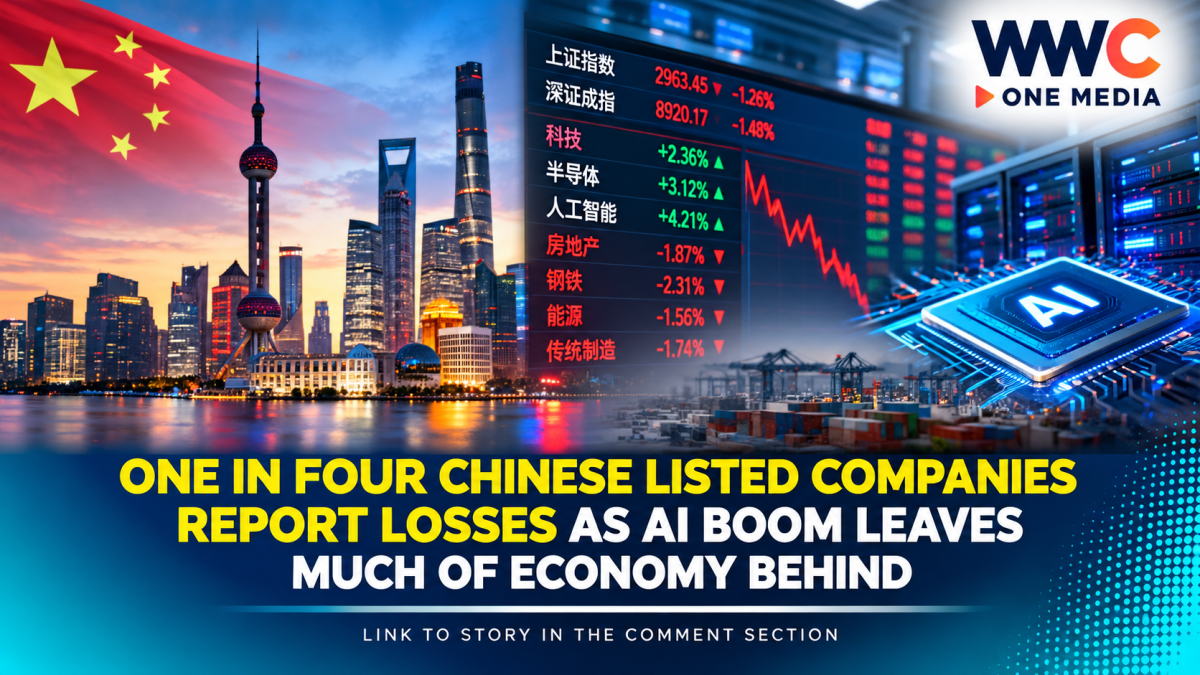
BEIJING — September 17, 2026 — China’s corporate economy is increasingly showing two very different faces: artificial intelligence, semiconductors and advanced manufacturing are powering a profit boom, while a large share of traditional businesses continue to struggle.
About one in four Chinese listed companies reported losses for 2025, according to a Nikkei analysis based on Shanghai DZH data. The figure represented the highest proportion since 2000, highlighting the uneven recovery across the world’s second-largest economy.
But the latest earnings data show that the divide has not disappeared in 2026. Instead, technology-driven companies are increasingly pulling away from businesses exposed to weak domestic consumption and the prolonged property downturn.
AI Is Driving a New Profit Engine
China’s AI push has produced some of the strongest earnings growth among listed technology companies.
South China Morning Post reported that profits among companies on Shanghai’s technology-heavy STAR Market more than quadrupled in the first half of 2026, while profits at Shenzhen’s ChiNext companies increased 33%.
Across all 5,557 mainland-listed companies, first-half profits increased 19.5% year-on-year, the fastest pace since 2022.
The surge has been supported by demand for AI computing, semiconductors and domestic technology substitution as China accelerates efforts to build its own technology supply chains.
But the Gains Are Far From Even
The headline profit growth masks major differences between sectors.
Bloomberg data reported by Moneycontrol showed that profits of onshore-listed Chinese companies increased 25.7% in the second quarter, the strongest growth in nearly five years.
Yet much of that improvement was concentrated in AI-linked technology and advanced manufacturing.
Traditional consumer businesses have faced a much tougher environment, with weak household demand, pressure on margins and continuing problems in the property sector.
Among the companies facing difficulties were property developer China Vanke, liquor producer Kweichow Moutai, and pig producer Muyuan Foods, according to the same report.
China’s Property Crisis Continues to Weigh
The corporate divide is closely connected to China’s broader economic imbalance.
Reuters reported this week that China’s industrial output grew 5.2% year-on-year in August, helped by high-tech manufacturing and AI-related industries.
But retail sales increased only 0.4%, while property investment plunged 19.9% from a year earlier.
The contrast shows how manufacturing and technology investment are currently performing much better than household consumption and property.
China’s second-quarter GDP growth was also just 4.3%, according to Reuters, below the government’s full-year growth target of 4.5%–5%.
Even AI Leaders Face a Profit Challenge
The AI boom does not automatically translate into immediate profits.
Alibaba, one of China’s largest technology companies, reported a 75% year-on-year decline in quarterly net profit in August as it dramatically increased spending on AI infrastructure.
The company’s revenue still rose 9%, while its cloud business benefited from strong AI demand. Alibaba has committed 380 billion yuan to AI-related investment from 2026 through 2029 and said it expects those investments to break even within three years under its current assumptions.
Other Chinese AI companies face similar pressures. Macquarie estimates that Z.ai and MiniMax could remain loss-making through 2030 because of the enormous cost of computing power required to develop and operate advanced AI models.
A K-Shaped Chinese Economy
The result is an increasingly visible “K-shaped” economic picture.
On one side are AI, semiconductors, robotics, batteries and other high-tech industries benefiting from government support, technological investment and global demand.
On the other are property, consumer services, construction-related industries and other traditional sectors facing weaker demand and excess capacity.
The latest earnings figures therefore tell a more complicated story than simply saying China’s companies are recovering.
Profits are recovering — but not everywhere.
What Comes Next?
The central question for China’s economy is whether the strength of technology and advanced manufacturing can eventually spread to the broader economy.
Industrial growth and exports can provide support, but economists and investors continue to watch household spending and the property market closely.
For now, China’s AI boom is creating powerful new winners while many older parts of the economy remain under pressure.
That divergence could become one of the defining economic stories of China’s next phase of growth.




Leave a Reply