
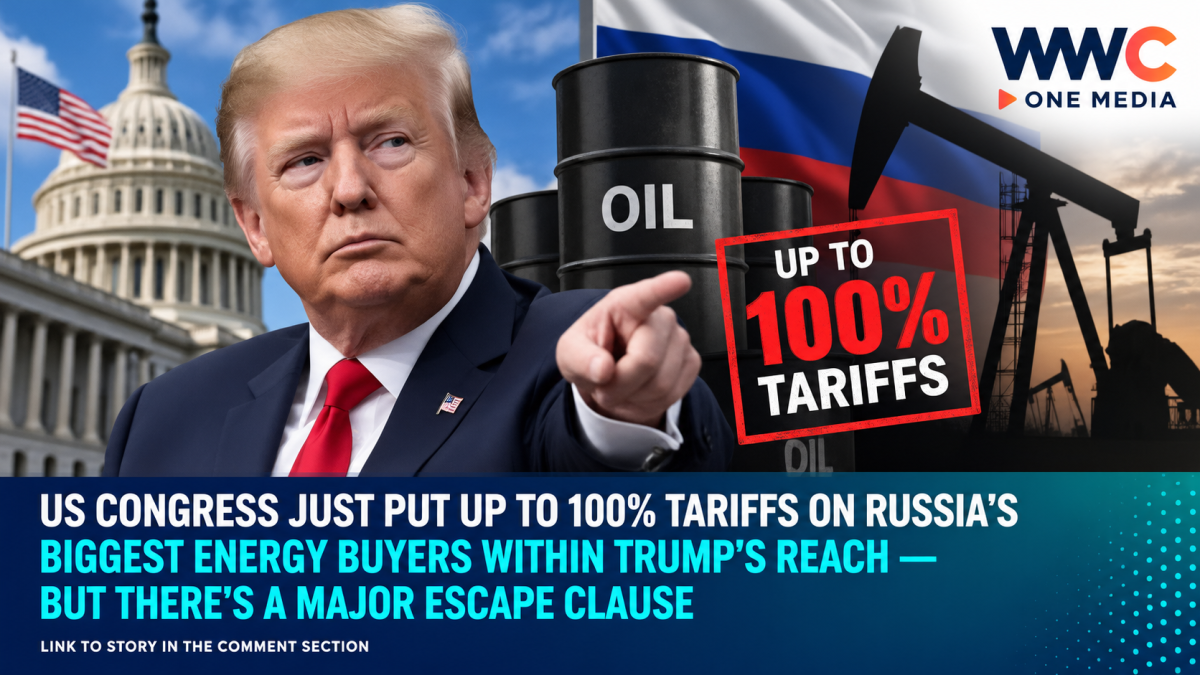
WASHINGTON — The United States Congress has approved a far-reaching sanctions package targeting Russia’s energy revenues, banks, senior officials and sanctions-evasion networks, placing legislation on President Donald Trump’s desk that could also expose some of Moscow’s biggest energy customers to tariffs of as much as 100%.
But one of the most important details is buried beneath the headline.
The bill does not automatically impose a flat 100% tariff on China, India or every country still purchasing Russian oil and gas. Instead, it establishes criteria targeting the five largest importers of Russian energy and five countries most involved in helping evade Russian oil sanctions, while giving the president significant discretion over tariff levels and waivers.
The House of Representatives approved the Lindsey O. Graham Sanctioning Russia and Iran Act of 2026 on September 16 by 262 votes to 159, sending the measure to Trump after the Senate passed it 86-11 in August. Trump has said he intends to sign the legislation, although as of the latest reporting it had not yet become law.
The House vote drew support from 203 Republicans and 58 Democrats, while seven Republicans and 152 Democrats voted against it.
What the Russia sanctions bill actually does
The legislation goes considerably further than the tariff provision attracting most of the attention.
The congressional text requires sanctions targeting Russian political and military officials, entities supporting Russia’s defense industry, Russian financial institutions and people or companies helping Moscow evade existing restrictions.
It specifically covers Russia’s Central Bank, Sberbank, VTB Bank and Gazprombank, among other institutions, and calls for restrictions on transactions involving them. The measure also targets foreign financial institutions involved in significant dealings with covered Russian banks, subject to specified exceptions.
Russia’s so-called shadow fleet is another major focus.
These are tankers and associated networks used to continue shipping Russian energy while circumventing Western sanctions or oil-price restrictions. The legislation allows sanctions against vessels, owners, operators, insurers and other entities involved in specified sanctions-evasion activities.
The bill additionally covers foreign entities supplying certain goods and services to Russia’s defense-industrial base and people involved in some major Russian energy projects.
The number most people may miss: 500%
One provision could permit an even higher tariff than the widely reported 100% figure.
Under Section 112 of the Senate-passed text approved by the House, the president is directed, within 30 days of enactment, to raise tariffs on goods imported directly from Russia to a rate of up to 500%.
That provision includes oil, natural gas, LNG, petroleum products, petrochemicals, coal and other Russian goods.
The separate — and potentially much more geopolitically consequential — provision concerns countries that continue purchasing Russian energy.
Why China and India are being mentioned
Section 113 directs the administration to identify countries that rank among the five largest importers by volume of Russian crude oil or natural gas, as measured over the relevant 12-month period.
It also covers the five countries most involved in facilitating Russian oil sanctions evasion.
Goods imported into the United States from qualifying countries could face duties greater than zero and as high as 100%.
Reuters, AP and other outlets have identified China and India as potentially affected because both have remained major purchasers of Russian energy.
But saying the legislation has already imposed a 100% tariff on either country would be inaccurate.
The actual rate can be set below 100%, and the legislation requires determinations about which countries meet its criteria. The U.S. Trade Representative would then reassess the relevant rankings every 180 days.
There is also a specific natural-gas exception for a country whose Russian gas purchases account for less than 15% of Russia’s total annual gas exports, provided that country has taken significant steps to reduce those imports.
Trump also gets waiver authority
Another key provision explains why the bill divided lawmakers who otherwise support Ukraine.
The legislation allows the president to waive sanctions, restrictions or duties if he submits a written certification to Congress saying the waiver is in the national interest of the United States, accompanied by an explanation.
That discretion became a major point of disagreement in the House.
Democratic Leader Hakeem Jeffries opposed the legislation, arguing that its tariff authority was too broad and that the waiver provisions could mean sanctions intended to affect Russia are not ultimately enforced as supporters expect.
Other Democrats argued that Trump already possesses significant sanctions powers and questioned why Congress should give the White House additional tariff authority that could potentially affect U.S. allies.
Supporters rejected that criticism, saying the bill provides additional economic tools to restrict revenue reaching Moscow and encourage negotiations over the war.
Republican Representative Michael McCaul, one of the House sponsors, argued that the legislation could increase economic pressure on Russia and countries sustaining its energy trade. Democratic Senator Richard Blumenthal, who worked on the measure with Graham, similarly said he hopes sanctions can increase pressure for negotiations. Those are lawmakers’ stated objectives; whether the measures will produce that result remains uncertain.
Why Lindsey Graham’s name is on the bill
The legislation is named after the late Republican Senator Lindsey Graham of South Carolina, who spent more than a year developing and promoting the sanctions proposal with lawmakers including Blumenthal.
Graham introduced the effort in 2025, but congressional action was delayed for months.
Trump did not clear Republican leaders to move forward until July 2026, Reuters reported, shortly before Graham’s death on July 11.
The Senate eventually passed the package in August with strong bipartisan support.
Ukrainian President Volodymyr Zelenskyy had personally urged lawmakers to approve it and attended a Senate procedural vote during a visit to Washington. Before the House vote, Zelenskyy again publicly called for the legislation to advance.
Why Iran is in a Russia sanctions bill
Despite the focus on Moscow, the legislation is formally called the Lindsey O. Graham Sanctioning Russia and Iran Act of 2026.
The Iran section is comparatively straightforward.
The bill would extend the Iran Sanctions Act of 1996 from 2026 until 2031, preserving sanctions authority covering areas including Iran’s energy sector.
AP reported that adding the five-year Iran sanctions extension was part of the negotiations that helped secure Trump’s support for the broader package.
Sanctions would not necessarily last forever
The Russian sanctions section also contains conditions under which measures could eventually be terminated.
Among them, the president could seek to terminate relevant sanctions against Russia after certifying to Congress that Moscow has signed a peace agreement accepted by Ukraine’s government and ended military hostilities and activities aimed at overthrowing or subverting Ukraine’s government.
Most of the legislation is also scheduled to sunset five years after enactment, although the Iran Sanctions Act extension is excluded from that sunset.
The package contains humanitarian exceptions covering transactions involving food, agricultural commodities, medicine, medical devices and specified humanitarian assistance.
Why this vote matters now
Russia’s February 2022 full-scale invasion of Ukraine has continued for more than four years, while energy exports remain an important source of Russian government revenue.
The new legislation represents the most substantial Ukraine-related measure passed by Congress since Trump returned to the White House in January 2025, according to Reuters, and AP described it as Congress’ most ambitious Ukraine-related legislative effort since the major emergency assistance package approved in 2024.
The timing is also notable.
The House approved the measure on its final scheduled voting day before lawmakers left Washington ahead of the November 3, 2026 midterm elections.
The vote demonstrated bipartisan support for additional economic measures against Russia, but the narrower margin in the House also exposed disagreements about how much tariff discretion Congress should delegate to the president.
What happens next?
The legislation now requires Trump’s signature before becoming law.
If he signs it as expected, several provisions would begin on defined statutory timelines rather than instantaneously.
Within 30 days of enactment, the administration would have to begin implementing multiple sanctions requirements and make determinations connected to tariffs on Russian goods and qualifying Russian-energy buyers. The government would also have to keep reviewing sanctions targets and energy-import rankings at intervals specified in the law.
That means the immediate headline — “100% tariffs on China and India” — is too simplistic.
The more accurate story is potentially more consequential:
Congress has created a legal framework that could force some of Russia’s biggest energy customers to weigh continued purchases of Russian oil and gas against potentially much higher costs for selling goods into the United States.
Exactly how aggressively that authority is used will depend substantially on Trump’s implementation decisions, future trade data and any waivers his administration chooses to issue.


Leave a Reply