
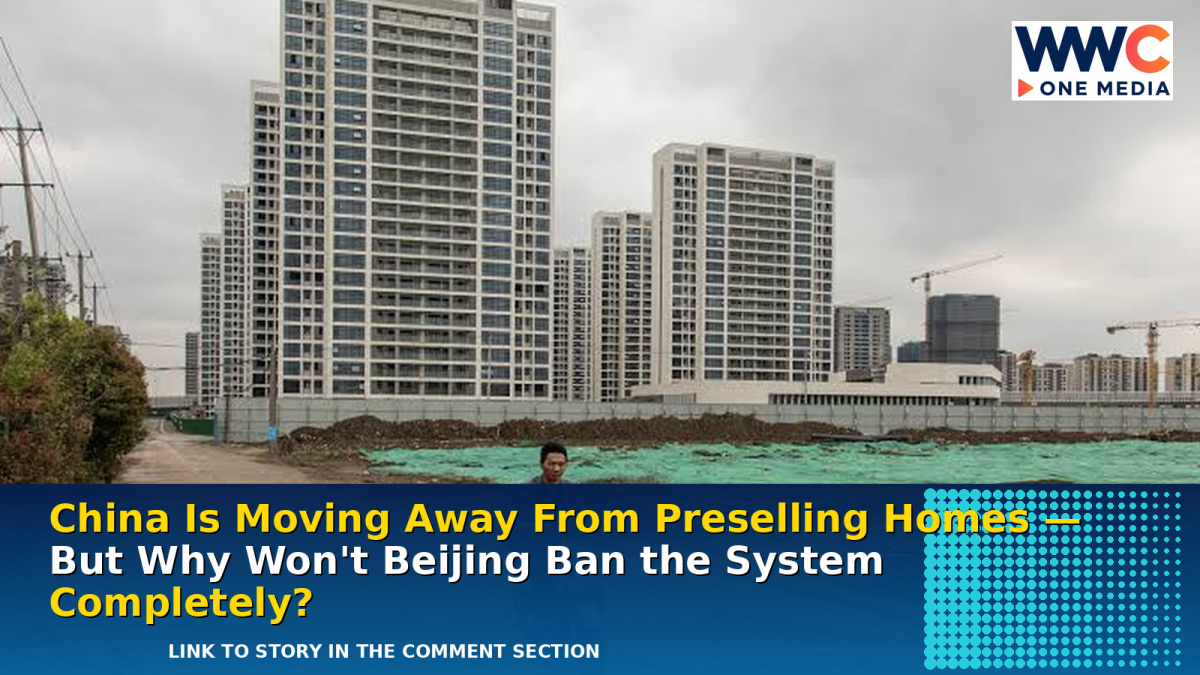
BEIJING — China is finally moving away from the housing system that helped fuel one of the biggest property booms in modern history.
But Beijing is not pulling the plug overnight.
For decades, Chinese developers have relied heavily on selling apartments before construction was completed. Buyers would put down deposits, take out mortgages and begin paying for homes that often existed only on paper.
The system powered a spectacular building boom.
It also helped create a dangerous cycle of debt.
Now, after years of developer defaults, unfinished apartments and collapsing buyer confidence, China is rewriting the rules.
But despite growing pressure to eliminate presales entirely, Beijing is taking a more cautious approach.
Why? Because banning housing presales overnight could create another financial shock at exactly the moment China is trying to stabilise its crisis-hit property market.
That is the central argument in a new South China Morning Post opinion piece examining Beijing’s increasingly aggressive — but still gradual — effort to dismantle the old property model.
China’s housing presale model is being dismantled
In late August, Chinese authorities introduced a major package of property reforms aimed at reducing developers’ dependence on money collected from buyers before homes are completed.
The changes were significant.
Under new guidelines, banks are generally expected to issue homebuyers’ mortgages only after residential projects have been completed.
Local governments are also being encouraged to prioritise the sale of completed homes, while financing rules are being redesigned to make banks and developers more directly responsible for funding construction.
In simple terms, Beijing wants to change the old system.
Instead of buyers financing construction first, developers and financial institutions are being pushed to carry more of the risk.
That could be one of the biggest structural changes to China’s housing market in decades.
The old model helped build China’s property empire
The presale system was once one of the engines behind China’s extraordinary urban expansion.
Developers could:
- Buy land
- Begin construction
- Sell apartments before completion
- Collect deposits and mortgage-related funds
- Use incoming cash to finance more construction
- Buy more land
- Launch more projects
The faster the projects moved, the faster developers could expand.
But the model also created a dangerous dependency.
Developers increasingly relied on future homebuyers’ money to finance current projects.
And when sales slowed?
The entire cycle could begin to break down.
That became painfully clear after China’s property crisis erupted in 2021.
As financing tightened and home sales weakened, heavily indebted developers began running out of cash.
Construction stopped.
Projects stalled.
Buyers who had already paid for homes were left waiting.
Some were left paying mortgages on apartments they could not move into.
Evergrande became the symbol of the crisis
Few companies represented China’s debt-fuelled property boom more dramatically than China Evergrande Group.
The developer became a symbol of the risks created by years of rapid borrowing, aggressive expansion and dependence on continued sales.
The SCMP opinion piece described late August as a watershed moment for China’s property crisis, following major developments involving Evergrande’s onshore liquidation proceedings and the criminal case against founder Hui Ka-yan.
The message was difficult to ignore.
The property model that produced China’s biggest developers was no longer sustainable.
But dismantling that model creates another problem.
What replaces it?
And who pays for construction while the industry transitions?
Why Beijing won’t simply ban presales tomorrow
At first glance, an outright ban may sound simple.
If presales created risks, eliminate them.
But China’s property market is too large and too deeply connected to the wider economy for such a sudden move to be painless.
Presales remain a dominant part of China’s new-home market.
Reuters reported that presales accounted for about 68 per cent of new-home sales by floor space in 2025.
That means developers, banks, local governments and buyers are still deeply connected to the system Beijing wants to change.
An immediate nationwide ban could create an enormous cash-flow shock for developers.
Projects would need to be financed without the early money traditionally provided by buyers.
Many weaker companies could struggle to survive the transition.
Construction activity could fall further.
Land purchases could decline.
And local governments could lose even more revenue.
The biggest problem: Developers still need money
This is the heart of Beijing’s dilemma.
Developers traditionally used presale-related funds as a major source of cash.
Remove that funding too quickly, and companies need another source.
That means:
- Development loans
- Bank financing
- Bond markets
- Equity financing
- Internal cash reserves
But not all developers have equal access to those options.
China’s financially stronger companies — especially major state-backed developers — generally have better access to financing.
Smaller and private developers often face higher borrowing costs and greater difficulty raising money.
That means a rapid transition away from presales could accelerate consolidation across the industry.
Some developers may adapt.
Others may disappear.
The new rules could cut developers’ cash flow sharply
The market reaction to the reforms showed how significant the changes could be.
After the new policy measures were announced, Chinese property stocks fell sharply as investors assessed the impact of restricting developers’ access to buyer-funded cash during construction.
Reuters reported concerns that the changes could significantly reduce developers’ investment capacity.
Developers have already been struggling with:
- Falling home sales
- Weak prices
- Heavy debt
- Limited access to financing
- Declining investment
- Lower land purchases
A sudden removal of presale funding could make those pressures even more severe.
That is one reason Beijing is choosing reform over an immediate nationwide prohibition.
China wants buyers to trust the market again
For Beijing, however, the old system has become increasingly difficult to defend.
The biggest damage from the property crisis may not simply be financial.
It is psychological.
Homebuyers lost confidence.
For many Chinese families, buying a home is one of the largest financial decisions of their lives.
But the property crisis created a terrifying possibility.
What if you pay for the apartment — and the developer never finishes it?
The new reforms are designed to reduce that risk.
By delaying mortgage disbursement and encouraging the sale of completed homes, authorities hope to shift more responsibility back to developers and financial institutions.
Analysts told Reuters the changes could help repair the sector’s trust crisis by reducing fears over stalled projects and non-delivery.
The new model changes who carries the risk
Under the old model, buyers often carried a substantial amount of early risk.
They committed money before the apartment was finished.
Developers used those funds to keep projects moving.
If the developer collapsed?
The buyer could face uncertainty.
The new system attempts to reverse that logic.
The developer should demonstrate greater financial capacity.
Banks should play a stronger role in financing projects.
Completed homes should become more important.
And buyers should be less exposed to construction risks.
That may sound straightforward.
But moving the financial burden away from buyers means someone else must carry it.
And that is where the transition becomes difficult.
Banks may become more selective.
Developers may build fewer projects.
And financing could increasingly flow toward larger companies with stronger balance sheets.
Smaller developers could be the biggest losers
The reforms could dramatically reshape China’s property industry.
Large developers with:
- Stronger liquidity
- Better bank relationships
- Government connections
- Lower borrowing costs
may be better positioned to survive.
Smaller developers may struggle.
Reuters reported that analysts expect the reforms to favour financially stronger companies while increasing pressure on weaker firms.
That could accelerate a trend already underway.
China’s once-crowded property industry could become dominated by a smaller number of financially powerful developers.
And many of those could be state-backed.
Beijing is choosing a gradual transition
China’s strategy appears to be simple.
Do not preserve the old system.
But also:
Do not destroy the market while trying to reform it.
The SCMP opinion piece argues that Beijing is trying to unwind the debt-driven growth model without triggering another financial crisis.
That explains why the government is focusing on a gradual shift.
New projects and newly transferred land are being pushed toward completed-home sales.
Existing projects are being handled differently.
Developers already deep into construction cannot simply be expected to rebuild their entire financing model overnight.
The transition therefore appears designed to avoid a sudden industry-wide funding collapse.
Beijing’s real target is the old property business model
The presale system is only one part of China’s larger problem.
The deeper issue is the growth model behind it.
For years, China’s property industry depended on:
- Rapid borrowing
- Rapid land purchases
- Rapid construction
- Rapid sales
- Constant expansion
That model worked while:
Prices were rising.
Buyers were confident.
Credit was available.
And demand remained strong.
But once those conditions changed, the system became vulnerable.
China’s government now appears to be trying to build a property market based on slower, more financially sustainable growth.
S&P Global Ratings said the latest reforms signal a broader effort to address the sector’s structural problems, including excessive leverage and overreliance on presales.
The reforms could hurt land sales
There is another major complication.
China’s local governments have historically relied heavily on land sales for revenue.
Property developers buy land.
Local governments collect revenue.
Developers build projects.
Homebuyers purchase apartments.
The entire system is interconnected.
But if developers have less cash and become more cautious?
They may buy less land.
That creates another financial problem for local governments already facing pressure from weaker land-sale income.
Reuters reported that China’s government land-sale revenue had already fallen sharply in the first seven months of 2026.
Property development investment was also declining.
That means Beijing is attempting to reform the housing market while one of its most important financial engines is already slowing down.
China is trying to fix the market without causing another crash
This is why the reforms are so politically and economically complicated.
Beijing wants to:
Protect homebuyers.
But it also needs to:
Prevent developers from running out of cash.
It wants to:
Reduce financial risk.
But it also needs to:
Keep banks lending.
It wants to:
End dependence on presales.
But it also needs to:
Avoid an immediate collapse in construction.
The government is effectively trying to change the engine of the world’s largest housing market while it is still running.
That requires caution.
Can completed homes bring buyers back?
One of the biggest hopes behind the reforms is that completed-home sales could restore confidence.
Buyers can see what they are purchasing.
They can inspect the apartment.
They do not need to worry as much about whether construction will be completed.
The system is also more common in many other housing markets.
But the transition comes with costs.
Developers need more capital before making sales.
Construction cycles may become slower.
And fewer projects may be launched.
S&P Global Ratings warned that while the policy reset could improve stability, it could also weigh on land sales and change the speed at which the industry operates.
A 40-year mortgage adds another twist
China’s new policy package also includes measures intended to reduce the immediate burden on homebuyers.
Authorities extended the maximum mortgage term to 40 years from 30 years.
The idea is to lower monthly repayments and potentially free up household cash.
But analysts are not convinced that longer mortgage terms will solve the fundamental demand problem.
The biggest obstacles may be:
- Weak employment expectations
- Slower income growth
- Falling home prices
- Concerns about future property values
If buyers believe home prices will continue falling, a cheaper monthly mortgage payment may not be enough to convince them to buy.
That is why the property crisis remains about more than financing.
It is also about confidence.
China’s property crisis is now entering a new phase
The latest reforms suggest Beijing is no longer simply trying to rescue the old property market.
Instead, it is trying to redesign it.
That distinction matters.
The goal appears to be:
Less speculation.
Less debt.
Less dependence on presales.
More completed homes.
More financial oversight.
More disciplined developers.
But transitions are rarely painless.
The companies that thrived under the old model may not survive the new one.
And China’s property sector could emerge smaller, slower and far more concentrated than it was during the boom years.
Beijing’s biggest gamble
China’s government is now making a difficult bet.
It believes the old property system is too dangerous to preserve.
But changing it too quickly could be dangerous too.
That is why Beijing is not banning housing presales outright.
At least not yet.
Instead, it is tightening the system.
Delaying access to buyer funds.
Increasing bank oversight.
Encouraging completed-home sales.
And gradually forcing developers to find other ways to finance construction.
The strategy is a balancing act.
Move too slowly, and the old risks remain.
Move too fast, and the property sector could suffer another major shock.
For now, China appears to have chosen the middle path.
The presale era is not disappearing overnight.
But its days as the foundation of China’s property boom may already be numbered.
The Bottom Line
China is not refusing to reform housing presales.
It is doing something potentially more consequential.
It is trying to slowly remove the system from the centre of the property market without triggering another wave of defaults, stalled projects and financial instability.
The question now is whether Beijing can pull off that transition.
Because after six years of property-sector pain, China’s housing market does not just need another policy announcement.
It needs buyers to believe again.
And that may be the hardest thing to rebuild.
WWC ONE MEDIA J.M.D




Leave a Reply