
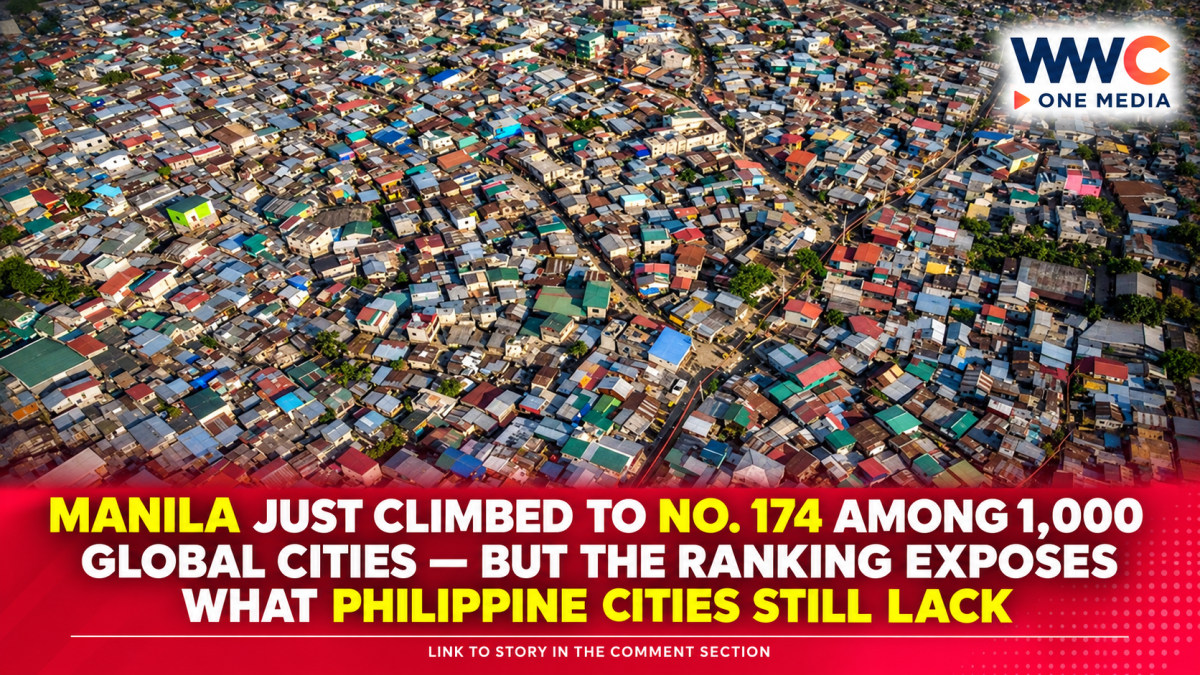
MANILA, Philippines — Nine Philippine cities have again made Oxford Economics’ ranking of 1,000 major urban economies worldwide, with Manila climbing to 174th place in 2026 as Asia’s expanding economic weight reshapes the global city map.
But simply appearing on the list does not mean Philippine cities have caught up with the world’s strongest urban centers.
Oxford Economics’ newly released 2026 Global Cities Index measures cities not only by the size of their economies, but also by their workforce, living conditions, environmental performance and quality of governance.
The Manila Standard reported that nine Philippine cities are represented in the latest edition, led by Manila at No. 174 globally.
That is an improvement from the previous edition, when Manila ranked 206th globally, according to 2025 index reporting.
The rise is notable.
But Oxford Economics’ methodology shows why a growing city can still struggle to become a globally competitive one.
Manila moved up—but the ranking measures much more than GDP
The Global Cities Index assesses five broad areas:
Economics, including economic size, GDP growth, employment, productivity and economic diversity;
Human Capital, including workforce size, educational attainment, university quality and the ability to attract skilled workers;
Quality of Life, including income, housing costs, health outcomes, crime and access to amenities;
Environment, including air quality, climate risks, green space and emissions;
and Governance, including political stability, regulatory quality, rule of law and government effectiveness.
That means cities cannot reach the top simply by becoming bigger.
They need to become more productive, more livable and more effectively governed at the same time.
For Philippine cities, that is the harder challenge.
Manila has made a significant jump
Manila’s latest 174th-place ranking represents a substantial improvement from the 2025 edition, where it placed 206th.
In the 2024 index, Manila was even lower at 256th, according to Manila Bulletin coverage of that year’s results.
Taken across the three editions, the trajectory points upward:
2024: 256th
2025: 206th
2026: 174th
Rankings can change because of methodology, updated forecasts and changes in other cities as well as improvements in Manila itself, so those movements should not be interpreted as a direct measurement of economic growth alone.
Still, the direction is significant.
Manila has moved more than 80 places higher in two editions.
The same Philippine urban centers keep appearing
Previous Oxford Economics rankings included Manila, Cebu City, Angeles City, Bacolod, Davao City, Cagayan de Oro, Dagupan, General Santos and Zamboanga City among Philippine entries.
Those same urban centers have repeatedly appeared in the index, reflecting the concentration of Philippine economic activity outside and alongside Metro Manila.
In the 2025 edition, Manila was followed by Cebu and Angeles, while cities including Bacolod, Davao, Cagayan de Oro and Dagupan also made the global 1,000.
Oxford Economics classifies some fast-growing Philippine cities differently according to their structural characteristics.
For example, Davao City is identified as an “Emerging Standout,” a category for developing-world cities that tend to outperform their national economies and attract residents through productivity and income growth.
Manila, meanwhile, has previously been grouped among Developing Megacities, cities with populations above 10 million whose infrastructure often struggles to keep pace with rapid urbanization.
That classification captures one of Metro Manila’s central contradictions.
Its enormous population and economic scale create opportunities.
They also create congestion, infrastructure pressure, housing challenges and environmental stress.
Asia is gaining economic weight
The Philippine results sit inside a much broader transformation.
Oxford Economics says the global economic center of gravity continues to move toward Asia.
Chinese and Indian cities are expected to generate some of the largest increases in urban GDP through 2050, even though several remain outside the top 100 today.
Cities such as Shenzhen, Taipei, Kuala Lumpur and Ho Chi Minh City are also highlighted as examples of Asia’s increasing influence.
Oxford projects that by 2050, Chinese and Indian cities covered by its database will collectively account for a greater share of urban GDP than European cities.
Shanghai alone is expected to overtake San Francisco in GDP much sooner, according to Oxford’s 2026 analysis.
That creates both an opportunity and a warning for Philippine cities.
Asia is growing.
But neighboring cities are growing too.
Kuala Lumpur is already among Oxford’s cities to watch
The regional competition becomes clearer when examining Southeast Asia.
Oxford Economics placed Kuala Lumpur among its new global “Cities to Watch,” giving the Malaysian capital an overall score of 75.4.
It received particularly strong marks for human capital and governance, according to Oxford.
Ho Chi Minh City also made the Cities to Watch list, supported by rapidly expanding economic activity and human-capital potential.
Singapore sits much higher still.
It ranked 29th globally in the latest index.
That gap matters.
Manila may have risen to 174th, but within Southeast Asia it still competes for capital, talent and corporate investment against urban centers that score more strongly across several structural measures.
The global leaders remain difficult to dislodge
At the top of Oxford Economics’ 2026 ranking, New York remained No. 1, followed by London and Paris.
Seattle placed fourth, San Francisco fifth, Dublin sixth, Boston seventh, San Jose eighth, Tokyo ninth and Zurich tenth.
These cities tend to combine several advantages simultaneously.
Large economies.
Highly educated labor forces.
Deep capital markets.
Major universities.
Corporate headquarters.
Reliable institutions.
Strong urban amenities.
Oxford describes their advantage as partly self-reinforcing: successful cities attract skilled workers and innovative businesses, which in turn make the cities even more productive and attractive.
That makes closing the gap especially difficult.
A city cannot simply construct a few office towers and become globally competitive.
Growth can become a weakness when infrastructure falls behind
Oxford’s description of “Developing Megacities” is particularly relevant to Manila.
These cities possess huge and relatively young workforces, creating the possibility of a demographic dividend.
But rapid population growth can also outpace investment in transport, housing, water, drainage and other infrastructure.
Metro Manila provides obvious examples.
Economic activity has expanded across the capital region, but residents continue to face transportation bottlenecks, flooding, housing affordability pressures and long commuting times.
These factors are not separate from economic competitiveness.
They influence whether skilled workers stay, whether multinational firms can operate efficiently and whether businesses view a city as an attractive long-term investment destination.
Quality of life can become an economic advantage
The index also challenges an old assumption: that economic growth and urban livability are separate policy objectives.
Oxford Economics treats them as connected.
Housing affordability affects whether workers can live near jobs.
Healthcare affects productivity.
Crime affects investment and mobility.
Transportation determines how efficiently workers and goods move.
Green space and air quality affect resident wellbeing.
Cultural and recreational amenities help cities attract highly skilled professionals.
That means infrastructure investment can influence several components of a city’s global competitiveness simultaneously.
A faster train, for example, may improve productivity while also reducing commute times and improving quality of life.
Philippine cities have another advantage: room to grow
Lower rankings are not necessarily synonymous with weak prospects.
Oxford Economics’ latest report puts particular emphasis on emerging cities whose productivity is rising rapidly.
Its “Emerging Standouts” category includes urban centers in developing economies that can benefit from improving productivity and incomes.
For cities such as Davao, Cebu or Cagayan de Oro, this can represent a different development path from older global capitals.
They do not need to become New York or London.
They can grow into stronger regional centers by attracting investment, improving transport and logistics, expanding higher education and creating better-paying industries.
The challenge is doing so without reproducing Metro Manila’s congestion and infrastructure problems as their populations expand.
Governance remains part of the competitiveness equation
Perhaps one of the least obvious parts of Oxford’s ranking is governance.
Its indicators include political and institutional stability, regulatory quality, government effectiveness, rule of law and ease of doing business.
These factors matter directly to investors.
Businesses want to know how quickly permits will be issued.
Developers need predictable zoning.
Companies need contracts to be enforceable.
Infrastructure investors need stable rules.
Residents need government services to work.
That means the competitiveness of Philippine cities ultimately depends not only on national economic policy but also on how effectively local institutions function.
Manila’s rise is encouraging—but rankings are not trophies
A climb from 256th in 2024 to 174th in 2026 makes an attractive headline.
But the more important value of the Global Cities Index is not bragging rights.
It is identifying what still holds cities back.
Oxford Economics explicitly describes the index as a benchmarking tool for policymakers, investors and businesses rather than merely a list of winners and losers.
For Manila and the eight other Philippine cities in the global 1,000, that means asking a harder set of questions:
Can transport infrastructure keep pace with population growth?
Can cities attract higher-value industries?
Can workers gain the skills those industries require?
Can housing remain affordable?
Can governments improve services and reduce regulatory friction?
And can fast economic growth translate into a noticeably better life for residents?
Nine Philippine cities making a global ranking is a sign that the country’s urban economies matter.
Manila climbing to No. 174 shows that their position can change quickly.
But in a century increasingly shaped by Asian cities, simply getting bigger will not be enough.
The real competition is becoming richer, more productive and more livable at the same time.



Leave a Reply