
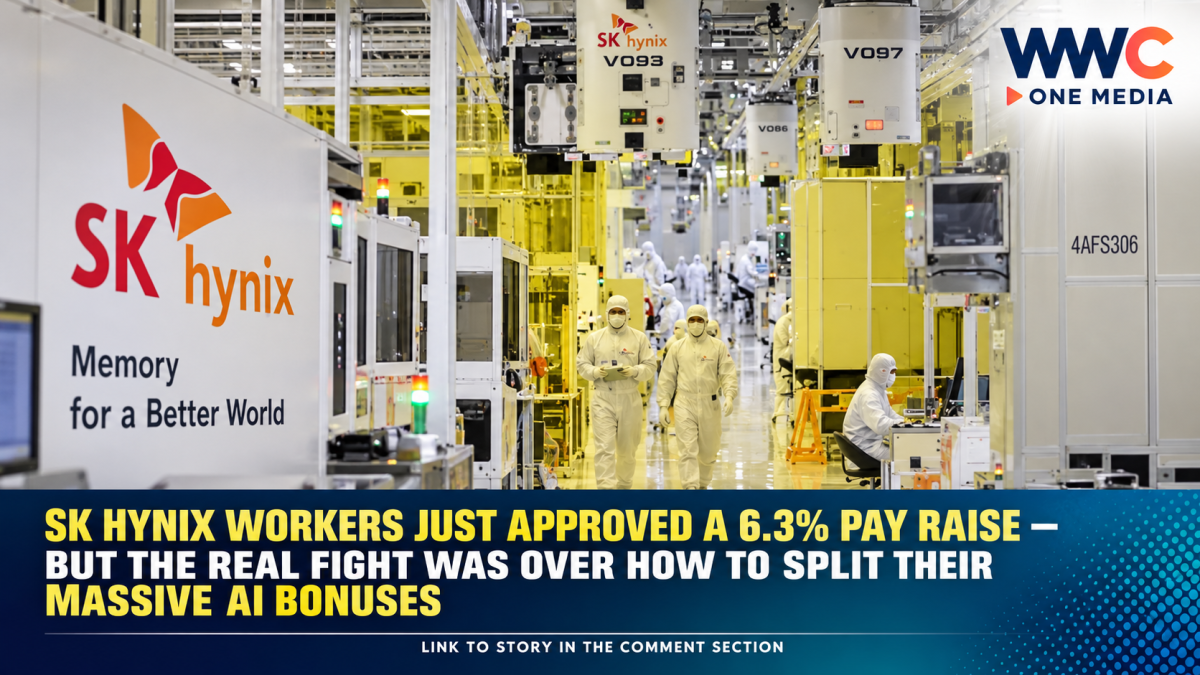
SEOUL — Workers at one of the biggest winners of the artificial-intelligence boom have finally approved a new pay agreement — but it took two votes and a surprisingly narrow labor fight over whether employees should receive more of their extraordinary bonuses in cash or company shares.
Production workers at SK hynix, the world’s second-largest memory-chip maker, approved a revised 2026 wage and collective-bargaining agreement on Wednesday, ending nearly a month of uncertainty after they rejected management’s first offer by just 25 votes.
The new deal preserves a 6.3% base-wage increase while changing the company’s profit-sharing structure so that 50% of the standard bonus is paid in cash and 50% in SK hynix shares.
That may sound like a small adjustment.
It was enough to turn a losing proposal into a winning one.
The agreement passed with 57.08% support, or 8,731 votes, among production-union members at SK hynix’s Icheon and Cheongju operations. More than 15,000 employees participated.
The vote brings this year’s wage negotiations close to a formal conclusion without a strike — an increasingly important outcome as SK hynix produces high-bandwidth memory, or HBM, that has become critical to the global AI industry.
The first deal lost by only 25 votes
The drama began with an agreement reached in August.
Management and labor representatives initially settled on a 6.3% wage increase, but proposed paying only 40% of profit-sharing bonuses in cash and 60% in treasury shares.
Production workers rejected it on August 25.
The margin could hardly have been smaller.
Of roughly 15,000 votes cast, 7,535 voted against and 7,510 supported the proposal — a difference of only 25 votes. Turnout was 93.8%.
That forced negotiators back to the table.
Three weeks later, management returned with a revised offer designed to address the issue that had generated the most resistance:
cash.
The new deal gives workers more cash upfront
Under the revised agreement, the standard profit-sharing mix shifts from:
40% cash / 60% stock
to:
50% cash / 50% stock.
But employees who actually want more stock will still have that option.
Workers can choose to increase the share-based portion from the base 50% to as much as 100% of their bonus, in increments of 10 percentage points.
That makes the final arrangement more flexible than the headline 50-50 split suggests.
An employee who prefers liquidity can take half in cash.
Someone confident that SK hynix shares will appreciate can elect to receive more — potentially all — of the award in stock.
The agreement therefore gives workers more control over how much market risk they are willing to accept.
Why were workers resisting SK hynix stock in the first place?
Ordinarily, receiving stock in a company experiencing record profits might sound attractive.
But SK hynix shares have also been exceptionally volatile.
Reuters reported that the stock reached a record high in June as enthusiasm around AI drove semiconductor valuations higher, then dropped as investors became more concerned about the enormous capital spending required to sustain the boom.
For an employee receiving a relatively modest share award, that volatility might be manageable.
For SK hynix employees, the amounts involved could be enormous.
Reuters calculated in August that workers could receive an average 2026 profit-sharing bonus of about 779 million won — roughly US$547,000 at the exchange rate used at the time — based on projected company earnings and the agreed profit-sharing formula. That remains an estimate rather than a guaranteed final payout because full-year operating profit has not yet been determined.
Suddenly, the difference between cash and stock becomes much more consequential.
A large share-price decline can dramatically alter the value of hundreds of millions of won in compensation.
The real story is SK hynix’s remarkable profit-sharing formula
The dispute exists because SK hynix employees already secured an unusually lucrative agreement last year.
Labor and management agreed that 10% of annual operating profit would fund employee profit-sharing bonuses, with the arrangement intended to remain in place for 10 years.
The previous cap on the profit-sharing payment was removed.
That decision looked generous when it was negotiated.
Then the AI memory boom became even more profitable.
SK hynix reported an astonishing 60.54 trillion won in operating profit for the second quarter of 2026 alone, on revenue of 79.32 trillion won, according to preliminary results released by the company in July. Operating profit rose 557% from a year earlier.
The company attributed the results to strong AI infrastructure investment, rapidly rising memory prices and greater sales of high-value products including HBM, server DRAM and enterprise SSDs.
That transformed what might otherwise have been a routine annual bonus into a much larger financial event for both employees and shareholders.
The AI boom is creating unusually wealthy chip workers
High-bandwidth memory has emerged as one of the most strategically important components in modern AI systems.
HBM packages multiple layers of memory together to deliver the huge amounts of bandwidth required by accelerators from companies such as Nvidia and other AI-chip developers.
SK hynix entered the current AI boom with a strong position in that technology.
TrendForce said earlier this year that SK hynix remained the leading supplier in the HBM market, although Samsung has been recovering share as competition intensifies around HBM4.
That has put SK hynix workers in an unusual position.
Their compensation is tied directly to operating profit at exactly the moment when AI has caused memory profitability to surge.
The result is bonuses large enough to raise not just labor questions but corporate-finance ones.
Management had a reason to prefer shares
There was also a logic behind SK hynix wanting to pay more of the bonus in stock.
Paying enormous performance awards entirely in cash would drain cash from the company at the same time it is spending heavily on new semiconductor capacity.
Sogang University management professor Kim Yong-jin told Reuters that an all-cash payment could have put both the company and employees in a difficult position, potentially consuming substantial cash and provoking public criticism over the scale of payouts.
SK hynix is simultaneously investing billions in fabs, advanced packaging and next-generation HBM capacity to meet AI demand.
So the company faced a balancing act.
Reward employees for generating historic profits.
Maintain enough cash to fund future growth.
And avoid diluting or destabilizing shareholder returns.
Paying employees in treasury shares addresses part of that problem.
Workers, however, understandably viewed the issue from another perspective:
a bonus is not worth the same amount if its value can fall before you convert it into cash.
The revised deal also accelerates money workers were waiting for
The 50-50 split was not the only concession.
Under last year’s structure, part of some performance bonuses had been deferred for payment over later years.
The revised 2026 agreement brings forward the remaining 20% deferred portion tied to last year’s performance, allowing it to be paid earlier rather than making employees wait through the original schedule.
That helped resolve confusion created as SK hynix moved from one profit-sharing system to another.
The company also agreed to bear additional costs arising from changes in the stock price during the distribution process, according to SBS.
For workers, that further reduces uncertainty.
There is also a protection for weaker years
The agreement contains an interesting safeguard that becomes important if the memory cycle eventually turns down.
If the profit-sharing payout falls below 1,000% of base pay, the bonus will be paid entirely in cash rather than being divided between cash, shares and deferred stock.
That means the share-heavy structure is primarily designed for unusually large profit years.
Semiconductors are notoriously cyclical.
The same memory manufacturers posting historic profits during periods of tight supply can experience steep earnings declines when supply catches up and prices fall.
SK hynix and its workers therefore had to negotiate not only around today’s AI windfall but also around what happens when conditions eventually become less favorable.
Employees also accepted a downside-sharing clause
The package does not only distribute upside.
It contains a clause that could allow SK hynix to defer up to 3% of wages if the company records losses, after labor and management first discuss employment-stability measures and other responses.
Deferred wages would be restored when the company’s financial position normalizes.
That makes the agreement unusual in both directions.
Workers participate heavily when profitability is extraordinary.
But the contract also establishes a mechanism for labor to share part of the burden during a serious downturn.
There are smaller benefits buried beneath the giant bonus numbers
The agreement also includes additional welfare provisions.
Earlier terms included expanded welfare points, improvements to bereavement and funeral assistance, and rules governing payments to workers reaching retirement.
The revised package expanded housing-loan assistance so that single-parent households, as well as married households, can qualify for certain additional support.
Those measures attract far less attention than a potential half-million-dollar average profit-sharing payout.
But they matter because wage negotiations cover the broader employment relationship, not simply one extraordinary AI-driven bonus year.
SK hynix can afford this partly because its balance sheet has changed dramatically
The AI boom has not merely increased accounting profit.
It has strengthened SK hynix’s cash position.
At the end of June, the company reported 88 trillion won in cash and cash equivalents, while total debt had declined to 18.6 trillion won.
That left SK hynix with a net cash position of about 69.4 trillion won, according to its second-quarter filing.
That financial strength has allowed the company to reward multiple constituencies at once.
Employees are receiving extraordinary profit sharing.
Meanwhile, shareholders are also getting a huge return of capital.
Shareholders are getting paid too
In August, SK hynix announced plans to buy back and cancel 40 trillion won of treasury shares and said more than 50% of free cash flow generated between 2025 and 2027 would be allocated to shareholder returns.
Reuters later reported that Samsung Electronics and SK hynix together had announced shareholder-return plans exceeding 130 trillion won for 2026, powered by the surge in AI-generated cash flow.
That creates another delicate balance.
Employees want to share in record profits.
Shareholders want those profits distributed or reinvested efficiently.
Management wants to preserve enough capital to build enormous new semiconductor facilities.
And customers want more HBM.
The AI boom has generated so much cash that the argument is no longer simply about whether SK hynix is profitable.
It is about who should receive the profits — and in what form.
This labor debate is spreading beyond SK hynix
SK hynix’s agreement is increasingly being treated as a benchmark elsewhere in the semiconductor industry.
Samsung Electronics faced its own tense wage negotiations earlier this year.
A union representing almost 48,000 Samsung workers suspended planned strike action in May after reaching a tentative compensation deal, averting an 18-day walkout that could have affected semiconductor operations.
Now Micron is confronting similar pressure in Taiwan.
Unions representing a large share of its workforce are demanding that the U.S. memory-chip maker permanently allocate 15% of global operating profit to employee bonuses, explicitly pointing to profit-sharing structures at SK hynix and Samsung as examples.
Micron has announced exceptionally large 2026 rewards for Taiwan workers, including one-time cash payments and total compensation reaching dozens of months of salary for some employees.
The unions still say that is not the same as establishing a transparent permanent formula tied directly to corporate profit.
That suggests SK hynix’s agreement could influence labor negotiations far beyond South Korea.
Why chip workers suddenly have more bargaining power
Timing matters.
Memory manufacturers are operating in a market where AI demand has created severe pressure on HBM supply.
Reuters reported this month that even Chinese AI-chip makers are raising accelerator prices because shortages of high-bandwidth memory are driving component costs sharply higher.
At the same time, semiconductor fabrication is extremely specialized.
Engineers and production workers cannot always be replaced quickly without affecting yield, output or manufacturing schedules.
That can strengthen employee bargaining power when companies are trying to meet aggressive customer commitments.
A labor disruption inside a critical HBM production network can potentially ripple through the AI supply chain.
SK hynix has now avoided that risk — at least for this bargaining round.
The final vote was decisive, but not overwhelming
There is one number worth remembering.
57.08%.
That was enough to approve the deal.
But it also means 42.92% still voted against it.
SBS reported that 6,566 workers opposed the revised agreement despite the higher cash proportion, early deferred payments and expanded flexibility.
That suggests the underlying debate has not vanished simply because the contract passed.
Some employees may still prefer an overwhelmingly cash-based bonus system.
Others may dislike deferred compensation.
Still others may be concerned that management is trying to conserve cash during a period of historic profitability.
The agreement resolves the bargaining process.
It does not necessarily resolve every disagreement behind it.
The AI boom has created a problem few companies expected
For years, semiconductor workers and management primarily negotiated over familiar questions:
Salary increases.
Working hours.
Job security.
Benefits.
Bonuses.
The AI explosion has added a much stranger problem:
What happens when the bonus itself becomes so enormous that paying it becomes a corporate-finance decision?
SK hynix promised workers 10% of operating profit.
Operating profit then exploded.
Management tried to shift most of the resulting payout into shares.
Workers narrowly said no.
The company returned with more cash, greater employee choice and accelerated deferred payments.
This time, they said yes.
That is why the agreement matters beyond a 6.3% raise.
SK hynix has become one of the most profitable companies at the center of the artificial-intelligence economy.
Now its employees are forcing the company to answer a question other AI winners may increasingly confront:
If workers help create an extraordinary technology windfall, how much of it should they receive — and should they get it in cash or be asked to bet part of it on the company’s future?




Leave a Reply